49 works in this view — arrow keys or swipe to move between them.
Dance in Art
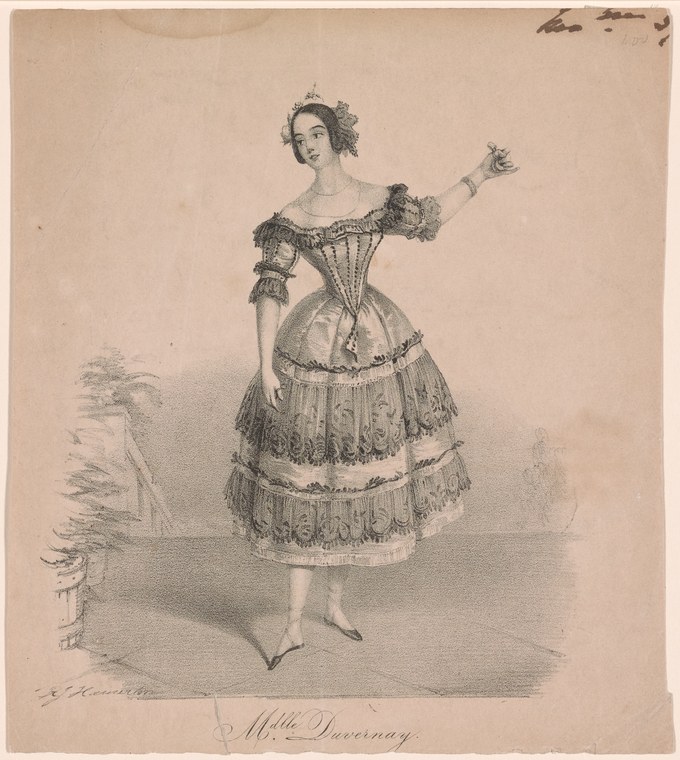
Mdlle. Duvernay: [the celebrated cachucha]
Unknown artist
- Collection:
- Prints depicting dance
- Source:
- New York Public Library
- Rights:
- Public domain — free to use, share and adapt.
- Recorded as:
- Public Domain
Duvernay is a now-obscure figure, but she was one of the most famous and highest-paid dancers of her era, a Spanish artist who achieved stardom on the European stage by mastering a folk idiom. The image documents both the star system of nineteenth-century theatre and the aesthetics of Romantic-era dance imagery—the emphasis on beauty, grace, and visual presentation over the capture of motion or technique. It also preserves the memory of the cachucha as a major theatrical spectacle, before it faded into obscurity.
What you are looking at
A young woman in mid-19th-century theatrical dress stands in a three-quarter pose against a plain background, her body animated and weight shifted onto her right leg. She wears a white off-shoulder dress with a tightly corseted bodice and a voluminous skirt composed of three deep flounces trimmed with dark ribbon or lace. Her left arm extends outward at shoulder height, the hand holding what appears to be a flower or small prop; her right arm is bent and held near her torso. Her hair is styled with ringlets and topped with a small ornament or tiara. The pose captures a moment of elegant suspension—neither fully planted nor fully in motion—characteristic of the Romantic theatrical idiom. The line work is fine and precise, rendered in a technique suggesting steel engraving or lithography, with delicate shading establishing form and fabric texture. The composition is intimate in scale, presenting the dancer as an object of visual study rather than within a narrative setting.
The dancing
A single female figure occupies the frame, positioned with her weight clearly on her back leg, creating a subtle contrapposto that suggests arrested movement. Her shoulders are drawn back and her torso lengthened; her left arm traces an open line away from her body while her right maintains a gentle curve near her centre. The pose reads as a moment plucked from a turn or travelling step—the kind of instantaneous attitude that became the signature of Romantic-era ballet imagery. The extended arm and lifted carriage of the head convey elegance and control, though there is no indication of the extreme turnout or lifted extensions that would define classical ballet technique as codified later in the century.
The dance depicted
This is a portrait of Mlle. Duvernay, a celebrated Spanish dancer who became famous in the 1830s–1840s for her performances of the cachucha, a lively folk dance of Andalusian origin. The cachucha was a virtuosic solo or duet featuring rapid footwork, sharp arm movements, and a rhythmic, flirtatious character; it became a showpiece for leading dancers of the Romantic era and was especially associated with the pairing of castanets and Spanish costume. Duvernay's fame rested largely on her interpretation of this role, which she performed across Europe. The image presents her in her signature theatrical guise: the white Romantic tutu, the off-shoulder neckline, and the studied composure all mark her as a star of the opera-ballet stage. However, the pose itself—the open arm, the calm uplift—does not convey the explosive energy or percussive footwork the cachucha demanded; instead, it presents the dancer as an object of contemplation, emphasising her beauty and grace over the technical virtuosity the role required.
How it was made
This is a steel engraving or possibly a lithograph, executed with considerable refinement; the precise line work, fine cross-hatching for shading, and careful attention to fabric texture all suggest professional reproductive printmaking intended for wide circulation. The technique allowed for the creation of multiple copies and made theatrical portraiture affordable and collectible, establishing a market for images of celebrated performers. Such prints were sold individually or as parts of theatrical albums and were consumed by the playgoing public as mementos of beloved stars. The skill of the engraver here is evident in the rendering of the tulle and ribbon flounces and in the subtle modelling of the face.
About this work
This is a theatrical portrait engraving of Mlle. Duvernay, a Spanish dancer celebrated for her performances of the cachucha across Europe in the 1830s–1840s. The image captures her in her signature Romantic-era stage costume: a white tutu with multiple flounces, off-shoulder bodice, and carefully arranged hair ornament. Rather than depicting her mid-performance, the engraving presents her in a composed, statuesque attitude—a moment of suspended elegance that emphasises her status as a star and object of desire. The work belongs to a rich tradition of nineteenth-century theatrical printmaking that documented the leading dancers of the age and circulated their images among theatre-goers and collectors.
Duvernay's prominence depended entirely on her mastery of Spanish folk choreography adapted for the European stage. The cachucha was a showcase for her speed, rhythmic precision, and command of castanets; by the 1830s it had become one of the most celebrated dance specialities of the age, performed and imitated across Europe and America. This engraving, while not showing her in action, testifies to the international fame she achieved through that single role.
How to look at it
The engraving freezes Duvernay in a moment of repose rather than action—a pose that allows full display of her costume and bearing. Notice how the artist has chosen a three-quarter view that opens the body to the viewer's gaze and emphasises the length and elegance of the figure. The extended arm creates a graceful line while also establishing a sense of arrested motion, as though she is mid-gesture. The face is rendered with clarity and delicacy, inviting the viewer to contemplate her features. For understanding Romantic-era dance imagery, observe how the priority is beauty and contemplation rather than the capture of virtuosic movement or technical difficulty; this reflects the aesthetic values of the period, which prized the dancer as a visual spectacle and symbol of grace.
The period
This engraving dates from the height of the Romantic era in dance and theatre, roughly 1835–1845. During this period, the Romantic ballet—with its emphasis on the ethereal, the exotic, and the female dancer—dominated European and American stages. Simultaneously, Spanish and other European folk dances were being appropriated, theatricalised, and incorporated into the repertoire of opera-ballet. The cachucha was one of several Spanish dances (others included the bolero and the fandango) that enjoyed enormous popularity during this period, often performed by dancers in exotic or national costume as interludes or finales in operas and ballets. Duvernay rode this wave of enthusiasm to become one of the highest-paid dancers in Europe. The theatrical portrait print was itself a key medium of the Romantic era, allowing the dissemination of celebrity images and supporting the development of a mass market for theatre culture. Prints of dancers were collected, pasted into albums, and displayed in homes, making famous performers into familiar presences.
Where it lives
This print is held in the New York Public Library's collection of prints depicting dance. It is an impression of a reproductive engraving, likely published in the 1840s or shortly after Duvernay's peak period of fame. Such prints were commercial objects, made for sale and circulation among theatre audiences and collectors of theatrical imagery.
Dance in this work
Questions about this work
Who was Mlle. Duvernay?
Duvernay was a Spanish dancer who became internationally famous in the 1830s–1840s for her performances of the cachucha, a Spanish folk dance. She performed across Europe and commanded very high fees; by contemporary accounts, she was among the best-paid dancers of her era. Her fame rested almost entirely on her mastery of this single role, which she had adapted from folk sources into a virtuosic theatrical showcase.
What is the cachucha?
The cachucha is a lively, rhythmic dance of Andalusian origin, traditionally danced solo or in pairs, characterised by rapid footwork, hip movements, arm gestures, and the use of castanets. When theatricalised for the European stage, it became a vehicle for displaying a dancer's speed, precision, and sense of rhythm. It was one of several Spanish dances (along with the bolero and fandango) that became fashionable in European theatre during the Romantic era.
Why does this image not show her dancing?
Theatrical portrait engravings of the Romantic era typically presented stars in composed, statuesque poses rather than mid-movement. This served multiple purposes: it allowed the engraver to display the dancer's costume and beauty clearly, established her status as a celebrated star, and created an image suitable for framing and collecting. Such portraits were as much about celebrity as about the specific roles or dances performed.
What can this print tell us about dance in the 1830s–1840s?
The print documents the central role of female performers in theatrical dance, the importance of exotic or national specialities (Spanish dances, in this case), and the emphasis on visual beauty and grace in Romantic-era aesthetics. It also shows how theatrical stars were marketed and celebrated through the medium of the engraved portrait, which was collected and displayed in homes, creating a culture of dance celebrity.
More dance artwork





