49 works in this view — arrow keys or swipe to move between them.
Dance in Art
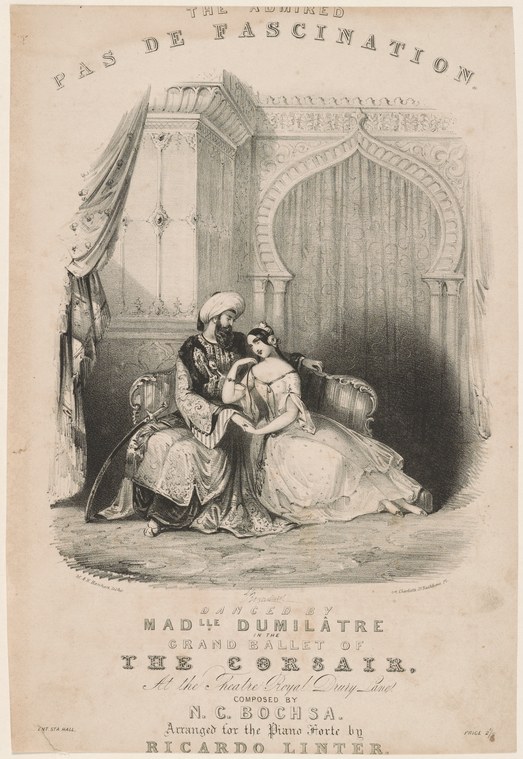
Danced by madlle. Dumilâtre in the grand ballet of The corsair
Unknown artist
- Collection:
- Prints depicting dance
- Source:
- New York Public Library
- Rights:
- Public domain — free to use, share and adapt.
- Recorded as:
- Public Domain
Le Corsaire stands at the intersection of ballet, Orientalism, and the commercial theatre of the Second Empire; this engraving is a primary artifact of how 19th-century ballet constructed and marketed exotic fantasy through the female dancer's body. For historians of ballet, gender, and imperialism, the image documents both the actual technique Dumilâtre deployed (visible in pointe work and turnout) and the ideological framework that framed such technique as erotic spectacle. The engraving's circulation—as a promotional artifact tied to sheet music and theatre programmes—reveals how ballet imagery shaped bourgeois taste and imagination across multiple media.
What you are looking at
A man in ornate Middle Eastern or North African dress—loose trousers, embroidered jacket, and a large turban—reclines on cushions in an arched interior space. Two women in classical ballet costume and pointe shoes attend to him in attitudes of supplication or entertainment. The setting is theatrical, with draped curtains, ornamental arches, and a patterned floor suggesting an interior palace or harem. The composition stages the man as the focal point, with the women arranged around him in exaggerated, graceful poses. The scene is rendered in mid-tone engraving with careful attention to fabric texture and architectural detail.
The dancing
The seated male figure dominates the composition, his weight settled into cushions with arms extended in a gesture of lordly ease. The two female figures—identifiable as ballet dancers by their tutus, fitted bodices, and pointe shoes—occupy subordinate positions. One woman is in a deep, reverential bow or curtsy; the other reaches toward him with an extended arm. Both dancers display the turned-out legs and elongated lines characteristic of academic ballet technique. The spatial relationship emphasises hierarchy: the man commands the space while the women perform submission and service.
The dance depicted
This is a theatrical ballet scene from Le Corsaire (The Corsair), a mid-19th-century romantic ballet that became a staple of European and Russian ballet companies. Mademoiselle Dumilâtre was a notable Parisian dancer who performed the role (possibly the slave dancer or harem attendant) in the Opéra's production. The image captures a moment of romantic spectacle typical of the era: the odalisque or concubine narrative that framed exotic fantasy through ballet technique. The scene conflates two simultaneous ideologies—the romanticisation of 'Oriental' luxury and the display of female dancers in submission—both central to 19th-century ballet's cultural project.
How it was made
This is a steel or copper engraving, likely produced for theatrical publicity or a published visual record of the ballet's production. The medium allowed wide distribution to Paris theatregoers and ballet enthusiasts. Engraving's fine linear technique suits the delineation of fabric, interior architecture, and the precise geometry of ballet posture. The title and credits are printed directly below the image, identifying the artist, the dancer, the ballet, and the arranger ("arranged for the Piano-Forte by Ricardo Winter"), indicating this was a multi-media promotion linking the ballet to sheet music and concert performance.
About this work
A theatrical engraving documenting Mademoiselle Dumilâtre in a scene from Le Corsaire, the 1856 romantic ballet that defined the mid-19th-century vogue for 'Oriental' fantasy in European ballet. The image captures a pivotal moment in the evolution of ballet spectacle: the transition from narrative court ballet to narrative romantic ballet, with its emphasis on the female body as exotic ornament and fantasy object. The composition reveals the period's visual logic—a hierarchy of gaze in which the (male) viewer is invited to occupy the perspective of the reclining man, observing the female dancers' performance of submission and delight. This is not documentary but promotional artwork, designed to circulate the ballet's romantic ideology through the very popular medium of theatrically distributed engravings.
How to look at it
Look at the precision of the dancers' feet and legs: Dumilâtre is rendered in the exact turnout and line expected of a trained ballet dancer, confirming this is a work of technical documentation as much as theatrical fantasy. Observe the spatial composition: the man's gaze and posture guide your eye, and you are invited to share his vantage point—to view the dancers as he does. Notice the contrast between the detailed, almost architectural rendering of the interior and the more stylised, elongated treatment of the dancers' bodies, which are presented as aesthetic objects rather than as anatomical beings. Finally, attend to the title block: the credits name the dancer and the ballet but not the engraver or original artist, a common practice that erased the labour of print-makers while preserving the names of performers and composers.
The artist
The artist is not recorded in the catalogue, but the work is signed and the engraving shows the precision and finish characteristic of mid-19th-century Parisian theatrical print-making. Such prints were typically commissioned by theatres or music publishers and created by specialist engravers working from drawings or paintings. The level of detail and the professional composition suggest a house engraver working for a major Parisian publishing house, likely associated with the Opéra or the music press. The arrangement credit to Ricardo Winter (the piece arranged for piano-forte forte) suggests this engraving was part of a broader multimedia campaign promoting the ballet through performances, sheet music, and theatrical imagery.
The period
Le Corsaire premiered in 1856 at the Opéra during the height of the romantic ballet era and the Second Empire's fascination with 'Oriental' spectacle. The 1850s were a period of acute Orientalism in European visual culture, following the Crimean War and increasing colonial expansion in North Africa and the Middle East. Ballet, as the most prestigious dance form in Europe, was deeply implicated in this ideological project: exotic subjects (harems, sultans, slave markets, pirate strongholds) allowed choreographers to stage narratives of capture, display, and female vulnerability to male desire. Romanticism in ballet was already in decline by the 1850s—the age of Taglioni and supernatural sylphs had passed—but Orientalism kept the form alive by offering new fantasies of the body and new justifications for the display of the female dancer. The engraving dates from this moment of transition and is a key artifact of how ballet became complicit in the visual ideology of imperialism.
Where it lives
This engraving is held in the New York Public Library's Prints depicting dance collection, a significant archive of theatrical and dance imagery from the 18th through 20th centuries. The print was likely acquired as part of a broader collection of theatrical memorabilia and is catalogued as a primary source for the history of 19th-century ballet and its visual representation.
Dance in this work
Questions about this work
Who was Mademoiselle Dumilâtre?
Dumilâtre was a dancer at the Paris Opéra in the mid-19th century, known for performing in romantic ballets including Giselle and Le Corsaire. She is documented in contemporary playbills and reviews but remains a relatively obscure figure in ballet history, overshadowed by more celebrated ballerinas. This engraving is one of the few surviving visual records of her performances.
What is Le Corsaire about?
Le Corsaire is a romantic ballet set in a pirate stronghold on a Greek island. The plot centres on the abduction of a European woman (Medora) by the pirate chief Conrad and includes scenes of harem life, shipwreck, and exotic spectacle. The ballet was enormously popular and remained in the repertory; it survives today in revised versions and is still performed by major companies, though the Orientalist narrative is now widely recognised as problematic.
Why is this engraving important?
It documents a key moment in the history of ballet as a visual medium and as a vehicle for Orientalist fantasy. The engraving shows how ballet technique (pointe work, turnout, extension) was deployed to render the female body as an exotic spectacle for male consumption. It is also a valuable document of 19th-century theatrical promotion and the circulation of ballet imagery through prints and sheet music.
What does the 'arranged for the Piano-Forte' credit mean?
This indicates that a composer (Ricardo Winter) adapted the ballet's music for solo piano, allowing amateur musicians and music lovers to perform and enjoy the score at home. The engraving was part of the commercial promotion of this arrangement, linking the visual spectacle of the ballet to the popular music market. This was a common practice in the 19th century, blurring the boundaries between theatrical, concert, and domestic musical cultures.
More dance artwork





