49 works in this view — arrow keys or swipe to move between them.
Dance in Art
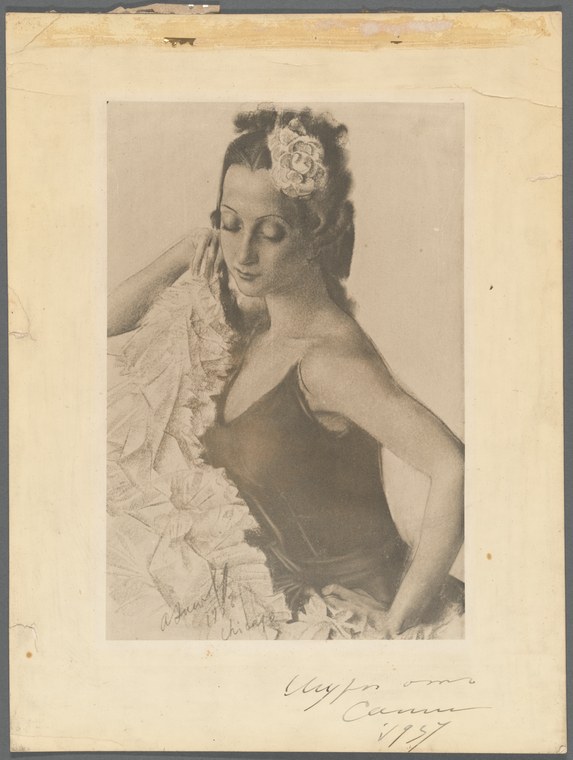
Alexandra Danilova as the street dancer in Le beau Danube
Unknown artist
- Collection:
- Prints depicting dance
- Source:
- New York Public Library
- Rights:
- Public domain — free to use, share and adapt.
- Recorded as:
- Public Domain
Danilova became one of the twentieth century's most celebrated and longest-performing ballerinas, and *Le beau Danube* was central to her international fame. This portrait captures her at or near the height of the work's popularity and her own star power, and shows how the ballet world presented itself to the public through photography—emphasizing character, beauty, and the dancer's individual interpretation over abstract technique.
What you are looking at
A woman in a dark sleeveless dance costume is photographed in three-quarter view, her body angled to the right. Her head tilts gracefully to the left, with her hand raised to her face in a contemplative or coquettish gesture. She wears a flower ornament in her dark, styled hair. A gauzy, patterned fabric drapes from her left shoulder across her body, creating movement and visual interest. The background is neutral and soft, placing full focus on the figure. The lighting is subtle and frontal, characteristic of theatrical portrait photography. Her posture suggests a moment of pause or character presentation rather than active movement.
The dancing
The dancer stands in a contrapposto stance with her weight settled and her frame composed for display. Her arm is bent with the hand raised near her face—a gesture suggesting either shyness, flirtation, or the assumption of a character. The other arm appears to rest at her side or be partially obscured by the draped fabric. Her torso is relaxed and upright, not engaged in dramatic extension or turnout. The pose reads as a formal theatrical portrait rather than a snapshot of dancing action.
The dance depicted
The title identifies this as Alexandra Danilova as the street dancer in *Le beau Danube*. This refers to Léonide Massine's 1924 ballet, which was an immediate success with the Ballets Russes and became one of the most frequently performed works of its era. The "street dancer" is a principal character in the narrative—a figure of flirtation and minor scandal in a Danubian setting. Danilova was known for her technical brilliance and dramatic presence, and her interpretation of this role emphasized theatrical charm and emotional nuance over virtuosic display. The pose here captures the character's personality and allure rather than a technical feat.
How it was made
This is a silver gelatin photographic print on paper, mounted on a larger sheet as was standard for theatrical and dance publicity materials of the 1920s–1930s. The photograph has been hand-signed in ink at the lower left, suggesting it was a professional studio portrait intended for distribution—likely to critics, theatre programs, or collectors of dance photography. The soft focus, controlled lighting, and careful composition reflect the aesthetic conventions of theatrical portraiture in this period, where the goal was to capture the dancer's character and appeal rather than technical precision.
About this work
This is a professional theatrical portrait of the Russian-American prima ballerina Alexandra Danilova, captured in character as the street dancer from Massine's *Le beau Danube*, one of the defining works of early twentieth-century ballet. The photograph documents not a moment of dancing but a moment of character—Danilova's interpretation of a seductive, playful figure through pose and presence. It belongs in a gallery of dance in art because it shows how ballet and character dance were marketed, remembered, and celebrated in the early twentieth century: through the dancer's body, face, and personality frozen in a studio setting. Such portraits were the primary means by which audiences outside the theatre encountered their favourite performers.
How to look at it
Notice the deliberate construction of the pose: the tilt of the head, the placement of the hand, the fall of the drape, all carefully arranged to convey character and appeal rather than movement. This is not a candid image but a formal presentation—the theatrical equivalent of a portrait sitter. The flower in the hair and the costume fragment visible in the image place the viewer inside the theatre world, but the photograph itself is a studio work, subject to all the conventions of portraiture. What makes it specifically a dance photograph is not the capture of motion but the presence of the dancer's body as the central subject, and the implicit understanding that viewers are encountering a known performer in a known role.
The artist
The photographer is not recorded in the catalogue. The style and format suggest a professional theatrical photographer working in Western Europe or possibly North America during the 1920s–1930s, but without a signature or studio mark clearly visible, attribution remains uncertain. Hand-signed photographs of this kind were often distributed without identifying the photographer, as the focus was on the performer rather than the image-maker.
The period
This photograph dates to the golden age of the Ballets Russes (1909–1929), when Diaghilev's company had transformed ballet into an avant-garde art form and made its dancers international celebrities. *Le beau Danube*, premiered in 1924, was a turning point: where earlier Ballets Russes works had been revolutionary and controversial, this ballet was immediately popular, blending classical technique with Massine's new *demi-caractère* vocabulary and a romantic narrative set in imperial Vienna. By the mid-1920s, ballet had become a subject of mass media interest, and photographs like this one were widely circulated in theatre programs, magazines, and as commercial prints. Danilova exemplified the "modern classical" dancer of the era—technically impeccable but also a dramatic and charismatic performer.
Where it lives
This photograph is held in the New York Public Library's collection of prints depicting dance. It appears to be a professional theatrical portrait from the 1920s or 1930s, distributed as a publicity image and later collected as part of the NYPL's comprehensive archive of dance history in print.
Dance in this work
Questions about this work
Who was Alexandra Danilova?
Danilova (1903–1997) was a Russian-American prima ballerina and one of the most celebrated dancers of the twentieth century. She joined the Ballets Russes in 1924 and quickly became a star, known for her technical brilliance, beauty, and dramatic presence. After the company's dissolution, she had a long career in America, performing, teaching, and mentoring multiple generations of dancers.
What is *Le beau Danube* and why is it important?
*Le beau Danube* (1924) is a three-act ballet choreographed by Léonide Massine with music by Johann Strauss II. Set in Vienna, it tells a lighthearted story involving a street dancer, a hussar, and a duchess. It was a major success and remains frequently performed. For the Ballets Russes, it represented a turn toward narrative and character-driven ballet after years of avant-garde experimentation.
What does the pose in this photograph tell us about the character?
The pose—contemplative, hand to face, gracefully angled—suggests a character who is alluring but also self-aware. The gesture can read as either coquettish flirtation or a moment of private reflection. This ambiguity is part of the street dancer's appeal in the ballet: she is charming and knowable, yet retains an inner life. Danilova's interpretation emphasizes personality and intimacy rather than distance or authority.
Why do we have so many photographs of Ballets Russes dancers?
The Ballets Russes was a commercial and critical success, and photographs of its stars were valuable commodities. They were used in theatre programs, sold to fans, published in magazines, and archived by cultural institutions. Photography was the primary way audiences outside major cities encountered the dancers and characters they could not see live. These images shaped how ballet was understood and remembered in the twentieth century.
More dance artwork





