49 works in this view — arrow keys or swipe to move between them.
Dance in Art
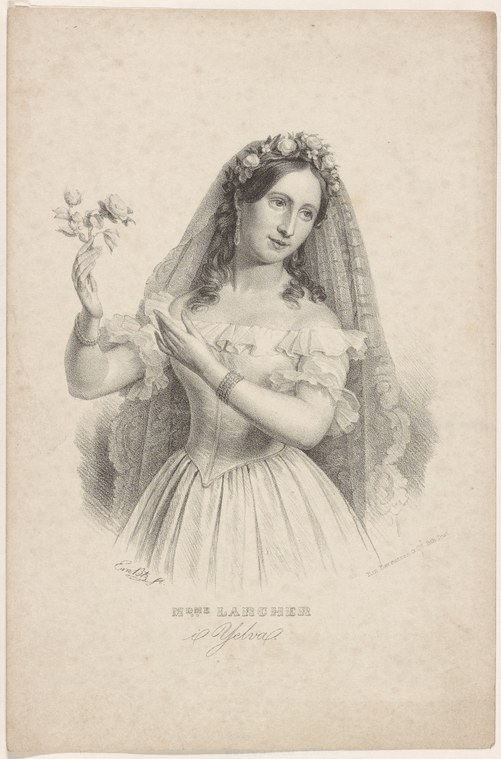
Mdme. Larcher i Yelva
Unknown artist
- Collection:
- Prints depicting dance
- Source:
- New York Public Library
- Rights:
- Public domain — free to use, share and adapt.
- Recorded as:
- Public Domain
This portrait preserves the visual culture of Romantic ballet at its height, documenting the costume, styling, and presentation conventions that shaped how dancers were seen. For historians and dancers, it offers concrete evidence of how 19th-century ballerinas embodied the Romantic ideal—an ideal that still influences ballet aesthetics today. The print's circulation and survival also tells us about the celebrity culture of 19th-century ballet and the commercial market in theatre portraiture.
What you are looking at
A young woman in Romantic-era dress stands in three-quarter view, gazing downward with a serene expression. She wears a white off-shoulder dress with a fitted bodice and voluminous skirt gathered at the waist, typical of 1840s–1850s ball gown silhouette. A delicate floral wreath crowns her dark hair, and a gossamer veil drapes from it to her shoulders. In her raised right hand she holds a small posy of flowers—roses or similar blooms rendered in fine detail. The figure is posed as if mid-movement or pause, with her weight settled and her left arm relaxed at her side. The background is plain and neutral, rendered in soft gray tones that push the figure forward. The overall effect is intimate and contemplative rather than dynamic—this is a portrait of a dancer or performer in costume rather than a depiction of active dance.
The dancing
The figure stands in a relaxed contrapposto, with weight settled on both feet and torso gently curved. The raised arm holding the flowers suggests a moment of presentation or acknowledgment—a pose common to the finale of a Romantic ballet, when the dancer receives applause or offers a symbolic gesture to the audience. The downturned gaze and serene facial expression convey a soft, modest demeanor aligned with Romantic aesthetics. There is no visible partner, and the pose does not suggest active partnered dancing.
The dance depicted
This is most likely a portrait of a ballerina in Romantic-era ballet costume, probably from the 1840s–1850s. The white dress, floral wreath, and delicate veil are hallmarks of the Romantic ballet aesthetic—the sylph or ethereal female ideal that dominated the period after the success of La Sylphide (1832). The pose and presentation suggest a moment of courtship or benediction within a narrative ballet, a common climactic or exit gesture. The work functions as a celebrity portrait rather than a scene of active dancing; it documents how the performer was costumed and how she presented herself to the public imagination.
How it was made
This is a finely executed engraving or lithograph on paper, rendered in black ink with careful attention to tonal modulation—especially in the rendering of fabric texture, the delicacy of the veil, and the soft modeling of the face. The technique allows for fine detail in the floral elements and embroidery-like patterns on the dress while maintaining a graphic clarity suitable for commercial reproduction and wide circulation. The fineness of the line work and the tonal subtlety suggest professional printmaking, likely created for publication as a theatre portrait or celebrity engraving. Such prints were sold as souvenirs and collected by enthusiasts of the ballet and theatre.
About this work
This is a Romantic-era ballet portrait, almost certainly from the 1840s or 1850s, depicting a named ballerina (Mdme. Larcher as 'Yelva') in costume. The image captures not choreography or movement but the visual ideal of the Romantic dancer: young, ethereal, modestly virtuous, and adorned with the iconography of the sylph—white muslin, flowers, and veils. It is a document of how 19th-century ballet presented the female body to the public gaze, and of how dancers were marketed and celebrated. The work belongs in a gallery of dance imagery because it shows us what ballet dancers were meant to look like, how they presented themselves in the theater, and how that image was disseminated through prints that reached far beyond the opera house.
How to look at it
Notice the downward gaze and the serene, passive expression—this is not the face of an athlete or a character in dramatic action, but of an idealized, almost supernatural being. The pose with the raised arm and flowers is a moment of pause or benediction, not a step or a leap; observe that her feet are planted and stable, her body in repose. The gossamer veil and floral crown are not functional costume elements but symbols of otherworldliness and virtue. The fineness of the printmaking—the delicate parallel lines that create tone and shadow—mirrors the delicacy the image claims to represent. This is a work of visual persuasion, designed to make the viewer admire and desire the figure depicted.
The period
This engraving dates from the golden age of Romantic ballet, roughly 1840–1860, when the Romantic movement dominated European dance and visual culture. The idealization of the ethereal female form—the sylph, the naiad, the spirit—had become the dominant aesthetic across ballet, poetry, and visual art following the sensational success of La Sylphide (1832) and Giselle (1841). Ballet was the fashionable entertainment of the aristocratic and middle-class audiences in Paris, London, and throughout Europe. Stars like Marie Taglioni, Fanny Elssler, and Carlotta Grisi were international celebrities, and prints and engravings of them in costume were mass-produced and sold as souvenirs. This portrait participates in that culture of celebrity and consumption.
Where it lives
The work comes from the New York Public Library's collection of prints depicting dance. It is catalogued under the name 'Mdme. Larcher i Yelva' but has not been assigned a precise date or medium in the catalogue record. The work is a reproductive print, likely created for wide circulation as a souvenir or promotional image.
Dance in this work
Questions about this work
Who was Mdme. Larcher?
The catalogue record provides no biographical information. Mdme. Larcher was a professional ballerina of the Romantic era—the title 'Mdme.' suggests she was married or of mature professional standing—who performed the role or character named 'Yelva' (likely a sylph or spirit in a Romantic ballet narrative). Without additional research, we cannot say more, but the quality of the engraving suggests she was a celebrated enough performer to warrant publication.
Is she actually dancing in this picture?
No. She is posed in a moment of stillness and contemplation, probably a moment from the ballet's narrative. This is a portrait in costume, not a depiction of choreography in action. The pose is graceful and elegant, but it is a presentational pose designed for the viewer's admiration, not a step or movement.
Why the flowers and veil?
These are the visual vocabulary of Romantic ballet. The flowers and veil signify that the character is ethereal, otherworldly, virtuous—a sylph or spirit rather than a mortal woman. The aesthetic emerged from Romanticism's fascination with the supernatural and the feminine ideal. They are symbols more than practical costume elements.
What kind of dance is this?
Romantic ballet, as practiced in the mid-19th century. The costume, the aesthetic of beauty and passivity, and the theatrical context all point to the European ballet tradition of the 1840s–1860s, which emphasized pantomime, pointe work, and the visualization of supernatural or exotic femininity.
More dance artwork





