49 works in this view — arrow keys or swipe to move between them.
Dance in Art
La péri
Unknown artist
- Collection:
- Prints depicting dance
- Source:
- New York Public Library
- Rights:
- Public domain — free to use, share and adapt.
- Recorded as:
- Public Domain
This work provides direct visual evidence of how Romantic ballet was staged and received in the mid-nineteenth century, documenting the iconic pose and costume of a work that defined the era. The image testifies to the celebrity of both the ballet and the ballerina, and to the sophisticated print culture that grew around the Paris Opéra. For dance historians, it preserves a moment that shaped the aesthetic of nineteenth-century classical ballet.
What you are looking at
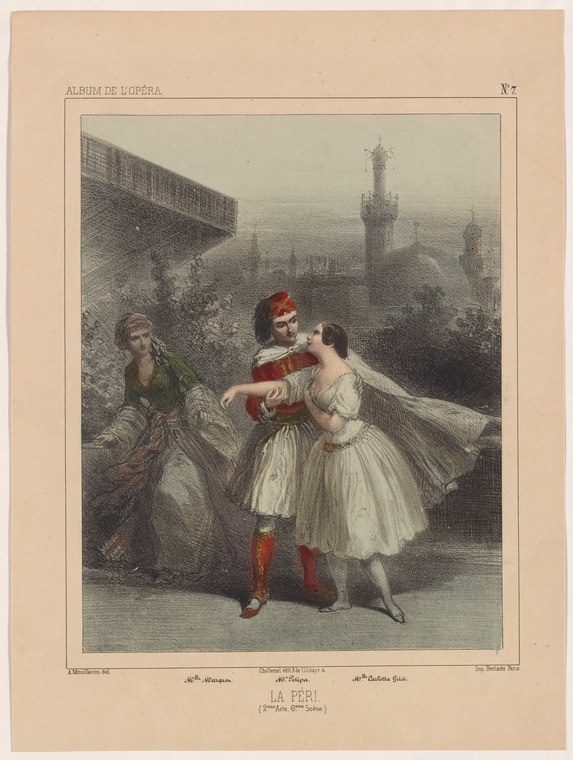
A theatrical scene set on a moonlit terrace overlooking a distant cityscape with minarets and towers. Three figures occupy the space: on the left, a woman in classical drapery gestures in surprise or concern; in the center, a male dancer in red tunic and cap reaches toward a young woman in a pale tulle skirt and pointe shoes, his body leaning forward in ardent pursuit or supplication. The woman in white leans away, one arm extended in a gesture of resistance or hesitation, her skirt caught in mid-movement. The lighting is ethereal and atmospheric, rendered through fine cross-hatching that creates deep shadow and luminous highlights on the figures and the architectural elements beyond. The composition suggests a moment of romantic drama or supernatural encounter.
The dancing
The central male figure displays a classical balletic frame with turned-out legs and an extended arm reaching toward his partner, whose weight appears shifted onto one leg in the balletic position. The female figure in white wears pointe shoes and a tutu-like skirt, positioned en relevé or in an unstable attitude that suggests alarm or flight. Her torso twists away from her partner while one arm gestures outward. The older woman on the left is rendered in a more naturalistic contrapposto, observing the encounter. The spacing and gestural language read as operatic or balletic vocabulary rather than social dance.
The dance depicted
This appears to depict a scene from the Romantic-era ballet *La Péri*, a work that premiered in 1843 at the Paris Opéra and became a signature vehicle for the ballerina Marie Taglioni. The title and formal composition align with the ballet's narrative of supernatural encounter and ardent male pursuit of an otherworldly female spirit. The male dancer's formal stance and the female's pointe-work position this within the balletic tradition. The print likely documents a celebrated moment from a stage production or the widely circulated imagery that surrounded this popular Romantic ballet.
How it was made
This is a hand-colored engraving or lithograph, executed in fine line-work and cross-hatching to create atmospheric depth and chiaroscuro effects. The warm tone of the paper stock and the soft color palette—flesh tones, pale greens, reds, and grays—suggest hand-coloring applied after the initial print. The technique allowed for reproduction and circulation of celebrated theatrical moments to a broad audience, making this the kind of souvenir or promotional imagery that documented the Romantic ballet as a public spectacle. The skillful rendering of fabric, light, and spatial recession indicates professional theatrical or artistic publication.
About this work
This hand-colored engraving documents a celebrated moment from *La Péri*, the iconic 1843 Romantic ballet. The image captures the supernatural encounter at the heart of the work's narrative: a male dancer in costume reaches toward a ballerina en pointe, whose otherworldly character is emphasized by the moonlit terrace setting and ethereal composition. As part of the Album de l'Opéra series (indicated by the title page notation), it belongs to the nineteenth-century tradition of theatrical prints that circulated imagery of famous dancers and ballets to a paying public, allowing those who could not attend the opera to consume these celebrated performances through visual reproduction.
How to look at it
Notice the precise moment the artist chose: not the height of a leap or a stable pose, but a moment of tension and proximity, with the male figure reaching and the female figure leaning away. The pointe shoes and tutu mark the female character as supernatural—in the Romantic tradition, pointe-work itself signified otherworldliness. Observe how the distant architecture and moonlit atmosphere frame the encounter as dramatic and staged, emphasizing the theatrical nature of the moment. The hand-coloring and fine engraved line-work create a sense of immediacy and intimacy despite the work's circulation as a commercial object.
The artist
The print is attributed to unnamed engravers and colorists working for the Album de l'Opéra, a commercial publishing venture centered on Paris operatic and balletic repertory in the mid-nineteenth century. These works were typically produced by collaborative workshops rather than individual artists, with engravers responsible for the composition and line-work, while colorists applied hand-tinting to meet market demand for finished prints.
The period
The mid-nineteenth century was the height of Romantic ballet, when works like *La Péri*, *Giselle*, and *Swan Lake* dominated European stages and when ballerinas achieved celebrity status comparable to operatic singers. The Romantic aesthetic—with its emphasis on supernatural characters, ethereal movement, pointe-work, and pale tutus—was at its commercial and artistic peak. Theatrical prints and illustrated opera annuals were major consumer goods, allowing audiences to collect images of celebrated performers and moments. The Paris Opéra's dominance in both performance and publication made Paris the center of this visual culture.
Where it lives
The work is held in the New York Public Library's collection of prints depicting dance, part of the broader theatrical print culture of the nineteenth century. The title page notation "Album de l'Opéra" indicates its origin in a commercial series devoted to Parisian operatic and balletic repertory.
Dance in this work
Questions about this work
What is *La Péri*?
*La Péri* is a Romantic-era ballet that premiered at the Paris Opéra in 1843, with choreography by Jean-Auguste Vestris and music by Friedrich Burgmüller. The story concerns a male dancer's pursuit of a Péri—a supernatural female spirit from Persian mythology. The work became famous as a vehicle for the ballerina Marie Taglioni and remained in the repertory throughout the nineteenth century.
How do we know this is from *La Péri*?
The title appears on the print itself at the bottom. The composition and iconography—the pointe-shod female figure, the male dancer in red tunic, the moonlit exotic setting, and the narrative of supernatural encounter—all correspond to known imagery and descriptions of the ballet's famous scenes.
Who made this print?
The print credits visible at the bottom indicate it was engraved and colored by artists working for the Album de l'Opéra publishing venture, but the individual names are not legible in this reproduction. Such prints were typically collaborative works produced by professional workshops in Paris.
Why was a woman on pointe considered supernatural?
In Romantic ballet convention, pointe-work and the ethereal silhouette it created were associated with non-human or otherworldly characters—sylphs, spirits, and magical beings. The Romantic aesthetic linked the technical achievement of dancing on the tips of the toes with the appearance of weightlessness and supernatural grace.
More dance artwork





