49 works in this view — arrow keys or swipe to move between them.
Dance in Art
Tancrède
Unknown artist
- Collection:
- Prints depicting dance
- Source:
- New York Public Library
- Rights:
- Public domain — free to use, share and adapt.
- Recorded as:
- Public Domain
This print preserves visual evidence of Baroque theatrical dance at a moment when written descriptions and musical scores are often the only surviving documents. It shows how the body was presented in formal stage performance before the rise of ballet d'action and narrative spectacle, making it a touchstone for understanding the aesthetic values and physical practices of an era of dance history largely lost to time.
What you are looking at
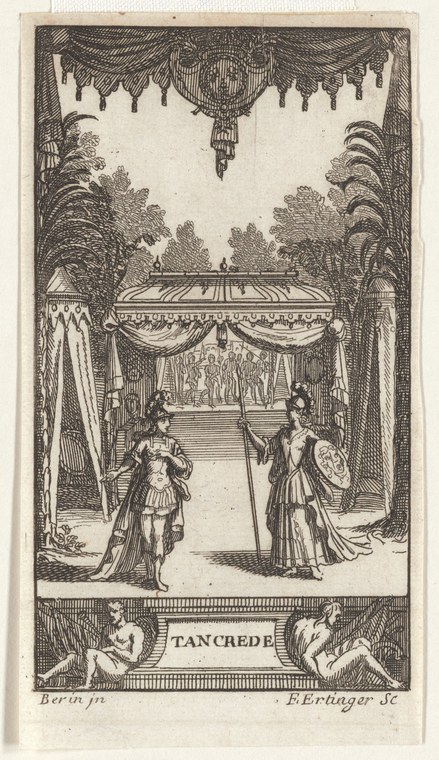
This engraving depicts a formal theatrical or operatic scene set in an elaborate garden pavilion. Two richly dressed figures occupy the foreground—a man in ornate military-style dress on the left and a woman in a long gown on the right, both in three-quarter poses that suggest interaction across the stage space. Behind them, visible through the pavilion's entrance, a gathering of figures in formal dress occupies a brightly lit interior space, suggesting an audience or court assembly. The setting is framed by tall trees with detailed foliage on either side, and the pavilion itself is decorated with draped fabrics and ornamental swags suspended from above. The composition uses strong linear perspective to draw the eye through the foreground figures into the theatrical depth, a convention of Baroque stagecraft representation. The engraving employs fine parallel line-work (hatching) to create shadow and dimension, characteristic of the technique.
The dancing
Both foreground figures stand in elegant, formal postures appropriate to courtly dance. The woman's pose shows a slight turn with her weight shifted, her gown's voluminous skirts dominating the silhouette; the man faces toward her with an open, presenting gesture. Neither figure is captured mid-step or in the strenuous positions of virtuoso dance; instead, they embody the restrained, dignified bearing expected of noble dancers. Their spacing and orientation suggest the formal patterns of a court dance—a procession or measured interaction rather than close partnership. The female figure's elaborate skirts and the male figure's upright carriage frame the conventions of Baroque court dress in motion.
The dance depicted
This appears to document a Baroque court dance, most likely a minuet or other formal measure of the period, though the title *Tancrède* suggests this may be a scene from an opera or ballet d'action rather than a social dance. The presence of the audience/court visible in the pavilion interior and the theatrical framing indicate this is a performance before witnesses, not a ballroom scene. The choreography, insofar as it is visible, follows the decorative, processional logic of Baroque theatrical dance: bodies held erect, movement through space valued over dynamic action, and formal spacing maintained. The dress and setting place this securely in the 17th or early 18th century, but the specific identity of the dance—whether minuet, courante, or a choreographed scene from a named work—cannot be determined from the image alone.
How it was made
This is a copper engraving, identifiable by the uniform parallel hatching lines that build shadow and form, the crisp line-work at contours, and the overall tonal range characteristic of the medium. The signature at lower left reads "Ber. in fec." (Berlinghieri fecit, Berlinghieri made it) and "B. Erlinger Sc." (B. Erlinger as engraver). Engraving was a medium of high prestige and significant labor, requiring careful planning and skilled hand-work; such prints circulated among collectors and court circles, making them vehicles for disseminating images of theatrical spectacle and courtly fashion to an educated elite. The fineness of the line-work and the care taken with architectural and textile detail suggest this was created for a wealthy or institutional patron.
About this work
This engraving documents a moment from a Baroque theatrical spectacle—a formal dance scene set in an ornamental garden pavilion. It captures not virtuosity but ceremony: two figures in rich dress occupy a stage space before witnesses, their postures and spacing governed by the conventions of 17th-century courtly performance. The image functions simultaneously as a record of dance practice, a display of fashion and architectural elegance, and a window into the visual language of Baroque court theater. For historians of dance, it offers evidence of how performers held their bodies, how space was organized on stage, and how dance was integrated into larger spectacles of power and display.
How to look at it
Look first at the foreground figures' posture and positioning: neither is in active motion, but rather in a posed, presentational attitude. Notice how the woman's skirts are rendered with careful parallel lines to suggest weight and volume—an important feature of courtly female dress that would have restricted movement to gliding, turning motions. The careful architectural framing—the perspective lines of the pavilion, the symmetrical trees—creates a stage space organized around display and ceremony rather than action. Finally, observe the audience visible through the interior: the dance is not private but performed for witnesses, a key element of court practice.
The artist
The engraving carries two signatures: "Ber. in fec." indicates the original designer or painter (likely Berlinghieri, an artist of the 17th or early 18th century), and "B. Erlinger Sc." attributes the engraving to B. Erlinger, who translated the design into the engraved medium. Erlinger is known as an engraver and print publisher active in Berlin, suggesting this work circulated from a German or Northern European center. The division of labor between designer and engraver was standard practice; the engraver held considerable skill and reputation in their own right.
The period
This engraving dates stylistically to the late 17th or early 18th century, the era when Baroque court ballet was at its height in Europe. Dance at court was a central courtly practice, closely aligned with music, spectacle, and the display of noble status. Operatic and ballet spectacles frequently featured elaborate garden or palace settings, and the theatrical apparatus—painted backdrops, architectural framing, symbolic use of light—was itself a major attraction. Engraved prints of such scenes served both to commemorate actual performances and to circulate idealized images of courtly splendor to courts and collections across Europe.
Where it lives
This engraving is held in the New York Public Library's collection of prints depicting dance. It enters the collection as a document of theatrical practice and courtly life, part of a broader visual archive of European performance culture.
Dance in this work
Questions about this work
Is this a real dance that was actually performed?
The theatrical setting and the title *Tancrède* suggest this documents or commemorates a specific operatic or ballet spectacle, likely performed at a European court. Whether this depicts an actual historical performance or an idealized theatrical scene cannot be determined from the image alone. The formal postures and spatial organization are consistent with known Baroque court dances, but the title suggests a narrative context—possibly a scene from a story or opera—rather than a social dance.
What was the title *Tancrède* about?
Tancrède was a subject of various Baroque operas and dramatic works, typically concerning a Crusader knight. Without further documentation, it is not possible to identify which specific theatrical work this print represents or what moment in the narrative it depicts.
How do I read an old engraving like this?
Engraved prints use fine parallel lines (hatching) to create shadow, tone, and form. Darker areas have denser, closer hatching; lighter areas have sparse lines or are left blank. The signature or inscription usually appears in a cartouche at the bottom. Look for the hand of the engraver in the precision and character of the line-work—each engraver had a recognizable style.
Why are the dancers so still and formal?
Baroque court dance valued elegance, control, and dignified bearing over the dramatic movement and emotional expression that later became central to Romantic ballet. The body was held upright, movements were measured and processional, and the overall effect was one of ceremony and display. This formal quality was inseparable from the social and political meanings of courtly performance.
More dance artwork





