49 works in this view — arrow keys or swipe to move between them.
Dance in Art
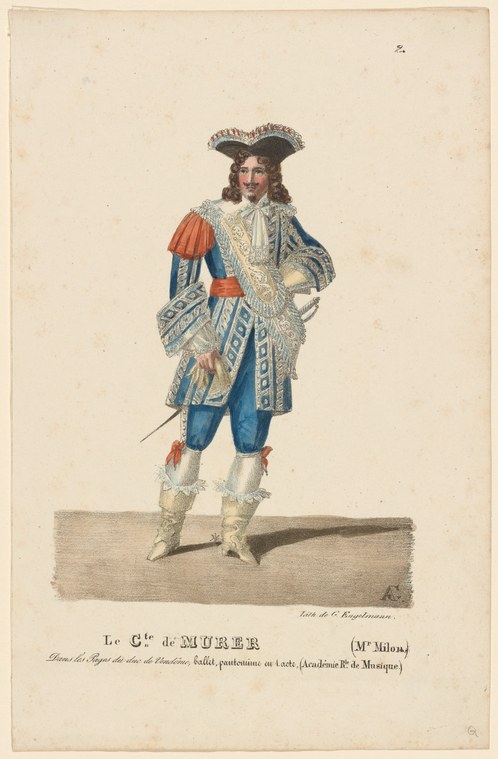
M'r Milon, le c'te de Murer dans Les pages du duc de Vendôme, ballet pantomime en 1 acte, Académie r'le de musique
Unknown artist
- Collection:
- Prints depicting dance
- Source:
- New York Public Library
- Rights:
- Public domain — free to use, share and adapt.
- Recorded as:
- Public Domain
This engraving documents a named performer in a specific ballet role at a precise historical moment—the 1730s Paris Opera—making it one of the few reliable visual records of early French ballet before the emergence of the ballerina as the dominant theatrical figure. It shows that male noble dancers were featured performers in their own right, and that ballet consisted of formally posed attitudes and expressively gestured arms rather than the traveling steps and lifted extensions that would later define classical technique.
What you are looking at
A single male figure in eighteenth-century court dress stands in a three-quarter pose against a neutral background. He wears a dark coat with elaborate embroidery in blue and gold, a white lace jabot at the throat, and matching lace cuffs; the coat's skirts are open to show red silk lining. His breeches are blue, meeting white stockings at the knee, and he wears dark heeled shoes. A tricorn hat with ornamental trim sits on his long, dark hair. His left arm extends forward with the hand open and relaxed; his right arm hangs at his side, also with an open hand. His weight appears centered, his posture upright but not rigid. The figure occupies the lower two-thirds of the composition, standing on a narrow platform or stage line. The print itself is hand-colored, with the coat's embroidery picked out in metallic pigments that catch light, and the background left cream with subtle aging marks.
The dancing
A single dancer in a relaxed standing position with arms in a soft, natural frame typical of the French noble style. The left arm is raised to about waist height with the hand open and gently extended; the right arm hangs naturally at the side. The posture is upright and elongated, the head held high with a composed expression. The weight is evenly distributed, the feet positioned in what appears to be a turned-out stance. There is no sense of violent motion or acrobatic exertion; instead, the figure demonstrates the dignified carriage and restrained elegance expected of courtly deportment.
The dance depicted
This is a portrait of a performer in a French ballet pantomime of the early eighteenth century, most likely from the 1730s based on the costume and engraving style. The title identifies him as the Comte de Murer (M. Milon), dancing the role in *Les Pages du duc de Vendôme*, a one-act ballet-pantomime performed at the Académie royale de musique (Paris Opera). The pose captures not a moment of dynamic action but rather an attitude of noble presentation—the standard way a leading dancer of the period would introduce a character to the audience. The costume, with its elaborate embroidery and jeweled appearance, indicates a person of rank, confirming that Milon danced the aristocratic roles typical of noble performers at court and in early opera-ballet.
How it was made
This is a hand-colored engraving, the medium established by the fine line-work visible in the drapery, the precise delineation of embroidery patterns, and the characteristic appearance of the printed base. Hand-coloring with watercolor or gouache adds dimension to the metallic ornaments and the red silk lining. Engravings of this type circulated widely in the eighteenth century as inexpensive records of celebrated performers and roles, distributed among patrons of the opera, dance masters, and the literate public. The technique allowed multiple impressions to be pulled from a single plate, making these images accessible beyond the theater itself—a significant vehicle for documenting and celebrating dance performance before photography.
About this work
This is a documentary portrait of a performer in early French ballet, capturing the appearance and formal bearing of a noble dancer in a specific role. It is among the earliest visual records of how ballet was dressed and presented in the theater of the Parisian academy. The image shows the fusion of theater, social rank, and physical accomplishment that defined French ballet in its formative decades—a moment when ballet was still primarily the domain of trained amateurs and court nobles rather than professional virtuosos.
For historians and dancers, the work provides concrete evidence of costume construction, the idealized posture and arm carriage of the period, and the theatrical context of the role. It demonstrates that early ballet focused on noble presentation and pantomimic expressiveness rather than the technical display that would dominate later in the century.
How to look at it
Attend to the placement and carriage of the arms—they are neither tucked nor exuberant, but held in what was called the *port de bras* (carriage of the arms), a foundational principle of nobility and elegance in the period. Notice the upright spine and the slight rotation of the hips and legs outward, conventions that distinguish theatrical noble style from everyday posture. The artist has chosen a moment of stillness and presentation rather than a leap or turn, which tells us that the aesthetic valued composure and formal grace over technical virtuosity. The elaborate costume, rendered in fine detail, was as much a part of the performance as the body itself.
The artist
The artist is not recorded. The engraving bears the inscription 'lith de C. Bogaertsman' or similar (the text is faint), possibly indicating a lithographer or printseller rather than the engraver. Prints of this type were produced by workshop operations in Paris, often based on designs by theatrical artists or the performers themselves. They were published as souvenirs and educational documents for the dance profession.
The period
The 1730s was a period of intense innovation in French ballet, following the reforms of Michel Fokine's predecessor Jean-Georges Noverre (though Noverre's major writings came later). Ballet was transitioning from a courtly amateur activity to a professional theatrical form, but male dancers still dominated leading roles. The costume shown here—with its jeweled coat, breeches, and heeled shoes—represents the theatrical adaptation of aristocratic dress, a visual language that conveyed rank and elegance. Engraved portraits of performers were a new market phenomenon, reflecting the growing celebrity of individual dancers and the public's appetite for access to theater stars. The Académie royale de musique was the apex of French dance training and performance, and roles in its ballets conferred prestige.
Where it lives
The print is held in the New York Public Library, in its collection of prints depicting dance. It is catalogued as a documentary print from the dance repertory rather than as fine art, reflecting its original function as a theater souvenir and performance record.
Dance in this work
Questions about this work
Who was the Comte de Murer?
He was a male dancer at the Paris Opera in the early eighteenth century, likely a noble amateur or trained professional who performed in roles of aristocratic character. The title given in the inscription suggests either nobility or a character role. Beyond what this print records, little is known of him; he belongs to a large population of working dancers whose names survive only in theater records and isolated images like this one.
What is a ballet-pantomime?
In the early eighteenth century, ballet-pantomime was a form in which dancers told stories through expressive gesture, facial expression, and poses, accompanied by music. It was distinct from pure dance and from spoken drama. The one-act form suggests a compact narrative or allegorical episode, likely from classical or courtly sources.
Why is he standing still if this is a dance portrait?
The stillness is the point. In this period, dance consisted of a vocabulary of poses, steps, and arm movements, and dancers were trained to hold themselves with dignity and control. A portrait captures the character and bearing of the performer rather than a moment of action. The pose itself—the carriage, the extension of the arm, the line of the spine—*is* the dance training made visible.
How does this costume compare to modern ballet dress?
The heeled shoe, the jeweled coat, the breeches, and the tricorn hat are typical of theatrical aristocratic dress of the period. This is the ancestor of modern male ballet costume in its emphasis on line and elegant carriage, but male dancers today wear tights and a fitted tunic rather than a coat and breeches. The heeled shoe is gone, replaced by the flexible ballet flat or pointe shoe.
More dance artwork





