49 works in this view — arrow keys or swipe to move between them.
Dance in Art
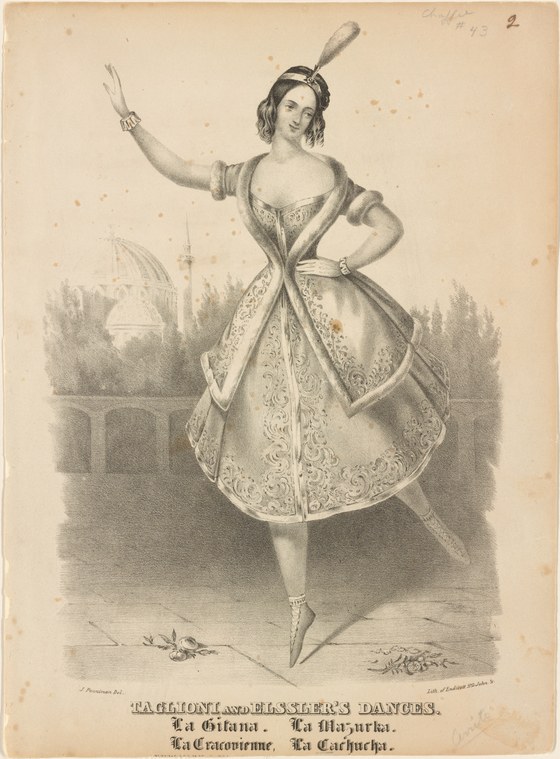
Taglioni & Elssler's dances
Unknown artist
- Collection:
- Prints depicting dance
- Source:
- New York Public Library
- Rights:
- Public domain — free to use, share and adapt.
- Recorded as:
- Public Domain
This engraving documents the visual language and celebrity machinery of Romantic ballet at its height, showing how two of history's most influential dancers were marketed and remembered. The work also reveals the gender, race, and exoticism embedded in Romantic ballet ideology—the idealized white female body, the appropriation of 'ethnic' character dances, and the reduction of complex performances to single transcendent poses.
What you are looking at
A solo female dancer in Romantic-era pointe work, captured mid-leap or suspension against a softly rendered landscape backdrop. She wears the characteristic costume of mid-19th-century ballet: a fitted bodice with short, layered tulle skirt (the hallmark tutu), and decorative detail at the waist. Her left arm extends upward holding what appears to be a fan or feathered accessory, while her right arm gestures outward in a classically graceful line. Her pose suggests the ethereal, weightless quality central to Romantic ballet. The background shows distant architecture—possibly a pavilion or theatre—and trees, establishing an outdoor or fantastical setting typical of narrative ballets of the period. The engraving technique lends the figure strong contrast against the softly shaded ground, emphasizing her isolation and the idealized beauty of the pose.
The dancing
A single dancer in a vertical, elongated alignment characteristic of ballet vocabulary. Her weight appears lifted, with the body held in a classical frame—shoulders back, torso upright despite the dramatic arm positions. The extended left arm curves upward in a gesture of presentation or display; the right arm opens to the side. Her legs are not fully visible in the lower portion, but the overall carriage suggests a sustained aerial position or the apex of a grand développé. The pose is entirely frontal and self-contained, designed to show the figure's line and grace rather than interaction or propulsion.
The dance depicted
This is Romantic ballet, most likely from the early-to-mid 19th century when ballerinas like Marie Taglioni and Fanny Elssler dominated European stages. The inscription below the image names both dancers and lists four of their signature dances: La Gitana, La Mazurka, La Cracovienne, and La Cachuca. The figure and pose are idealized types meant to represent the ethereal 'sylph' or exotic female characters of the repertory rather than a specific moment within a particular ballet. The fan-like object in the raised hand may reference the props these dancers used in character dances (particularly the Cracovienne and Cachuca, which drew on Central European and Spanish idioms respectively). The costume, pose, and presentation confirm this as theatrical ballet of the Romantic period.
How it was made
This is a steel or copper engraving, a mass-reproducible medium that circulated widely through print shops and was affordable to middle-class audiences hungry for images of celebrated performers. The fine linear hatching and careful stippled shading create volume and atmosphere without color. The technique's precision allowed for the rendering of costume detail—the tutu's tiers, the bodice trim, the feathers or ornaments—that would have been recognizable to anyone who had seen the dancers on stage. As a reproductive print rather than a unique work, it served both as memento and as advertisement, circulating knowledge of the stars' physical presence and iconic poses far beyond theatre audiences.
About this work
This is a promotional engraving documenting the performance styles of two of the most celebrated ballet dancers of the Romantic era, Marie Taglioni and Fanny Elssler. Rather than depicting a specific ballet or narrative moment, it presents a composite image—a single idealized female dancer embodying the aesthetic and costume vocabulary that both performers brought to their signature dances. The inscription anchors the image to real dancers and real roles, but the figure itself is a type: the Romantic ballerina as weightless, graceful, and exotic. The work belongs to a vast nineteenth-century print culture devoted to celebrity, dance, and the human figure in motion. It reveals how ballet imagery was circulated and consumed, and how dancers of the era cultivated their public personas through repeatable, recognizable poses.
How to look at it
Look at the pose as a distillation of Romantic ballet aesthetics: the lifted, elongated body; the graceful extension of the limbs; the emphasis on verticality and weightlessness. The artist has chosen a moment of suspension and display rather than movement or interaction. Note how the costume—the tutu, bodice, and the raised fan or feathered accessory—communicates character (exotic, refined, noble) without narrative context. Observe how the engraving technique creates an ethereal effect through soft shading and precise line, rendering the dancer as both a real body and an idealized vision. The frontal, statuesque pose was a standard formula for ballet celebrity prints, designed to be instantly recognizable and reproducible.
The artist
The artist is not recorded, which was common for commercial reproductive prints of the period. These engravings were typically made by skilled workshop engravers based on drawings or paintings by more celebrated artists, often unnamed. The print was published by commercial print houses (the notation at bottom suggests a London or Paris publisher, common nodes for ballet imagery). The work represents the anonymous labor of the printing industry that made celebrity visual culture accessible to the public.
The period
This print dates to the height of the Romantic ballet era (roughly 1830s–1850s), when ballet had shifted from court spectacle to commercial theatre, and dancers became celebrities with devoted fans and commercial merchandise. Taglioni's debut in La Sylphide (1832) ushered in the pointe-work aesthetic and the ethereal 'sylph' archetype. Elssler rose to prominence in the late 1830s, often cast as the more sensual, earthly counterpart to Taglioni. Both dancers cultivated signature roles and toured extensively across Europe and America. Character dances—national or ethnic dances incorporated into ballet—were repertory staples, and both Taglioni and Elssler performed Cachucas, Mazurkas, and Cracoviennas. The engraving celebrates both dancers' styles while conflating them into a single idealized image, a common strategy in mid-century ballet promotion.
Where it lives
This engraving is part of the New York Public Library's collection of dance-related prints. It is a commercial reproductive print, likely published in London or Paris in the 1830s–1850s, and would have been sold individually or as part of theatrical or ballet-fan magazines. The collection itself documents the print culture surrounding dance and celebrity in the nineteenth century.
Dance in this work
Questions about this work
Who were Taglioni and Elssler?
Marie Taglioni (Swedish, 1804–1884) and Fanny Elssler (Austrian, 1810–1884) were the two most celebrated ballet dancers of the Romantic era. Taglioni was famous for her ethereal technique, pointe work, and roles in Romantic ballets like La Sylphide. Elssler was known for her earthy, sensual style and her mastery of character dances. Both were international celebrities who toured Europe and America and were commemorated in prints, lithographs, and paintings throughout their careers.
What are the dances listed in the inscription?
La Gitana (The Gypsy), La Mazurka, La Cracovienne (a Polish dance), and La Cachuca (a Spanish dance) were signature character dances performed by both dancers. Character dances were national or ethnic dances incorporated into ballet, often used as divertissements or variations. These four were among the most popular and repeatable items in the Romantic ballet repertory.
Why is the dancer on pointe?
Pointe work became central to Romantic ballet in the 1830s, as part of the aesthetic of weightlessness and the idealization of the female body. Taglioni was instrumental in establishing pointe technique as a signature element of ballet. Standing on the tips of the toes created the illusion of effortlessness and ethereal quality that Romantic ballet valued. It was also technically difficult and admired as a mark of virtuosity.
What is the fan or object in the dancer's raised hand?
It is likely a feathered fan or plume, props that were used in character dances, particularly the Cachuca and Cracovienne, which featured dramatic arm movements and hand gestures. The object helps identify the image as representing the character-dance repertory that both dancers performed.
More dance artwork





