49 works in this view — arrow keys or swipe to move between them.
Dance in Art
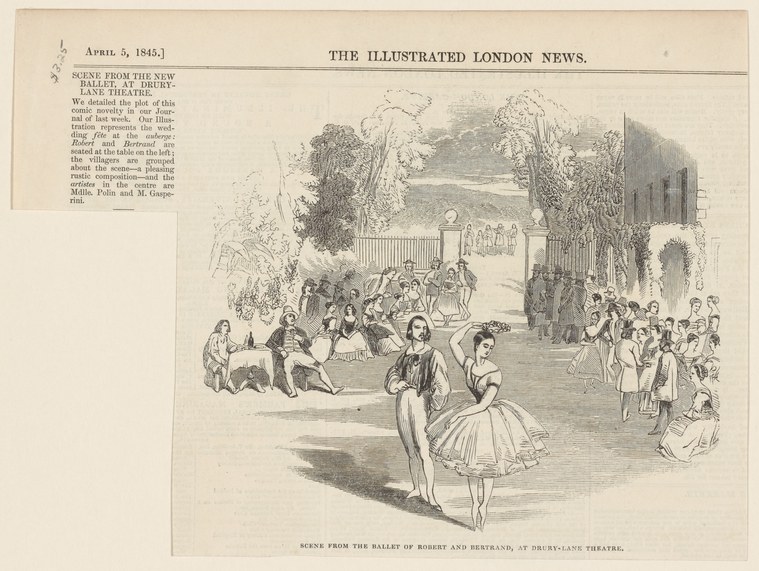
Scene from the ballet of Robert and Bertrand, at Drury-Lane Theatre
Unknown artist
- Collection:
- Prints depicting dance
- Source:
- New York Public Library
- Rights:
- Public domain — free to use, share and adapt.
- Recorded as:
- Public Domain
This is direct, contemporary evidence of how Romantic ballet looked on the London stage in the 1840s—not a later recollection or re-staging, but a picture made for the newspaper while the ballet was still in performance. The engraving shows the actual costume, spatial composition, and dramatic staging that an audience would have seen, and its publication in a national illustrated newspaper shows how central ballet had become to metropolitan cultural life.
What you are looking at
A theatrical scene from a Romantic-era ballet, depicted in an engraving showing an outdoor or garden setting with classical architecture—a colonnade and pediment visible in the background. The composition is crowded with figures arranged in informal groups across the stage. In the foreground, a female dancer in a pale tulle skirt executes a pose or turn, her body extended in a graceful line; to her left, a male dancer in dark costume stands nearby. The setting features abundant foliage and trees, and the crowd of supporting figures—some seated, some standing in conversation—creates a festive, social atmosphere. The light falls naturally across the scene, with the engraver's lines suggesting depth and movement through careful handling of shadow and tone. The overall mood is one of theatrical celebration, likely depicting a scene of courtship or romantic revelation central to the ballet's narrative.
The dancing
The principal female dancer occupies the visual center, her weight shifted into a supported position with her body held in an elegant, elongated line—her arm extended, leg lifted or pointed. She wears a fitted bodice and full romantic tutu. The male dancer beside her adopts an attentive, supporting stance. The corps de ballet and attendant figures are rendered in smaller scale and softer focus, arranged to frame the principals without competing for attention. The grouping suggests partnered work and the formal hierarchies of romantic ballet staging.
The dance depicted
The print depicts a scene from *Robert and Bertrand*, a ballet performed at Drury Lane Theatre in London. The engraving captures a moment of romantic spectacle typical of Romantic-era ballet—a focal point of narrative revelation or emotional climax. The ballet would have been performed to orchestral music and structured around a hierarchical cast of principals and corps. The staging shows the ballet d'action conventions of the period, in which mime, pantomime, and choreographed ensemble scenes carried narrative meaning alongside pure dance. The presence of the architectural setting suggests a dramatic location within the story rather than an abstract stage.
How it was made
This is an engraving published in *The Illustrated London News* on 5 April 1845, printed from a wood or steel engraving that could be reproduced widely and distributed with the newspaper. The medium allowed fine detail and tonal control—the artist used careful cross-hatching and line work to convey fabric texture, spatial depth, and atmospheric light. As a newspaper illustration, this work reached a broad, educated readership and served both documentary and promotional functions, recording a theatrical event for those who saw it and advertising future performances to those who did not.
About this work
This engraving documents a scene from a Romantic-era ballet performed in London's West End, capturing the visual spectacle and social prestige that ballet held in the 1840s. It shows the conventions of theatrical staging and costume at a moment when ballet was a major draw for London audiences and Romantic narratives of courtship and revelation dominated the repertory. The work records not only the dance itself but the broader theatrical and social context in which Romantic ballet was experienced—a crowded, fashionable entertainment that drew the eye with elaborate costume, pretty dancers, and emotional narrative set in picturesque or exotic locations.
How to look at it
Attend to the principal dancer's extended, supported pose and the spatial relationship between the male and female dancers—this shows the partnered work that was central to Romantic ballet. Notice how the engraver has rendered the tulle skirt with fine parallel lines that suggest both fabric and movement, and how the corps de ballet is arranged in loose, atmospheric groupings in the background rather than in geometric formations. The architectural setting and garden foliage are not mere scenery but part of the theatrical spectacle—Romantic ballet placed narrative and emotion in picturesque landscapes. The moment chosen is one of apparent revelation or emotional significance, not a jump or virtuoso turn, reflecting the priority placed on grace, sentiment, and narrative clarity over technical display.
The period
The 1840s were the height of the Romantic era in ballet, when the narrative ballet d'action dominated the repertory in London, Paris, and across Europe. *La Sylphide* and *Giselle* had been created in the previous decade and established the aesthetic: pointe work, ethereal costume, melancholic or supernatural narratives, and the visual primacy of the ballerina. London had a strong tradition of ballet and pantomime at Drury Lane and other patent theatres, and London audiences embraced Romantic ballet with enthusiasm. The illustrated newspaper was a new technology—*The Illustrated London News* began publication in 1842—and it made theatrical scenes accessible to readers who could not attend performances, creating a visual culture of ballet consumption beyond the theatre itself.
Where it lives
The engraving comes from *The Illustrated London News* for 5 April 1845 and is held in the prints and dance imagery collection of the New York Public Library. It is one of many such engravings that documented London theatrical life for the newspaper's readership and now serve as a primary visual record of mid-nineteenth-century stage practice.
Dance in this work
Questions about this work
Which ballet is this scene from?
*Robert and Bertrand* was performed at Drury Lane Theatre; the title refers to the main male characters and likely derives from a narrative of rivalry or mistaken identity in the Romantic tradition. The ballet is no longer in the standard repertory, and details of its choreography and music survive primarily through engravings like this one and occasional reviews in contemporary newspapers and journals.
What is the female dancer wearing?
The dancer wears the costume of the Romantic era: a fitted bodice over a corset, and a full skirt of pale tulle (or silk gauze) extending to mid-calf—the romantic tutu. Her hair is arranged in ringlets, and her pale stockings and soft ballet slippers complete the aesthetic of ethereal grace that defined the period. The costume became iconic of Romantic ballet and remained largely unchanged for decades.
How do we know this is ballet and not another form of dance?
The costume and physique of the principal female dancer, the apparent pointe work, the partnered relationship with a male dancer in dark formal costume, and the theatrical setting all point to ballet. The title of the engraving and its publication context (a London theatre in 1845) confirm it. The aesthetic is unmistakably that of Romantic ballet, the dominant form in Western theatres of the period.
Why was this printed in a newspaper?
*The Illustrated London News* pioneered the use of wood engravings to bring theatrical and social news to a mass readership. Readers could not all attend performances, so engravings like this brought the spectacle of theatre into the home. The image also advertised the ballet to those who had not yet seen it, driving ticket sales and creating a visual culture of metropolitan theatre-going.
More dance artwork





