49 works in this view — arrow keys or swipe to move between them.
Dance in Art
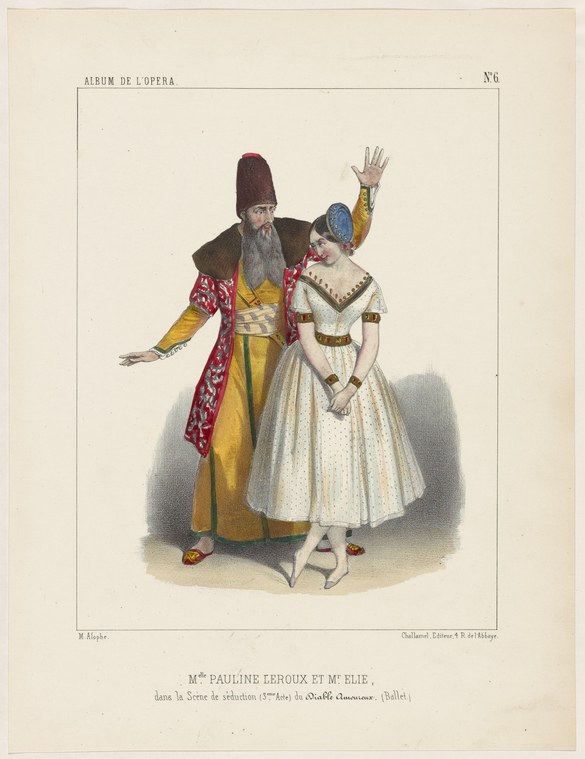
Melle. Pauline Leroux et Mr. Elie, dans la scène de séduction (3eme acte) du Diable amoreux
Unknown artist
- Collection:
- Prints depicting dance
- Source:
- New York Public Library
- Rights:
- Public domain — free to use, share and adapt.
- Recorded as:
- Public Domain
This print preserves a specific moment of theatrical choreography and pantomime from the Romantic ballet repertory—a seduction scene designed to display both narrative acting and balletic elegance. For historians and dancers, it documents the port de bras, posture, and costume conventions of mid-19th-century European ballet, particularly the contrast between the exotic-masculine and ethereal-feminine roles that defined the period.
What you are looking at
A colored engraving from a 19th-century opera album presents a moment of theatrical seduction. A bearded man in Russian or Eastern European costume stands at left, wearing a tall fur hat, a golden-yellow tunic with ornate red embroidered trim, and a draped red-and-gold sash. His left arm extends in a welcoming gesture toward a young woman in a white ballet dress with gold trim and a decorative blue headdress. She stands slightly behind and to his right, one arm raised in an elegant arc. The pale ground behind them emphasizes the figures against the shallow theatrical space. The hand-coloring is delicate: flesh tones, subtle shadows on the woman's skirt, careful delineation of the embroidered fabrics. The composition captures a moment of courtship or seduction between two dancers, frozen mid-interaction.
The dancing
The male dancer occupies a confident, grounded stance with his weight forward and his torso angled toward his partner. His extended left arm traces a line of invitation. The female dancer stands in a balletic frame—upright, elongated, with her raised arm continuing the line his gesture established. Both maintain an aristocratic posture that emphasizes verticality and controlled extension rather than naturalistic ease. The spatial relationship between them—not yet touching but actively engaged—captures a moment of courtship suspended between approach and response.
The dance depicted
This depicts a scene from *Le Diable amoreux* (The Amorous Devil), a Romantic opera or ballet-pantomime that enjoyed European popularity in the 19th century. The seduction scene in Act III was a showpiece for the dancers' ability to mime narrative and romantic tension through gesture and positioning. The costumes—his exotic Russian dress, her white romantic tutu—align with the Romantic ballet convention of pairing aristocratic or fantastic male characters with ethereal, vulnerable heroines. The raised arm and courtly bearing of both dancers reflect the balletic vocabulary of the period, particularly the French school's emphasis on port de bras and elegant restraint.
How it was made
This is a hand-colored engraving, a reproductive print technique standard for theatrical souvenirs and opera albums in the mid-19th century. The line work is fine and precise, printed in black or dark brown, with hand-applied watercolor or gouache defining costume, flesh, and setting. This technique allowed for rapid, relatively affordable reproduction and wide circulation—such prints reached dancers, patrons, and theater enthusiasts across Europe. The quality of the hand-coloring varies with individual copies; this example shows careful attention to the embroidered details and fabric textures.
About this work
This engraving documents a moment from a Romantic-era theatrical work, preserving the costumes and gestures of a specific famous seduction scene. It belongs to a large category of 19th-century opera and ballet ephemera—publicity prints, souvenirs, and reference images that tracked the repertory and celebrated its performers. The named dancers Pauline Leroux and Elie (or a variant spelling) were known to audiences of their time, but the print's value now lies in what it shows about Romantic ballet vocabulary, costume design, and the intersection of pantomime and dance in popular theater. The engraving format permitted wide distribution, making such works primary evidence for how a scene was staged and danced across different cities and seasons.
How to look at it
Attend to the arm positions and the direction of the gaze: the woman's raised arm echoes and completes the man's invitation, creating a visual dialogue without physical contact. This is the vocabulary of Romantic mime and courtship—restraint and elegance standing in for passion. Notice also the costume details: the elaborate embroidery and the height of his hat convey the 'otherness' that made him a compelling theatrical figure. The blank background throws all emphasis onto the dancers' bodies and their relationship, a compositional choice typical of engraved theater prints.
The artist
The engraver's name does not appear in the catalogue record. The print is credited to the publisher Ostinelli in Paris, a firm known for opera and ballet albums. Such albums were often illustrated by staff engravers whose individual identities were subordinated to the publisher's brand; attribution requires further research in publishing records or contemporary journals.
The period
The Romantic era (roughly 1830–1870) elevated ballet to a central art form in European opera houses. Exotic and supernatural narratives—demons, sylphs, enchantresses—became the preferred vehicles for the display of graceful femininity and ethereal movement. At the same time, choreographers relied heavily on pantomime to convey plot, and the quality of a dancer's mime and gesture was as celebrated as technical facility. Opera and ballet albums like this one served as both marketing tools and collective memory, allowing the repertory to circulate beyond the theaters where it was performed. The hand-colored engraving was the dominant medium for such ephemera before photography became accessible.
Where it lives
The print is held in the New York Public Library's prints collection, catalogued as depicting dance. It is one of thousands of such theater prints produced in the mid-19th century, both as bound albums and as individual loose prints sold at the theater or by print dealers.
Dance in this work
Questions about this work
Who were Pauline Leroux and Elie?
They were theater dancers known in Paris in the mid-19th century, but detailed biographical records are sparse. Such prints are often the primary surviving evidence of their performances. To identify them with certainty requires cross-reference with theater playbills, reviews, and dance archives of the period.
What is 'Le Diable amoreux' and who composed it?
It is a Romantic-era ballet or opera-ballet that enjoyed wide popularity across European theaters. The seduction scene in Act III became a celebrated showpiece. However, the work exists in multiple versions by different composers and choreographers, making a definitive attribution difficult without additional documentation.
How common were hand-colored theatrical prints like this?
Very common. Between roughly 1820 and 1880, opera and ballet albums were a major form of theatrical promotion and audience engagement. Performers and theaters sold them as souvenirs, and they appeared in bound collections. Thousands survive, though the quality of hand-coloring and the fame of the performers determine their value to collectors and historians.
More dance artwork





