49 works in this view — arrow keys or swipe to move between them.
Dance in Art
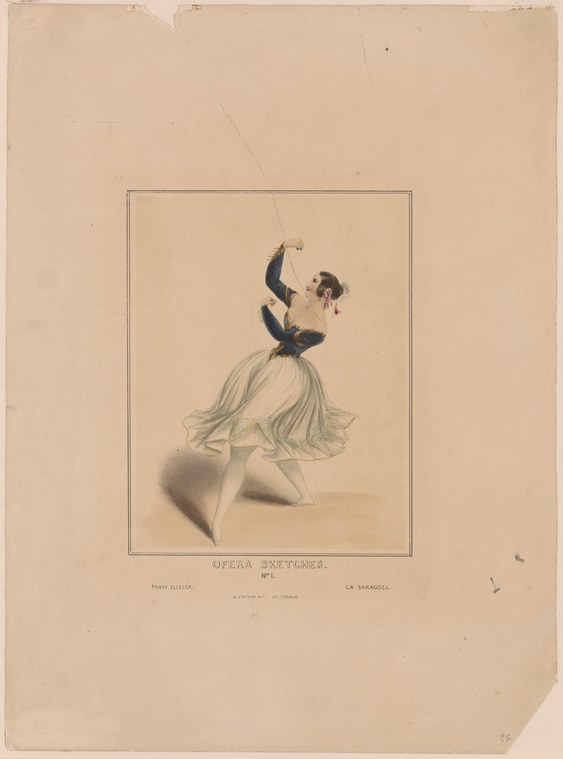
Opera sketches. No. 1. Fanny Ellsler [sic]. La Saragoza
Unknown artist
- Collection:
- Prints depicting dance
- Source:
- New York Public Library
- Rights:
- Public domain — free to use, share and adapt.
- Recorded as:
- Public Domain
Fanny Elssler was a towering figure in Romantic ballet, and images of her performances are primary historical documents of how that era understood virtuosity, character dance, and the female dancer's body. This print shows her not in the ethereal, pale roles associated with Marie Taglioni, but in a vehicle that emphasized dramatic presence and technical command—a different and equally important strand of Romantic ballet that later historians sometimes overlook.
What you are looking at
A single female dancer in mid-leap dominates the composition, captured against a plain cream background within a simple rectangular border. She wears a pale tulle skirt with a fitted bodice and dark (blue or black) corseted top, her hair adorned with what appears to be a decorative comb or ornament. The dancer is suspended in the air in a dramatic pose—her body twisted, one leg extended upward in an arabesque or attitude, the other bent beneath her, arms raised and positioned asymmetrically to frame the movement. Her weight appears momentarily weightless, the instant of maximum elevation frozen. The print has the pale, delicate tonality of hand-colored lithography, with careful shading used to model the dancer's form and suggest the translucency and volume of the tulle skirt. The composition is intimate in scale and focused entirely on the dancer's body and the geometry of her leap.
The dancing
A single dancer, captured at the apex of a sustained jump or bound. The torso is rotated; one arm is raised high and bent, the other extended lower, both deployed for balance and expressive line. The legs are in a crossed or twisted position typical of romantic-era pointe work—one leg extended fully, the other folded. The dancer appears to be on or near pointe, and the asymmetrical arm and leg placement suggests a codified classical vocabulary rather than free movement. The overall line is serpentine and deliberately composed for visual effect.
The dance depicted
This is a Romantic-era ballet study, almost certainly depicting a moment from the choreography of the 1830s–1840s, the golden age of the Romantic ballet. The title attributes the work to the celebrated dancer Fanny Elssler (note: the catalogue spells it 'Ellsler'), and "La Saragoza" was one of her signature vehicles—a Spanish-themed character dance that showcased her renowned technique and dramatic flair. Elssler was famous for her naturalistic, dynamic style and her command of both classical technique and demi-caractère (character) movement. The pose and costume suggest a character or national dance genre rather than pure classical ballet, yet the evident elevation and pointe work indicate classical training. The image freezes a moment of virtuosic display typical of the solo variations ('variations') that Elssler would have performed in such roles.
How it was made
This is a hand-colored lithograph, identifiable from the crayon-drawn line work, the tonal printing characteristic of lithography, and the careful hand-coloring visible in the skirt, bodice, and flesh tones. Lithography allowed for softer transitions than engraving and a broader tonal range; the delicate modeling of the dancer's body and the luminous quality of the tulle suggest the technique was well-suited to capturing the ethereal ideal of Romantic ballet. The print belongs to the tradition of dance portraiture and theatrical souvenir prints that circulated widely in the 1830s–1840s, aimed at both admirers of the art and the public eager for images of celebrated performers.
About this work
This is a lithographic portrait-study of Fanny Elssler, one of the most celebrated ballerinas of the 19th century, performing in the character dance *La Saragoza*. The work captures a single moment of technical display—a sustained leap with complex arm and leg positions—that was central to Romantic ballet's appeal: the illusion of effortless flight and the dancer's command of the body. As part of the series "Opera Sketches," it documents both a specific performance tradition and the visual language used to celebrate and circulate images of star dancers in the early 19th-century theater. The print preserves not only the dancer's likeness but a frozen instant of movement that audiences of the time would have recognized and prized.
How to look at it
Attend first to the moment of suspension: the artist has chosen the instant of maximum height, not the push-off or the landing, which requires understanding the physics of the jump and considerable skill to depict convincingly. Notice how the arms are positioned asymmetrically—neither in classical symmetry nor in a naturalistic pose, but composed to frame and extend the line of the leap. The dark bodice and pale skirt create strong value contrast, making the dancer's silhouette read clearly. The sparse background and rectangular frame isolate the dancer, emphasizing her body as the sole subject—a convention of dance portraiture that treats the performer as a heroic or iconic figure.
The artist
The artist is not recorded. The print was published as part of a series titled "Opera Sketches" and is held by the New York Public Library. The series appears to have been a commercial venture aimed at theater-goers and collectors of dance and opera imagery, common in Paris in the 1830s–1840s. Such prints were often created by minor or anonymous lithographers working from sketches or memory of stage performances.
The period
This work dates to the Romantic era of ballet, roughly 1830–1850, when the art form was at a cultural peak in Paris and across Europe. The two dominant ballerinas of the period were Marie Taglioni (the ethereal, otherworldly dancer) and Fanny Elssler (the dramatic, virtuosic, sensual performer). Lithography was the dominant medium for theatrical prints and publicity in this period, allowing for rapid, relatively cheap reproduction. Character dances—Spanish, Italian, Hungarian, Russian—were a staple of ballet programs, valued for their national color and the contrast they provided to classical pure dance.
Where it lives
The work is held by the New York Public Library in its collection of prints depicting dance. It is catalogued as part of the "Opera Sketches" series, number 1, and attributed to the dancer Fanny Elssler and the role La Saragoza, though artist, date, and medium are not recorded in the extant catalogue entry.
Dance in this work
Questions about this work
Who was Fanny Elssler?
Fanny Elssler (1810–1884) was an Austrian dancer and one of the greatest ballet stars of the 19th century. She was celebrated for her dramatic presence, virtuosity, and naturalistic style—a counterpart to the more ethereal Marie Taglioni. She excelled in character dances and dramatic roles, and toured extensively in Europe and America.
What is La Saragoza?
La Saragoza (or La Zaragoza) was a Spanish-themed character dance choreographed for Elssler, likely featuring the rhythms and gestures of Spanish national dance. It was one of her signature roles and showcased her ability to combine classical technique with dramatic characterization and national flavor.
Why is this a lithograph and not a painting or engraving?
Lithography was the dominant technology for theatrical prints in the 1830s–1840s because it was faster, cheaper, and more capable of subtle tonal variation than engraving. It allowed artists to create softer, more painterly images that could be hand-colored, and prints could be distributed widely to audiences and collectors.
What does the pose tell us about Romantic-era ballet?
The suspended leap, the pointe work, the asymmetrical arm positions, and the combination of elevation with dramatic gesture all exemplify Romantic ballet's ideals: technical command, the illusion of weightlessness, and emotional or character expression. The artist has frozen a moment that requires both classical training and theatrical presence to execute.
More dance artwork





