49 works in this view — arrow keys or swipe to move between them.
Dance in Art
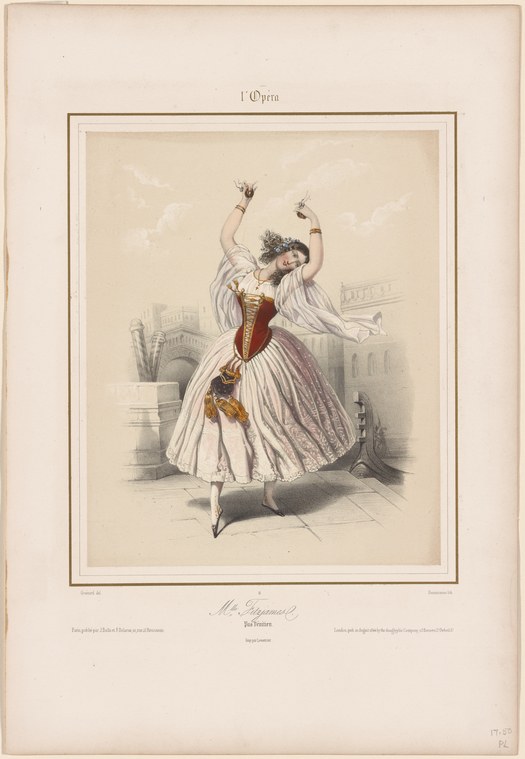
L'Opéra. Mlle Fitzjames, Pas vénitien
Unknown artist
- Collection:
- Prints depicting dance
- Source:
- New York Public Library
- Rights:
- Public domain — free to use, share and adapt.
- Recorded as:
- Public Domain
This print documents the aesthetics and marketing of Romantic ballet at its height, showing how dancers were celebrated, costumed, and posed for public consumption. It is a primary source for understanding the technical ideals, body image, and star system of mid-19th-century ballet, as well as the role of lithographic prints in dance history.
What you are looking at
A young female dancer in a virtuosic pose occupies the center of this hand-colored lithograph. She stands in near-profile, her body arched backward in an extreme cambré with her arms raised high above her head, both fists clenched as though holding castanets or similar props. Her costume consists of a white muslin or silk overdress with puffed sleeves worn over a deep red or burgundy corset, typical of mid-19th-century ballet dress. The skirt falls just below the knee, revealing her legs and soft ballet slippers. The setting suggests a Venetian or Mediterranean backdrop—architectural elements including what appears to be a palazzo or colonnade are visible in soft shadow behind her. The ground is minimally rendered, and the composition is framed by a simple double border in the style of theatrical prints of the period. The lighting is cool and even, characteristic of lithographic technique, with pale cream tones dominating the background and the figure rendered in careful gradation of tone.
The dancing
The dancer is captured in an extreme backbend with both arms raised vertically, suggesting a moment of great balletic elevation or turn recovery. Her weight appears to be on one supporting leg, while the other leg would be extended or in a pointed position to balance the composition. The torso is articulated with clear understanding of the dancer's line—the ribs follow the arch of the back, and the neck extends in line with the spine. The arm position, though theatrical rather than strictly academic, shows the lifted shoulder and extended fingertips characteristic of trained movement. There is only one figure, isolated against the architectural setting.
The dance depicted
This is almost certainly a Romantic ballet of the 1840s–1850s, and the inscription 'Pas vénitien' (Venetian step) indicates a character or national dance number within a larger theatrical work. The dancer's costume and the architectural setting suggest an opera-ballet context, possibly from a narrative work set in Venice. The extreme port de bras and cambré reflect the technical and aesthetic ideals of mid-century ballet, where displays of flexibility, line, and exotic location-based character dancing were central to entertainment. Mlle Fitzjames, identified in the title, was a celebrated Paris Opéra dancer of this era, and such prints were issued as souvenirs of celebrated performances and roles.
How it was made
This is a hand-colored lithograph, a medium that was the standard for theatrical portraiture and souvenir prints in the 1840s–1850s. Lithography allowed for soft tonal effects and large print runs at reasonable cost, making it ideal for distribution to audiences and collectors. The hand-coloring was applied after printing, typically with watercolor or gouache, which accounts for the delicate, slightly translucent quality of the tones. The technique is well-suited to capturing the theatrical lighting and the refined detail of costume and physique that were the selling point of such images.
About this work
This is a theatrical souvenir print documenting a celebrated dancer of the Paris Opéra in a character dance number from a Romantic-era ballet. The 'Pas vénitien' was a solo or featured number, likely from a larger work such as *Les Vêpres siciliennes* or another orientalist or Mediterranean-themed ballet of the mid-19th century. The print serves as both a record of the dancer's celebrated performance and as evidence of how Romantic ballet marketed and distributed images of its stars to the public. Mlle Fitzjames was one of the leading soloists of her generation, and this image captures both her technical prowess and the aesthetic ideals of mid-century dance—fluidity of line, extreme extension, and the romanticization of non-European settings and characters.
How to look at it
Notice the moment the artist has chosen: not a step, but a held pose—the extreme cambré is a display of flexibility and line rather than a movement in progress. This reflects Romantic ballet's emphasis on the dancer's body as a visual object to be admired. The arms raised high and the head thrown back create a sense of abandon and emotion characteristic of the period. The architectural setting, though sketchy, confirms this is a character dance with a specific geographical or narrative frame—the 'Venice' of the title. The softness of the lithographic line and the delicate hand-coloring enhance the ethereal, romantic mood.
The artist
The artist is not recorded. However, the style and subject matter are consistent with the atelier of theatrical lithographers working for the Paris Opéra in the 1840s–1850s, such as those associated with the publisher Maison Brandus or Benoist. These workshops produced hundreds of such souvenir prints of celebrated dancers, and many went unsigned or bore only the printer's mark. The quality of the drawing suggests a trained illustrator familiar with dance anatomy and costume.
The period
This print dates to the height of the Romantic ballet era, when works such as *La Sylphide* (1832), *Giselle* (1841), and *La Péri* (1843) had established new aesthetic standards for dance. The mid-19th-century Paris Opéra was the center of European dance, and its dancers were international celebrities. The Romantic ideal prized ethereal, weightless movement; extreme flexibility and extension; and the dancer's ability to embody fantastical or exotic characters. The 'Pas vénitien' and similar character dances allowed dancers to display virtuosity within a narrative or pictorial frame, and they were among the most popular items in theatrical souvenir print collections.
Where it lives
This is a theatrical souvenir print from the New York Public Library's collection of dance-related prints and ephemera. Such prints were sold at the theater, in print shops, and through subscription; they served as mementos of celebrated performances and as promotional images for dancers and the institution. The NYPL's collection includes hundreds of similar French and Italian theatrical prints from the 19th century.
Dance in this work
Questions about this work
Who was Mlle Fitzjames?
Mlle Fitzjames (often spelled Fitzjames or Fit-James) was a celebrated dancer of the Paris Opéra during the Romantic period, active from the 1840s onward. She was known for her technical skill, her elegance, and her ability to perform the character dances that were a staple of mid-century ballet. She danced in works by the leading choreographers of her time and was featured in many theatrical souvenir prints.
What is a 'Pas vénitien'?
A 'Pas vénitien' or Venetian step is a character dance number set in or evoking Venice, typically performed in the context of a larger ballet. Character dances were used in Romantic ballets to introduce exotic locations, local color, and opportunities for dancers to display virtuosity. Such dances often featured national or regional costume and were often performed as solo or small-group numbers.
Why was this printed?
Lithographic prints of famous dancers were a primary form of merchandise and publicity for the 19th-century theater. Audiences could purchase prints as souvenirs of celebrated performances, and dancers used them for promotion. The prints were also collected by connoisseurs of dance and theater, much as theatrical photographs are today.
What does the pose tell us about Romantic ballet?
The extreme backbend with raised arms shows the Romantic ideal of the dancer as a flexible, ethereal, almost superhuman figure. The pose is held rather than caught in motion, emphasizing the body's line and the emotional or pictorial moment. This reflects the era's emphasis on beauty, extension, and the dancer's transformation into a character or fantastic being.
More dance artwork





