49 works in this view — arrow keys or swipe to move between them.
Dance in Art
Costume prints
Unknown artist
- Collection:
- Prints depicting dance
- Source:
- New York Public Library
- Rights:
- Public domain — free to use, share and adapt.
- Recorded as:
- Public Domain
This work documents the visual culture and costume conventions of 19th-century theatrical dance at a moment when printed images of performers became a primary vehicle for circulating dance aesthetics beyond the theater. The print reveals how dancers were marketed and remembered—not in action but as composed, elegant figures in costume—and how the pointed foot and classical line had become the visual signature of theatrical legitimacy and training.
What you are looking at
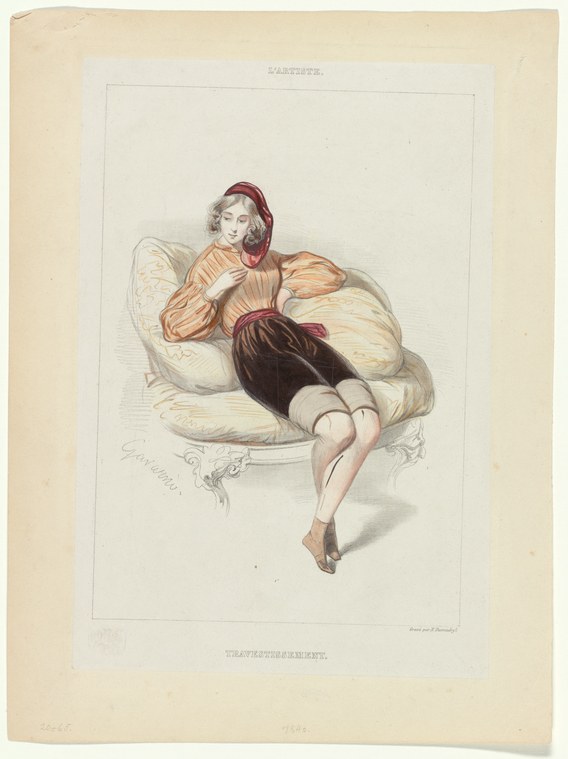
A single female figure reclines across an ornate, cream-colored settee or chaise longue, positioned diagonally across the composition. She wears a rust-orange or terracotta-colored long-sleeved garment—likely a dress or tunic—and dark (possibly black or deep brown) lower garments or stockings. A deep crimson or wine-colored fabric, possibly a shawl or head covering, drapes across her head and shoulders. Her pose is languorous and deliberately theatrical: one leg extends toward the lower right edge of the frame with the foot pointed downward, while her upper body reclines against the upholstered back of the settee. Her gaze is directed toward the viewer, and her expression appears contemplative or melancholic. The background is plain and neutral, rendered in pale wash. A delicate ornamental detail appears beneath the settee. The overall composition suggests a moment of leisure, reverie, or performance pause rather than active dancing.
The dancing
The figure's body is entirely supported by the furniture rather than held in an active dance position. The extended leg and pointed foot suggest training in classical technique, but the body is relaxed and arranged for visual effect rather than movement. The arm nearest the viewer is bent and positioned near the torso; the other arm rests on the settee. This is a posed, static arrangement emphasizing line, grace, and a certain melancholic languor rather than the dynamic tension or symmetry expected in an active dance hold or frame.
The dance depicted
This is not a depiction of active dancing but rather a costume study or theatrical portrait of a dancer at rest or in character. The pointed foot suggests classical ballet training, and the theatrical styling—the rich colored fabrics, the deliberate pose, the settee as a prop—implies this may represent a dancer from the Romantic or late 19th-century theatrical tradition. The image appears designed to showcase the figure's elegance, line, and costume rather than to capture a moment of performed movement. Without further context, it is difficult to assign a specific dance genre beyond noting the classical training evident in the foot position.
How it was made
This is a hand-colored print, likely a lithograph or hand-tinted engraving based on the delicate line work, soft wash backgrounds, and tonal gradations. The figure is rendered in fluid, confident line with selective color applied to garments and accessories—the orange tunic, crimson head covering, and black stockings are defined in color while the face and settee are left primarily in monochrome or pale tone. This technique was common for theatrical costume prints and dance illustrations in the 19th century, allowing mass reproduction with the added appeal of hand coloring, which would have made these affordable yet visually striking for theater-goers and dancers themselves.
About this work
This is a costume print—likely from the 19th century—depicting a female dancer or theatrical performer in staged repose. Rather than capturing active movement, it functions as a portrait showcasing the figure's training (evident in the pointed foot and graceful line), costume, and persona. The print belongs to a tradition of theatrical imagery that circulated widely during the Romantic era and beyond, when lithographic costume plates were popular both as souvenirs and as reference material for dancers and costumers. The work sits at the intersection of dance documentation and theatrical fashion illustration, preserving both the visual grammar of classical training and the aesthetics of 19th-century stage costume.
How to look at it
Attend to the deliberate artifice of the pose: the settee is a theatrical prop, the draped fabrics are arranged for visual effect, and the figure's gaze toward the viewer suggests performative awareness rather than absorption in movement. The pointed foot is the most legible sign of classical training, positioned to emphasize line and elegance. The choice to depict the dancer at rest—rather than in mid-leap or turn—reflects the conventions of theatrical portraiture, where the ideal dancer was often presented as a composed, graceful object rather than an athlete in action. This tension between the dancer as a trained body and the dancer as a fashionable, leisure-class figure is central to understanding how 19th-century dance was seen and represented.
The period
This print dates from the era of Romantic ballet and the rise of theatrical lithography, when dance imagery became a commodity. From the 1820s onward, prints of famous dancers—often in costume, frequently in posed or narrative arrangements rather than mid-movement—were sold to the theater-going public. These costume prints served both as theatrical souvenirs and as reference material for aspiring dancers and costume makers. The aesthetics of the Romantic era—a taste for languorous poses, richly colored fabrics, and the fetishization of the pointed foot—are evident throughout. This was also a period when dance documentation was shifting from written description toward visual representation, and prints like this one were among the primary ways dance was circulated, discussed, and remembered.
Where it lives
This print is held in the New York Public Library's collection of prints depicting dance. It is catalogued as one of a series of costume prints, a common form of theatrical ephemera from the 19th century. The lack of a recorded artist, date, or medium in the catalogue suggests it may have been a mass-produced theatrical souvenir or reference print, possibly one of many anonymous plates produced for the theater trade.
Dance in this work
Questions about this work
Is this person actually dancing?
No. This is a posed costume study or theatrical portrait. The figure is reclining on furniture in an arranged, static position rather than executing any movement. The pointed foot suggests classical ballet training, but the image captures a moment of repose or character portrayal rather than active dancing.
What does the pointed foot tell us?
The deliberately pointed foot is a sign that this performer trained in classical ballet technique. In the 19th century, the pointed foot became the visual marker of legitimate theatrical dance training and status. Its inclusion here, even in a reclining pose, emphasizes the dancer's credentials and the classical tradition she represents.
What is this print for?
This is likely a theatrical costume print—the kind sold to theater audiences as souvenirs or used by dancers and costumers as reference material. It documents both how a performer appeared in a particular role and the fashion conventions of theatrical dress in the 19th century. Such prints circulated widely and were an important form of dance documentation and promotion in an era before photography became standard.
Why is she posed this way?
The languid, reclined pose reflects the aesthetics of Romantic-era theater, which valued elegance, grace, and a certain melancholic beauty. The settee and rich fabrics situate the figure in a realm of leisure and refinement. This pose showcases the dancer's line, training, and costume while also presenting her as a fashionable, desirable figure—part of the theatrical marketing of performers in this period.
More dance artwork





