49 works in this view — arrow keys or swipe to move between them.
Dance in Art
Costume prints
Unknown artist
- Collection:
- Prints depicting dance
- Source:
- New York Public Library
- Rights:
- Public domain — free to use, share and adapt.
- Recorded as:
- Public Domain
Costume prints like this are among the only direct visual evidence of how Romantic-era ballet looked in performance, since photography was not yet reliable for capturing movement and choreography remained largely undocumented. The pose and costume together show how dancers were trained to stand and present themselves—the body line, the carriage, the integration of arms and skirt—and what costume designers and choreographers considered essential to a character or role.
What you are looking at
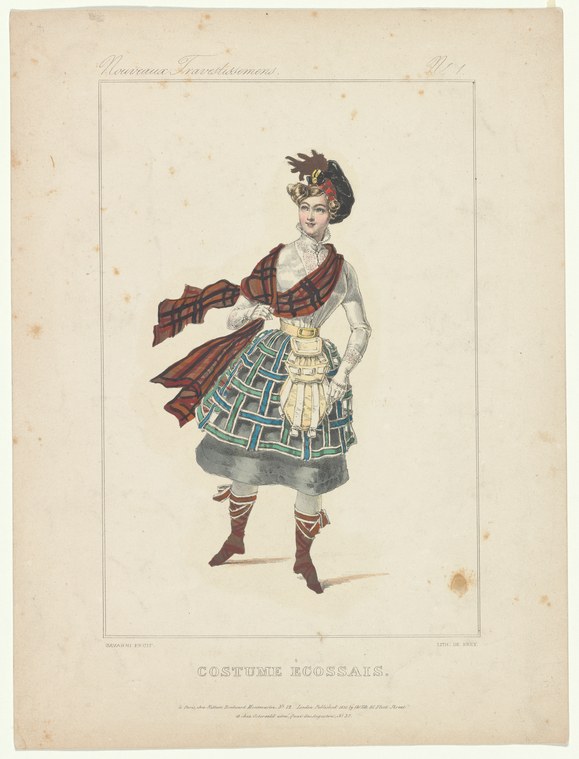
A single female figure stands against a plain background, posed in a dynamic contrapposto stance characteristic of theatrical costume studies. She wears a plaid skirt in blue and green with a cream underskirt, paired with a short-sleeved white chemise and a deep wine-red shawl draped across her shoulders. Her dark hair is dressed high with feathers or ornamental pins. She wears wine-red stockings and dark boots that reach mid-calf. Her left arm extends outward holding the shawl in a sweeping gesture; her right arm rests at her side. Her weight is shifted onto her back leg, creating an S-curve through her body. The pose suggests movement—a turn or a moment of display—rather than stillness. The style is that of a costume print or fashion plate, rendered in hand-colored engraving or lithograph with delicate line work defining the figure against white paper.
The dancing
A single dancer or performer shown in three-quarter view, weight thrown back on one leg with a pronounced hip displacement. The torso is upright and elegant, the head held high with a slight turn. The extended arm and floating shawl suggest a spinning motion or the swirl of a pirouette just captured. The stance shows understanding of theatrical carriage—the kind of posed elegance required in early 19th-century stage performance. No partner is present; this is a study of individual presence and costume display.
The dance depicted
This appears to be a costume study for Romantic-era theatrical dance, likely ballet of the 1820s–1840s based on the dress style and the printed format of such costume documentation. The high-waisted skirt, short sleeves, and overall silhouette are consistent with early Romantic ballet costume. The pose and costume suggest either a character role—possibly a Scottish or folk character given the plaid—or a soloistic moment within a larger work. Without an artist signature or title inscription visible, the specific role and dance cannot be confirmed, but the professional quality and presentation indicate this was a commercial print documenting performance costume rather than a private sketch.
How it was made
Hand-colored engraving or lithograph on wove paper, printed and then colored with watercolor or gouache. The fine line work defining the figure, the delicate shading in the skirt pleats, and the precision of the costume detail are consistent with commercial costume prints of the early-to-mid 19th century. This technique allowed for mass reproduction and distribution to theaters, dancers, and the public eager for records of celebrated performances. The quality of execution suggests a professional atelier rather than a individual artist's study.
About this work
This is a professional costume print documenting theatrical dress and pose from the early Romantic ballet period. It represents the genre of performance documentation that circulated widely in the 19th century, allowing theaters across Europe to replicate celebrated roles and giving dancers and audiences a visual record of how a role was performed. The print format—hand-colored engraving suitable for reproduction—signals this was a commercial product aimed at theaters, dancers, and aficionados rather than an archival document or fine-art object. Such prints were crucial infrastructure for the international circulation of choreography and performance style before the advent of photography and notation became reliable.
How to look at it
Attend to the pose: the back leg carries weight, the front leg is freed, the torso curves upward, the head and arm extend outward—this is the vocabulary of Romantic ballet carriage. Notice how the skirt and shawl are drawn to enhance movement: the plaid is rendered in perspective to suggest the three-dimensional volume and how it would catch in motion. The costume itself—the shortness of the skirt, the puffed sleeve, the bold color—is not modest 19th-century dress but theatrical costume designed to project presence on stage at a distance. The feathered hair and red stockings add to the sense of artifice and display.
The artist
Unknown. The print bears no visible signature or attribution. The professional quality and format suggest it was produced by a commercial print house specializing in theatrical documentation, likely in Paris, London, or another major theatrical center. Such prints were often attributed to the costume designer or the theater rather than to the printmaker or colorist.
The period
This print dates to the Romantic ballet era (roughly 1820s–1840s), when ballet was the dominant theatrical spectacle in Europe and prints of celebrated dancers and roles were highly marketable. The plaid skirt and folk costume detail suggest the influence of Romanticism's interest in national character, the exotic, and the picturesque—themes that drove both choreography and visual culture of the period. The costume style is consistent with the early phase of Romantic ballet, before the tulle skirt lengthened to the ankle and before pointe work became standardized.
Where it lives
Held by the New York Public Library as part of a collection of dance-related prints. The catalogue assigns it no specific date, artist, or title beyond 'Costume prints,' indicating it is one of many undated costume studies in theatrical collections.
Dance in this work
Questions about this work
What dance is this showing?
The specific dance cannot be determined from the print alone. The costume and pose are consistent with Romantic-era ballet of the 1820s–1840s, likely a character role—possibly a Scottish or folk character given the plaid. The pose suggests a moment of turning or display rather than any specific step or combination.
Why does this look different from modern ballet?
This is early Romantic ballet, before pointe technique became standardized and before tutus lengthened to ankle length. The skirt is short and full, the arms are lower and more integrated with the body, and the overall silhouette is higher-waisted and less ethereal than the later Romantic and classical ballet images we know today.
Who made this print?
The artist or print house is not recorded. It was likely produced by a commercial theatrical print workshop in Paris, London, or another major theater center, where such costume documentation was a regular trade.
Why is there no background or scenery?
Costume prints focused on the figure and costume detail. A plain background allowed the eye to see the full silhouette, the cut of the dress, the volume of the skirt, and the pose without distraction—essential information for replicating the role in another theater.
More dance artwork





