49 works in this view — arrow keys or swipe to move between them.
Dance in Art
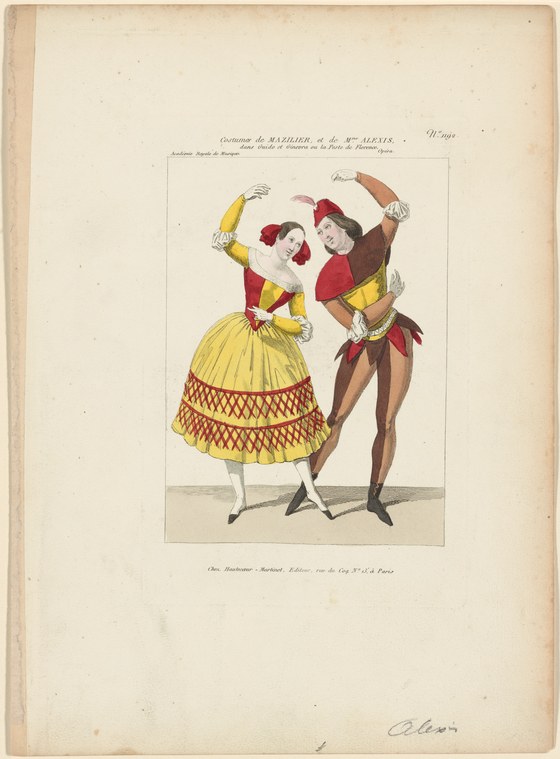
Costumes de Mazilier et de Mme. Alexis dans Guido et Ginevra: ou La peste de Florence, Opéra
Unknown artist
- Collection:
- Prints depicting dance
- Source:
- New York Public Library
- Rights:
- Public domain — free to use, share and adapt.
- Recorded as:
- Public Domain
Costume prints are among the most reliable visual documents of 19th-century dance practice, recording not only the design of stage dress but the posture, bearing, and compositional logic of major roles in canonical works. This print is named and dated to the performers and production, making it valuable evidence of Romantic ballet technique and aesthetics at a specific moment in Paris. For historians and dancers, such prints are primary sources that photograph and written description cannot fully replace.
What you are looking at
Two dancers in bright theatrical costume dominate a cream background. The figure on the left wears a vivid yellow skirt with red horizontal striping across the lower hem, a red bodice, and a white blouse with yellow sleeves; both arms are raised in a graceful arc above the head. The figure on the right, dressed in brown tights, a red bodice, and a short yellow-trimmed jacket, stands close beside, with one arm raised to mirror the partner's gesture. Both wear white stockings and dark shoes. Their faces are rendered in white makeup typical of stage performance. The composition is intimate and frontal, presenting the pair as a unified theatrical image against an undefined space. The hand-coloured technique gives the work a luminous quality, with the yellow particularly radiant.
The dancing
Both dancers are upright and closely positioned, nearly touching at the hip. Their raised arms create a symmetrical frame above their heads—a balletic port de bras suggesting elegance and courtship. The woman's weight appears to be on one leg, with a subtle suggestion of turnout; the man stands more squarely planted. Neither figure shows the strain of active movement; the moment is poised and composed rather than dynamic. The positioning and arm carriage suggest a formal, theatrical embrace of the kind found in Romantic-era ballet pas de deux.
The dance depicted
This is almost certainly a scene from *Guido et Ginevra, ou La Peste de Florence*, a French opera-ballet by Auber performed at the Académie Royale de Musique (Paris Opéra) in the 1830s. The costume print documents the stage dress of two principal dancers—Mazilier and Mme. Alexis—at a moment of intimate choreography typical of the Romantic ballet of the period. The gestural vocabulary (raised arms, upright carriage, formal positioning) and the theatrical makeup align with the ballet conventions of this era, when such prints served as publicity and record for significant roles. The yellow and red colour scheme suggests either a Spanish or Italian setting, consistent with the opera's Florentine subject.
How it was made
This is a hand-coloured engraving or lithograph, a standard medium for theatrical costume documentation in 19th-century France. The technique allowed rapid reproduction and wide distribution among theatre-goers, press, and the dance world itself. Hand colouring was applied after printing, which explains the slight variations in saturation and the occasional overflow of colour beyond the line. Such prints were among the primary visual records of major stage roles and served as both souvenir and archival document, circulating in albums, folios, and individual sheets. The careful preservation of detail in the faces and the precision of the dress suggest a commercial workshop of some skill.
About this work
This is a costume print documenting a scene from a major French opera-ballet of the 1830s, showing two lead performers in character dress at a moment of theatrical intimacy. The work belongs to the rich tradition of 19th-century European theatrical imagery—a category distinct from fine art, created primarily for circulation among audiences and the profession. It is both a performance record and a work of visual culture that shaped how Romantic ballet was seen, remembered, and reproduced. The print's survival in a collection of dance-related imagery confirms its historical value: it is evidence of who danced what, how they were dressed, and what the physical language of the moment was understood to be.
How to look at it
Attend to the moment the artist has chosen: not mid-leap or mid-turn, but a composed, frontal presentation—what might be called a 'pose' or tableau. The raised arms are the key gesture, conventional in Romantic ballet for expressing grace, aspiration, or emotional openness. Notice how the two figures are scaled and positioned identically to stress their partnership and equality, despite the difference in their dress. The precision of the makeup and costume detail—every stripe of the skirt rendered—shows that this is documentary work, intended to record exactly what the audience saw on stage.
The artist
The artist is not recorded in the catalogue, which is typical for commercial theatrical prints of this period. The work is likely the product of a Paris-based theatrical print publisher or workshop—possibly associated with the Académie Royale de Musique itself—rather than a named fine artist. The quality of execution and the precision of costume detail suggest professional theatrical documentation rather than artistic speculation.
The period
The 1830s–1840s were the height of Romantic ballet in France, the era of *La Sylphide*, *Giselle*, and the star system centred on the Paris Opéra. Ballet was increasingly understood as a serious dramatic art form, and major roles were celebrated through costume prints, lithographs, and engravings that circulated as commodities. Mazilier was a significant choreographer and dancer of the period; such named prints of principal performers became collectible items and served as a form of theatrical fame. The style of dress here—particularly the woman's yellow skirt and the theatrical makeup—reflects the Romantic aesthetic of the period, with its combination of historical or exotic costume and balletic formality.
Where it lives
The work is held in the New York Public Library's collection of prints depicting dance. It is catalogued by performance title, performer names, and theatrical context rather than by artist, a classification system reflecting the print's status as historical performance documentation rather than as a fine art object.
Dance in this work
Questions about this work
Who were Mazilier and Mme. Alexis?
Mazilier (full name Joseph Mazilier, 1801–1868) was a prominent French ballet master, choreographer, and performer of the Romantic era, known for works including *La Gypsy* and *Marco Spada*. Mme. Alexis was likely a principal female dancer of the Paris Opéra, though detailed records are sparse. Both were stars of the Opéra in the 1830s–1840s, and this print documents a celebrated partnership.
What is *Guido et Ginevra*?
*Guido et Ginevra, ou La Peste de Florence* (Guido and Ginevra, or The Plague of Florence) was an opera by Daniel Auber, a leading French composer of the period. It was performed at the Académie Royale de Musique (the Paris Opéra) and featured significant ballet sequences, which was standard in French grand opera of this era. The opera combined sung drama with elaborate choreography and spectacle.
How were costume prints made and distributed?
Theatrical prints were created by specialist print workshops in Paris and other major theatre cities. An artist or engraver would document the costume and the performer's pose from sketches or direct observation. The image would be engraved or lithographed, then hand-coloured by teams of colourists working in assembly-line fashion. Prints were sold individually, in folios, and as album series; they were collected by theatre enthusiasts, preserved in portfolios by dancers and choreographers, and eventually entered institutional collections.
What do the raised arms tell us about the dance?
Raised arms in Romantic ballet express emotion and grace, and signal a moment of formal beauty rather than active steps. This pose is consistent with the vocabulary of the pas de deux in ballets of the 1830s–1840s, where the male dancer often supported the female dancer in poses of stillness and elegance. The mirror image of the two arms suggests either a moment of unified emotion or a formal courtship gesture—both common in Romantic ballet.
More dance artwork





