49 works in this view — arrow keys or swipe to move between them.
Dance in Art
Theatrical portraits
Unknown artist
- Collection:
- Prints depicting dance
- Source:
- New York Public Library
- Rights:
- Public domain — free to use, share and adapt.
- Recorded as:
- Public Domain
This print documents the aesthetics of Romantic ballet and the celebrity culture that surrounded individual dancers in the mid-19th century. It shows how theatrical dance was marketed to the public through costume, glamour, and portraiture—a powerful strategy that shaped how dance was understood and valued by audiences.
What you are looking at
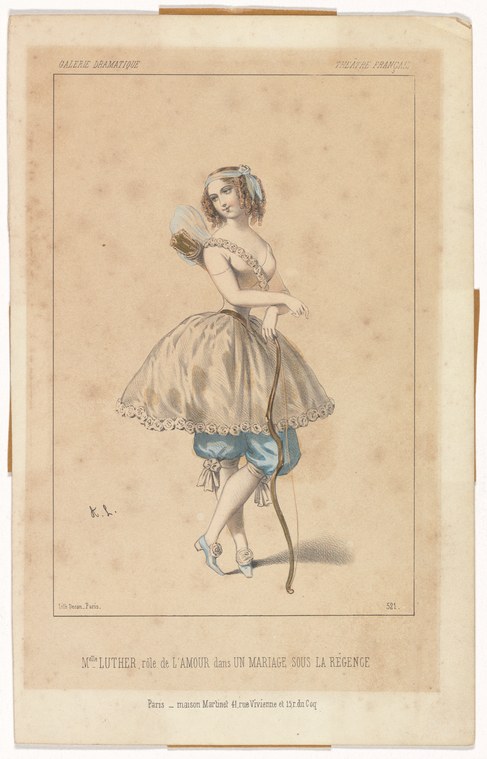
A young female dancer stands alone against a plain beige background, positioned in a three-quarter view that displays her full figure. She wears the costume of a mid-19th-century theatrical dancer: a white corseted bodice with short sleeves, a voluminous skirt of pale silk or tulle that falls to mid-calf and ends in a deep lace border, and blue silk ribbons or bows at the hips. Her hair is styled in the fashion of the 1840s–50s, arranged in ringlets around her face. She holds a large feather fan in her right hand, angled across her body. Her left arm hangs naturally at her side. She stands in a relaxed but graceful pose, with her weight evenly distributed, facing forward with a composed, direct gaze toward the viewer. Her pose suggests a moment of rest or a formal portrait rather than mid-movement.
The dancing
The dancer is captured in an upright, frontal stance with no turn-out or lifted extension visible. Both legs appear straight and in neutral position, with no rise onto the ball of the foot. The arm holding the fan is flexed at the elbow and drawn across the torso; the other arm rests simply. The overall frame is open and symmetrical rather than aligned or compact. There is no evidence of the turned-out legs, elevated port de bras, or tensile control that would characterize trained classical ballet technique of the period.
The dance depicted
This is a theatrical portrait of a professional dancer, likely a prima ballerina of the 1840s–50s Romantic era, shown in her stage costume rather than in an active dance pose. The voluminous tulle skirt, lace trim, corseted bodice, and ringlet hairstyle are consistent with Romantic ballet costuming of the period—the style seen in works like *La Sylphide* (1832) and *Giselle* (1841). The feather fan was a common theatrical accessory of the era. However, the dancer is not shown dancing: she stands in a static portrait pose that prioritizes the display of costume and appearance over the capture of movement or technique. This is a genre image typical of theatrical portraiture of the period, where the dancer is presented as a celebrated performer and stage personality rather than as a dancing body.
How it was made
This is a hand-coloured lithographic print, likely from a series or folio of theatrical portraits. The medium allowed for rapid production and mass circulation of celebrity portraiture at low cost, making individual performers' images affordable and collectible. The delicate hand-colouring of the figure—the flesh tones, blue ribbons, and white dress—contrasts with the plain lithographic border and background, a convention of the period that concentrated visual interest on the figure itself. The quality of the printing and the elegance of the colouration suggest this was a commercial product aimed at middle-class theatre-goers and dance enthusiasts who collected such prints.
About this work
This is a theatrical portrait print of a Romantic-era ballet dancer, rendered in hand-coloured lithography and likely dating to the 1840s or 1850s. It captures not a moment of dance but a formal presentation of a professional performer in her stage costume—the iconic white tulle dress, corseted bodice, and accessories of mid-19th-century ballet. The print belongs to a vast body of theatrical portraiture that turned individual dancers into public personalities and commodities, circulating their images through commercial print networks. Such portraits served as souvenirs, promotional images, and records of the fashionable appearance and costume conventions of their era.
The work is historically significant as both a document of Romantic ballet's visual culture and as an example of how dance was mediated to the public through the female performer's image. Unlike action prints that attempted to capture choreography, this portrait emphasizes the dancer as a celebrated figure in her own right—a shift in how dance was commodified and consumed.
How to look at it
The portrait freezes the dancer in a moment of repose—she is not caught mid-leap or mid-turn, but rather presented as a composed figure for viewing and appreciation. This is a deliberate choice: unlike action prints that attempted to capture the dynamism of movement, this print prioritizes the dancer's appearance, costume, and social status. The hand-colouring draws the eye to the delicate blue ribbon bows and the luminous white tulle of the skirt, emphasizing the material beauty of the costume. Notice that the dancer's pose makes no demand on the body—there is no visible physical strain, turned-out legs, or lifted carriage. This is portraiture in the tradition of society painting, adapted to theatrical subjects.
The artist
The artist is not recorded in the catalogue. The inscription at the bottom appears to read "Mlle. Luther, rôle de l'Amour dans Un Mariage sous la Régence" [Miss Luther, role of Love in A Marriage Under the Regency], identifying this as a print of a specific performer in a specific theatrical role. The style and production quality suggest this was made by a commercial lithographic publisher in Paris or London, centers of theatrical portraiture in the mid-19th century. The marked initials "V.L." or similar may indicate the artist's hand, but this cannot be verified from the record.
The period
This print dates to the height of Romantic ballet, when the ballerina emerged as the central figure of the theatrical stage, celebrated for her ethereal beauty, technical skill, and offstage persona as much as for her dancing. The 1840s–50s saw the standardization of the tulle skirt, pointe work (though not yet universally), and the white-dressed, sylph-like aesthetic that dominated European ballet. This was also the era of mass-market theatrical portraiture: lithographic prints of named performers were produced by the thousands and collected as souvenirs and fashion images. The feather fan and jewelled accessories visible here reflect the material luxury and glamour associated with the prima ballerina, who occupied a complex social position as a celebrated artist and, often, a commodity in the marriage and patronage markets.
Where it lives
The work is part of the New York Public Library's collection of prints depicting dance (NYPL Dance Division, General Research Collections). It is a hand-coloured lithographic print, likely from a commercial series of theatrical portraits produced in Paris or London in the mid-19th century. Such prints were published in folios, singly, or as part of theatrical souvenir collections and were widely distributed to theatre audiences and collectors.
Dance in this work
Questions about this work
Is this a photograph?
No. This is a hand-coloured lithographic print, a drawing technique that allows for mass production and creative interpretation. You can see the characteristics of the medium in the soft edges, the uniformity of line, and the carefully applied hand-colouration that brings the figure to life. Photography existed by the time this print was likely made, but lithography remained the preferred medium for theatrical portraiture because it allowed for flattering idealisation and could be produced quickly and cheaply.
Why isn't she dancing?
This is a portrait, not an action scene. Theatrical portraits of the mid-19th century typically presented the performer in a formal pose that showcased costume, beauty, and social status rather than capturing movement. Action and choreography were subjects for other kinds of prints; this one is designed to be a souvenir and a celebration of the individual performer.
What was a typical Romantic ballet costume?
By the 1840s–50s, the standard costume for a leading female dancer consisted of a fitted bodice (usually white or pale-coloured, with short puffed sleeves), a voluminous skirt of white or pale tulle that fell to the calf, and pale silk shoes. Accessories such as feathers, jewels, ribbons, and flowers were added depending on the role. The silhouette was designed to emphasise the slenderness of the torso and the airiness of the skirt, creating the 'sylph-like' appearance that defined Romantic ballet aesthetics.
Who was Mlle. Luther?
The inscription identifies her as performing the role of 'Love' in a production called 'A Marriage Under the Regency.' She was evidently a professional dancer of sufficient reputation to warrant a commercial portrait print. Beyond the information in the inscription, her biography is not recorded in the available sources. Such prints often constituted the only surviving record of minor and mid-level performers.
More dance artwork





