49 works in this view — arrow keys or swipe to move between them.
Dance in Art
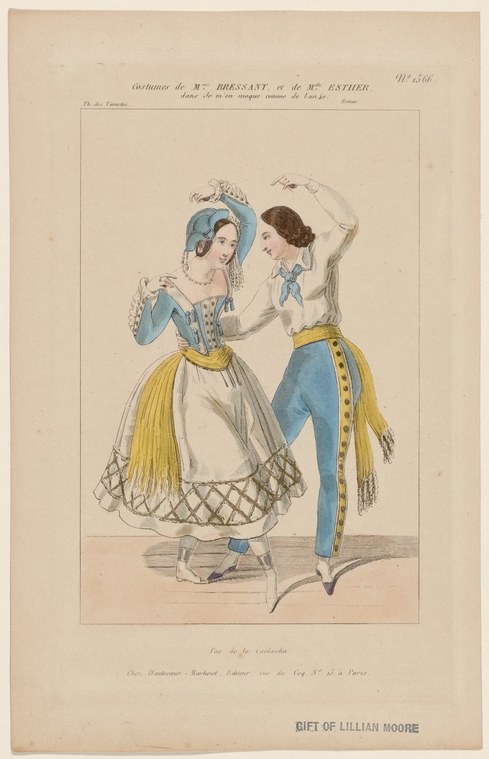
Costumes de Mme Bressant, et de Melle Esther, dans Je m'en moque comme de l'an 40. Revue
Unknown artist
- Collection:
- Prints depicting dance
- Source:
- New York Public Library
- Rights:
- Public domain — free to use, share and adapt.
- Recorded as:
- Public Domain
This work is crucial evidence of the breadth of theatrical dance in early nineteenth-century Paris beyond the canonical ballet d'action of Romantic ballet. It shows how coterie dance, social gesture, and contemporary fashion were staged in commercial theatre, and it documents the performance practices of named dancers—Bressant and Esther—whose work is otherwise almost entirely lost to history. The print itself is an artefact of how dance was consumed as a visual and social commodity, not only as live performance.
What you are looking at
Two female dancers in theatrical dress face each other in an animated interaction. The figure on the left wears a pale blue jacket bodice with white puffy sleeves edged in lace, a white skirt with elaborate gathered hem decorated in gold fringe or braid, and a pale blue bonnet or headdress with feathering. The figure on the right mirrors this palette, wearing a blue jacket and white skirt with gold trim, her arm raised expressively as if in greeting or exclamation. Both dancers wear pale stockings and heeled slippers. The composition is spare—a plain ground line and neutral background—focusing all attention on the bright silks and the theatrical interaction between the two figures. The print shows signs of hand colouring in the delicate watercolour washes of blue and gold leaf or paint.
The dancing
Both dancers stand in a three-quarter profile or frontal view, suggesting the viewer's perspective from the audience. The left figure stands still, facing her partner with one arm at her side and one raised to shoulder height in what appears to be a gesture of address or salutation. The right figure's raised arm extends upward, the hand elegant and articulate. Both stand upright with weight forward, in the refined posture demanded by aristocratic dance. The pose is stable and composed—neither figure is caught mid-leap or in rapid transition, but rather in a moment of acknowledgment or conversation staged as movement.
The dance depicted
This is a costume design for theatrical dance of the early nineteenth century, almost certainly for a Parisian revue or comedy. The title indicates these are costumes for performers named Mme Bressant and Mlle Esther in a production called 'Je m'en moque comme de l'an 40' (a French idiom meaning 'I don't care a fig'). The style of dress—the pale silks, the refined bonnet, the white skirt with metallic trim—suggests the fashionable coterie or parlour dance aesthetic of the Restoration or early Romantic period. The animated pose between the two figures suggests a scene of social interaction staged as ballet or comic pantomime, in which gesture and decorum matter as much as footwork. The lack of pointe shoes or the extended line typical of ballet suggests this may be a lighter theatrical dance—revue, comedy-ballet, or musical theatre rather than serious ballet d'action.
How it was made
This is a hand-coloured engraving or possibly a lithograph tinted with watercolour. The fine line-work defining the silhouette, the precision of the pleating and lace, and the delicate rendering of the fabric suggest engraving; the soft wash of blue and the careful application of gold leaf or paint suggest the hand finishing typical of early nineteenth-century theatrical costume prints. The technique allowed multiple impressions to be sold individually to theatre patrons, dancers, and print collectors, making these designs visible to a wide audience beyond the stage.
About this work
This is a costume design for a pair of dancers in a Parisian theatrical production of the Restoration era, likely early 1820s to 1830s. It documents the refined, fashionable aesthetic of French theatrical dance during a period when stage dress drew directly from the silhouettes and materials of contemporary couture. The two figures demonstrate the kind of elegant, stationary gesture work and social interaction that characterised lighter theatrical pieces—revues, vaudevilles, and comedy-ballets—that competed with serious ballet d'action for Parisian audiences. As a hand-coloured print sold separately from the theatre, it also reveals how the visual culture of dance was consumed and circulated: fashionable audiences collected and displayed these images of celebrated dancers in their dressing rooms and parlours.
How to look at it
Look at the posture and the hands. Neither dancer has the extended, weightless line that would characterise ballet proper; instead, both occupy a refined, upright carriage that prioritises decorum and legibility to an audience. The raised arm of the right figure is expressive but controlled—a gesture of salutation or exclamation, not a port de bras in the ballet sense. The calm of both faces and the stillness of the composition (neither is mid-movement) suggest that this moment is one of theatrical dialogue or social interaction, staged as dance and costume. The hand-colouring draws attention to the luxury of the fabrics and the care of the execution: this is a record of a fashionable appearance, not a study of movement.
The artist
The artist is not recorded. The style and format are typical of Parisian theatrical costume prints of the 1820s–1840s, a period in which printmakers and hand-colourists working in the rue Saint-Antoine and nearby districts produced thousands of such designs. These prints were often unsigned or signed only with initials, as they were commercial products made for rapid distribution rather than exhibition pieces.
The period
This print dates from the period following the Restoration of the Bourbon monarchy in France (1815–1830), a time of theatrical effervescence and the consolidation of the Romantic movement. Serious ballet—the works of Taglioni, the development of pointe work, the aesthetics of weightlessness and supernatural beings—was rising in prestige and dominance on the Parisian stage. Simultaneously, lighter theatrical forms—revues, vaudevilles, musical comedies—remained extremely popular and profitable, and employed dancers who were skilled in deportment, facial expression, and social interaction as much as in technical virtuosity. Fashionable theatrical dress of the period, as shown here, often drew directly from current women's fashion: the pale silks, the fitted bodice, the gathered skirt, the bonnet are all of the moment. This alignment of stage dress with street fashion reinforced the idea that the theatre was a space of elegance and modernity.
Where it lives
The print is held in the New York Public Library's collection of prints depicting dance. It is described in the record only by title, artist unknown, and date unknown. The inscription at the top reads 'Costumes de Mme Bressant et de Mlle Esther, dans Je m'en moque comme de l'an 40. Revue' and includes a reference number or volume code at the upper right.
Dance in this work
Questions about this work
Who were Mme Bressant and Mlle Esther?
They were named performers in Parisian theatrical productions of the early nineteenth century. Beyond the titles and roles recorded in prints such as this, almost no biographical information survives. The fact that their costume designs were printed and sold separately suggests they were well-known enough to be of interest to theatre patrons and print collectors.
What was 'Je m'en moque comme de l'an 40'?
The title is a French idiom meaning 'I don't care a fig' or 'I couldn't care less.' It refers to the year 1740 as a proverbial date so distant it is beyond concern. The phrase suggests the revue was a light, comic piece, and the costume styles—fashionable and theatrical but not grandiose—align with that genre.
Why is there no artist's name?
Theatrical costume prints of this period were often made and distributed by printmaking workshops and hand-colouring studios as commercial products. The prints were sometimes signed and sometimes not; many artists remain anonymous because the work was not conceived as fine art for exhibition but as merchandise for theatre patrons and dance enthusiasts.
Is this a design for ballet?
Almost certainly not ballet in the Romantic sense. The poses, the absence of pointe shoes, the refined but static gesture, and the genre of the production (a revue) all suggest this is from a lighter theatrical form—a comedy-ballet, a vaudeville, or a revue—in which social interaction, witty dialogue, and fashionable appearance mattered as much as technical dance.
More dance artwork





