49 works in this view — arrow keys or swipe to move between them.
Dance in Art
Mlle Baretta's dances, composed by F. A. Muller
Unknown artist
- Collection:
- Prints depicting dance
- Source:
- New York Public Library
- Rights:
- Public domain — free to use, share and adapt.
- Recorded as:
- Public Domain
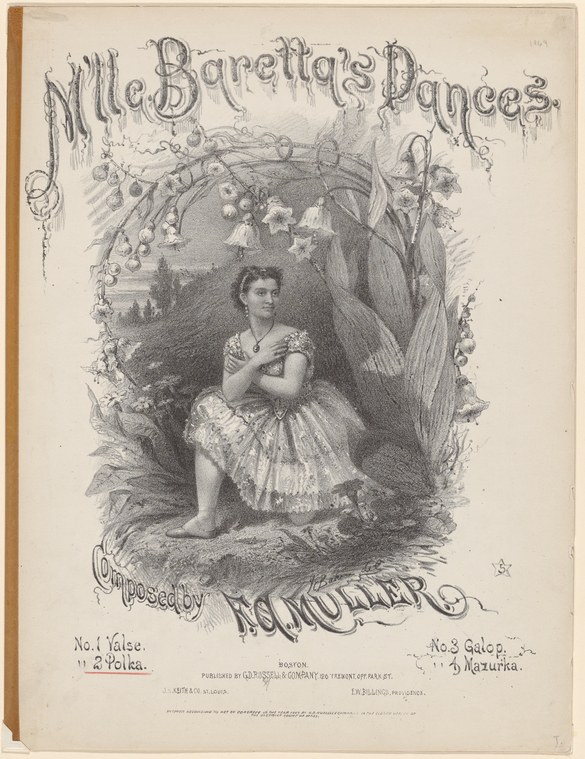
This print documents both a specific choreographer and performer otherwise poorly recorded in dance history, and shows how Romantic ballet was marketed and circulated to the public through printed media. For historians of dance imagery, it exemplifies the conventions used to represent ballet in the mid-nineteenth century—the woodland setting, the melancholic introspection, the emphasis on the solitary female dancer as a figure of mystery and otherworldliness.
What you are looking at
A young female dancer stands alone in a forest clearing, wrapped in an ornate decorative border of climbing vines, flowers, and foliage rendered in fine lines. She wears a white or pale tulle skirt, short and gathered, with what appears to be a corseted bodice and off-shoulder sleeves typical of mid-nineteenth-century theatrical dress. Her posture is introspective rather than dynamic—one arm crosses her body protectively while the other rests at her side, and her gaze is directed downward. She stands on relevé or with weight shifted to one leg. The background shows a moonlit or ethereal woodland setting with dark trees and atmospheric perspective. The overall mood is dreamlike and melancholic, evoking the supernatural or fantastical narratives popular in Romantic ballet. This is a cover or title page for a collection of dances, with ornamental lettering in a gothic revival style and publication details at the foot.
The dancing
The dancer is captured in a moment of stillness rather than active motion. Her weight appears shifted onto one leg, with the supporting leg potentially en relevé. Both arms are held in a soft, contracted position—neither arm is raised high or extended in the classical épaulement of formal ballet technique. Her torso shows a gentle contrapposto, and her head is inclined downward in a pose suggesting reverie, introspection, or sorrow rather than the alert, outward-facing presentation of classical technique. The composition emphasizes a single, solitary figure rather than ensemble or partnered work.
The dance depicted
This appears to be theatrical ballet from the Romantic era, likely 1840s–1850s, based on the tutu length (shorter than classical tutus), the costume silhouette, and the ethereal woodland setting characteristic of works like Giselle or La Sylphide. The title references Mlle Baretta (or Beretta), who was an active performer in European ballet during this period. The collection is noted as 'composed by F. A. Muller,' suggesting these were choreographic works created for or featuring this dancer. The image does not show active choreography but rather a publicity or decorative representation of the dancer as a Romantic heroine—a common convention for theatrical prints and dance publications of the period. The supernatural or woodland setting and the dancer's withdrawn demeanor suggest the narrative ballets of the Romantic repertory were the frame.
How it was made
This is a steel engraving or lithograph, likely from a printed music cover or dance portfolio. The fine line work, the tonal modeling achieved through cross-hatching and stippling, and the integration of ornamental lettering and decorative borders are consistent with mid-nineteenth-century theatrical printing. The technique allowed for mass production of promotional materials and sheet music covers, making images of celebrated dancers widely available to a paying public. The ornate decorative framing—a hallmark of Victorian-era commercial printing—suggests this was a luxury item for collectors of dance, music, and theatrical memorabilia. The quality and finish indicate professional commercial production rather than an artist's original drawing.
About this work
This is a cover or title page for a published collection of dances associated with Mlle Baretta and composed by F. A. Muller, dating to the mid-nineteenth century. It represents the Romantic ballet movement and the culture of theatrical dance publishing in the era when lithography and steel engraving made images of celebrated dancers accessible to a broad audience. The dancer is shown not in action but as a figure of romantic fantasy—a common way theatrical ephemera presented ballet to the public. The work sits within the tradition of dance-related prints and theatrical promotional materials that documented the stars and repertory of nineteenth-century ballet.
How to look at it
Attend to the dancer's posture and gaze: she is not shown in a moment of virtuosity or classical alignment, but in introspection and vulnerability. This was a deliberate pictorial choice reflecting Romantic aesthetics—the emphasis on emotion, nature, and the inner life rather than technical display. The ornate border frames her as both a theatrical figure (set apart and idealized) and a creature of nature (the vines and flowers suggest she belongs to the forest). The downward gaze and crossed arms are hallmarks of how nineteenth-century prints depicted the female dancer as a subject of romantic longing and melancholy rather than active agency.
The artist
The artist is not recorded. The work is attributed to 'F. A. Muller' as composer of the dances, not as the visual artist. Steel-engraved and lithographed dance covers and portfolios were a major commercial category in nineteenth-century publishing, often produced by specialized theatrical print shops and publishing houses rather than individually credited artists. The quality of execution suggests a professional engraver or lithographer working for a established publisher.
The period
This work dates to the height of the Romantic ballet era (approximately 1830s–1860s), when narrative ballet on supernatural and literary themes dominated the stages of Europe. The ethereal, melancholic aesthetic of the image reflects the movement's fascination with ghosts, sylphs, and doomed maidens. Printed dance music, sheet music covers, and theatrical portraits became a major market during this period, reaching beyond the theater audience to amateur musicians and dance enthusiasts who purchased printed materials for home entertainment. The decorative, ornamental style of the lettering and border is consistent with Victorian graphic design of the 1840s–1860s.
Where it lives
This object is held in the New York Public Library's collection of prints depicting dance. It is catalogued as a published theatrical print or sheet music cover, likely from the 1840s–1860s. The work's presence in a institutional dance collection reflects the NYPL's role in preserving theatrical ephemera and dance-related prints as primary documents of performance history.
Dance in this work
Questions about this work
Who was Mlle Baretta?
Mlle Baretta (or Beretta) was a nineteenth-century ballet dancer active in European theaters during the Romantic era. She was celebrated enough to have choreographed works created for her and to merit publication of dance portfolios and prints. Beyond this, detailed biographical information is sparse in readily available sources, making printed materials like this one valuable documents of her career and reputation.
What is F. A. Muller's role?
F. A. Muller is credited as the composer of these dances—the choreographer. It was common in the nineteenth century for choreographers to also compose music or to work closely with musicians. Muller may have been both a choreographer and musician, or the credit may indicate he arranged or selected music for this dance portfolio.
Why is the dancer shown standing still, not dancing?
Romantic-era dance prints often depicted dancers in expressive or narrative poses rather than in the midst of a choreographed step. This emphasized the dancer as a dramatic character and created an aesthetic image suitable for display, collection, and retail sale. The standing pose allows the viewer to see the costume and the dancer's face, making it an effective promotional image.
How was this image made?
This is a steel engraving or lithograph—a printmaking technique that allowed multiple copies to be produced from a single prepared surface. Both techniques were widely used for theatrical prints and music covers in the nineteenth century. The fine detail and ornamental lettering were well-suited to these commercial printing processes.
More dance artwork





