49 works in this view — arrow keys or swipe to move between them.
Dance in Art
Backstage scene
Unknown artist
- Collection:
- Prints depicting dance
- Source:
- New York Public Library
- Rights:
- Public domain — free to use, share and adapt.
- Recorded as:
- Public Domain
This engraving documents the aesthetic and social context of eighteenth-century European court dance at a moment when such dance was central to aristocratic identity and courtship. For historians of dance representation, it shows how prints mediated the experience of dance for those who could not attend court balls—translating movement into static, composable images that emphasized elegance and decorum. It is evidence that dance history must account for how dance was seen and circulated through visual culture, not only how it was performed.
What you are looking at
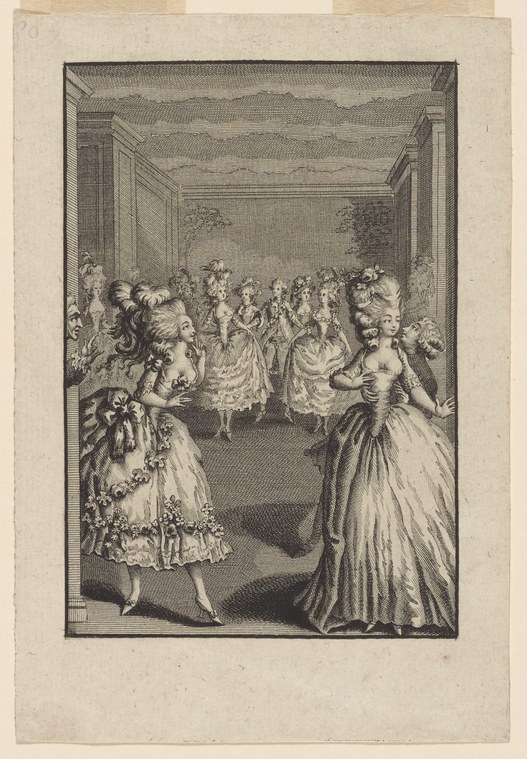
This engraving depicts a formal indoor dance or social gathering in what appears to be an eighteenth-century European aristocratic setting. The scene is framed by classical architecture—tall columns and a coffered ceiling—establishing an elegant ballroom or palace interior. In the foreground, two women in elaborate court dress dominate the composition: the woman on the left wears a richly decorated gown with deep ornamental patterns, while the woman on the right, in a simpler but graceful gown, appears to be the focal point. Both are positioned as if observing or participating in the festivities. Behind them, a crowd of courtiers in similar formal dress fills the middle distance, creating a sense of social occasion and spectacle. The figures are rendered in the detailed, linear style characteristic of eighteenth-century printmaking, with careful attention to the texture of fabrics, the arrangement of hair, and the deportment of aristocratic bodies.
The dancing
The two foreground women stand in elegant, upright postures typical of court etiquette, with graceful arm positions and balanced stance. The woman on the right displays a slight turn in the torso and a poised extension of the arm, suggesting either the moment before or after a dance movement. The crowd behind them maintains formal vertical alignment, arranged in a loose gathering rather than organized couples or sets. The bodies are elongated and refined, consistent with the aesthetic conventions of courtly movement, though the print's resolution and style obscure detailed footwork or specific partnering holds.
The dance depicted
This appears to document a formal court dance or ball of the eighteenth century, most likely a minuet, cotillion, or quadrille—the standard social dances of European aristocracy in this period. The setting, dress, and compositional focus on poised, mannered movement all point to historic-regency or historic-baroque courtly dance traditions. The engraving likely captures the social and visual spectacle of the dance rather than a specific moment of choreography; it celebrates the elegance and refinement of the participants and the occasion itself. Without a clear title or inscription visible, the precise dance cannot be identified with certainty, but the genre is unmistakable.
How it was made
This is an engraving, a relief or intaglio print technique that produces finely detailed black-and-white compositions through incised lines on metal plates. The technique allowed for precise rendering of architectural detail, fabric texture, and the refined silhouettes of court dress—all essential to documenting aristocratic social practice. Engravings were a primary means of circulating images of courtly life among the educated classes and were often based on paintings or direct observation. The skill evident here—particularly in the rendering of space, fabric, and human figuration—suggests this was produced for a cultivated audience familiar with both dance and printmaking.
About this work
This eighteenth-century engraving documents the visual and social spectacle of a European court dance, preserving not the dance technique itself but the setting, dress, and decorum that framed aristocratic dancing. The work sits within a long tradition of prints celebrating courtly entertainment and refinement; such images were as much about displaying wealth, fashion, and social position as about recording movement. For dance historians, it offers crucial evidence of how dance was understood and represented in this period—as an art of elegant posture and graceful spacing rather than virtuosic footwork, and as a vehicle for social display and courtship within the formal structures of aristocratic life.
How to look at it
Attend to the composition: the two foreground women are staged as if for observation, and the artist has arranged the crowd behind them to frame their figures and gesture. The architectural setting—the columns and coffered ceiling—establishes formality and restraint, values reflected in the upright postures and measured spacing of all the figures. Notice how the engraver has used line weight and cross-hatching to suggest the weight and texture of fabrics; the careful rendering of dress tells us this is a moment of visual spectacle as much as physical performance. The stillness of the figures, despite the implication of dance, reflects the eighteenth-century aesthetic of grace as control and restraint rather than dynamic movement.
The period
This print dates from the height of the eighteenth-century European aristocratic social order, when formal court dances such as the minuet, cotillion, and quadrille were the primary social and aesthetic expressions of courtly refinement. Dance in this period was inseparable from etiquette, courtship, and the visual display of rank and fashion; every movement was codified and meaningful. The engraving tradition itself was flourishing as a medium for circulating images of courtly life, fashion, and entertainment to a growing educated middle class who aspired to or were curious about aristocratic practice. Prints of dance scenes were common products of this visual culture, serving both documentary and aspirational functions.
Where it lives
Held in the New York Public Library's collection of prints depicting dance. This print likely dates from the eighteenth century and was produced in Europe, though without artist attribution or date information in the record, full provenance remains uncertain.
Dance in this work
Questions about this work
What dance is being shown here?
The specific dance cannot be identified with certainty from the print alone, but the formal court setting, aristocratic dress, and elegant posturing suggest a minuet, cotillion, quadrille, or similar eighteenth-century European court dance. The composition emphasizes the social and visual spectacle of the dance rather than specific choreographic detail, which is typical of prints documenting aristocratic balls.
Why are the dancers so still if this is supposed to be a dance?
This reflects both the conventions of eighteenth-century court dance, which valued control, restraint, and elegant posture over visible exertion, and the conventions of printmaking, which freezes movement into a single moment. The engraver has chosen to represent the social and aesthetic experience of the ball rather than the dynamic moment of choreography.
How were images like this used?
Engravings of court dances circulated among the educated classes and the aspirational middle class, serving both as documentation of aristocratic practice and as models for imitation. They were often produced in series or as illustrations in books on etiquette, fashion, or dance instruction, making them crucial vehicles for the dissemination of courtly aesthetics and behavior.
More dance artwork





