49 works in this view — arrow keys or swipe to move between them.
Dance in Art
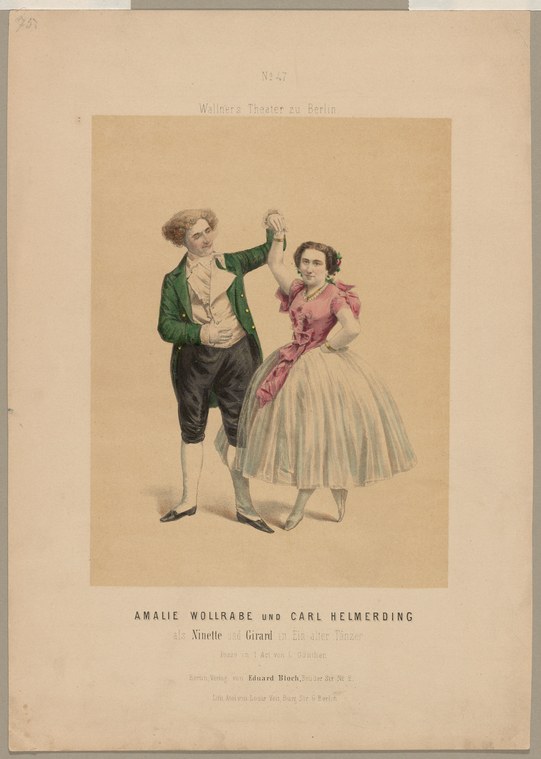
Amalie Wollrabe und Carl Helmerding als Ninette und Girard in Ein alter Tänzer
Unknown artist
- Collection:
- Prints depicting dance
- Source:
- New York Public Library
- Rights:
- Public domain — free to use, share and adapt.
- Recorded as:
- Public Domain
For dance historians, this print documents the repertoire and casting of 19th-century theatrical dance outside the major Paris and London opera houses, showing how Romantic ballet and its performance conventions circulated through Central European stages and companies. For anyone studying how dance was marketed and remembered, the print exemplifies the commercial theatrical image culture that made dancers into recognized celebrities, their likenesses and roles distributed through affordable lithographs that served as both souvenirs and advertisements.
What you are looking at
A young man in green coat and black breeches stands at center-left, one arm raised high in a theatrical gesture, leaning slightly back with evident energy and charm. Opposite him stands a young woman in a pink bodice with a voluminous cream skirt, her posture demure and receptive. The pair are positioned as if in mid-flirtation or courtship dance, the man's elevated gesture suggesting he is paying court or inviting her into movement. The background is plain and neutral, focusing all attention on the figures and their interaction. The hand-colored lithograph technique renders their skin tones warmly and gives definition to the woman's layered skirt and the man's tailored coat; the composition suggests a theatrical scene frozen at a moment of playful interaction.
The dancing
The man's raised arm and backward-leaning torso create an open, expansive frame—his posture is animated and presentational, as though demonstrating or inviting. The woman's upright stance with arms held loosely at her sides suggests she is being courted or challenged to dance. Both stand on a single plane without closed hold; the distance and angle between them indicate a social or theatrical dance, not a partnered ballroom frame. Their positioning and the man's theatrical reach suggest a moment of male display and female reception typical of 19th-century theatrical courtship scenarios.
The dance depicted
This appears to depict a scene from a 19th-century ballet or theatrical dance, most likely a romantic or comedic male-female interaction such as those common in the Paris Opéra repertoire of the 1840s–1860s. The title references a character named Ninette (a common generic name for an ingénue or soubrette in ballet) and Girard (a male romantic lead or comic character), performing in a work titled *Ein alter Tänzer* (An Old Dancer). The man's expansive, demonstrative arm position and the woman's receptive stance are consistent with the courtship dances or flirtatious duets of Romantic ballet, where male dancers often performed elaborate gestures and small jumps to display technique. The scene captures a moment of theatrical seduction or invitation central to 19th-century ballet narrative.
How it was made
This is a hand-colored lithograph, identifiable from the tonal washes, the soft edge definition, and the application of watercolor or gouache tints to the printed stone-image. The technique allowed for rapid and affordable reproduction, making theatrical prints accessible to a broad public—these were commonly sold as souvenirs or illustrations in theatrical journals and print collections during the mid-19th century. The hand-coloring suggests this was a mid-range commercial product: lithography with selective manual coloring was standard for theatrical portraiture of named dancers in major roles. The preservation of the performers' names in the caption indicates this documented a specific, recognizable performance or pair.
About this work
This is a theatrical souvenir documenting a scene from a 19th-century dance or ballet performance, likely from a German or Central European stage, showing two named performers—Amalie Wollrabe and Carl Helmerding—in a moment of romantic or comedic interaction. The work belongs to the large body of mid-19th-century lithographic theatrical prints that recorded the stars, roles, and key moments of the ballet and pantomime repertoire. It represents both the Romantic ballet tradition and the commercial culture of theatrical celebrity that surrounded it: these prints were consumed by audiences as mementos of favorite dancers and performances, circulated through print shops and theatrical foyers. The image preserves not only a choreographic moment but evidence of how dance was consumed, advertised, and remembered in its own time.
How to look at it
Attend to the man's raised, extended arm and his backward lean—these are the key choreographic information. His gesture is not a waltz frame or ballroom hold but a theatrical, demonstrative reach, suggesting a moment of male virtuosity or courtship display. The woman's receiving posture—upright, composed, slightly demure—is the counterpart. Note how the lithographer has chosen to freeze a moment of dynamic imbalance and exchange, not a stable formation. The hand-coloring of the woman's pink bodice and cream skirt draws the eye to her silhouette and the volume of fabric, emphasizing the visual spectacle of the female form in motion, a hallmark of Romantic ballet presentation.
The artist
The artist is not recorded. The print carries the attribution mark of a Berlin publisher or printmaker ("Wallers Theater zu Berlin" appears at the top), suggesting it was produced by a commercial theatrical print house serving German-speaking audiences. Such shops typically employed a range of trained lithographers, colorists, and printers whose individual names rarely appear on theatrical souvenir prints.
The period
This print dates to the mid-19th century, when Romantic ballet—with its emphasis on ethereal female dancers, elaborate storytelling, and male performers as virtuosic courtiers or princes—was the dominant theatrical dance form. German and Central European stages actively imported or imitated the Paris Opéra repertoire while also developing local companies and original works. Lithographic reproduction had become the standard method for circulating images of theater stars and scenes; these affordable prints were part of a burgeoning consumer culture around celebrity performance. The title *Ein alter Tänzer* (An Old Dancer) suggests the work may have been a comedy or character piece, a genre that flourished alongside the ethereal ballets in mixed repertoires of the period.
Where it lives
The print is held in the New York Public Library's collection of prints depicting dance, part of a larger genre of 19th-century theatrical souvenir images. The notation "Wallers Theater zu Berlin" indicates it was published in Berlin, likely for sale in or around a theater of that name or for broader circulation in German-speaking territories.
Dance in this work
Questions about this work
Who were Amalie Wollrabe and Carl Helmerding?
They were performers in 19th-century German theater, here documented in named roles. Without additional archival records, little more can be said from the print alone. Dance company rosters, playbills, and theatrical journals of the period would provide fuller biographical details. The fact that their names appear on the print indicates they were recognized stars of some standing.
What is *Ein alter Tänzer* and where was it performed?
The title translates as *An Old Dancer*. The work was likely a ballet, pantomime, or theatrical dance piece performed in German-speaking Europe, but the specific theater, date, and full cast cannot be confirmed from the print alone. The playful title suggests it may have been a comedy or character piece rather than a grand Romantic ballet.
How were these prints made and sold?
This is a lithograph (printed from a stone), then hand-colored by brush with watercolor or gouache. Such prints were mass-produced and sold as theater souvenirs in print shops, foyers, and through street vendors. They were affordable enough for a broad audience and served as both mementos of favorite performers and advertisements for upcoming shows.
What does the man's gesture tell us about the dance?
The raised arm and expansive, backward-leaning torso are consistent with the 19th-century ballet male vocabulary: displays of virtuosity, courtship, and dramatic expressiveness. This is not a closed ballroom hold but a theatrical presentation moment, typical of Romantic ballet duets or comedic male-female scenes.
More dance artwork





