49 works in this view — arrow keys or swipe to move between them.
Dance in Art
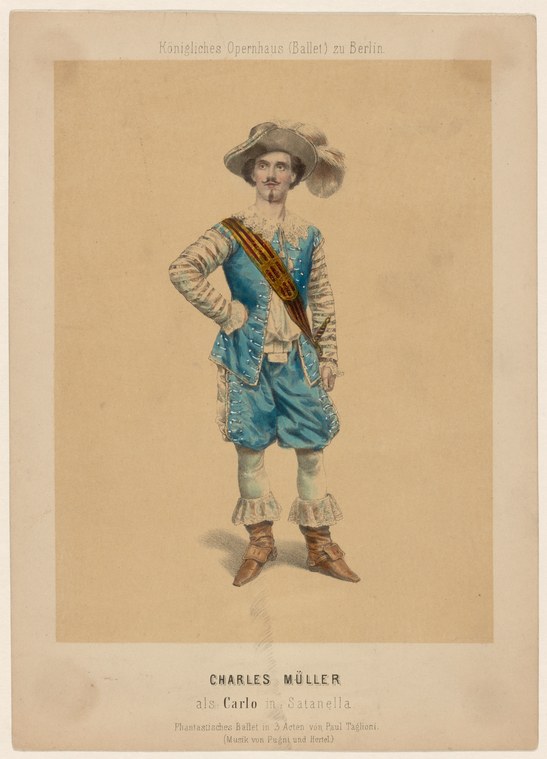
Charles Müller als Carlo in Satanella,: phantastisches Ballet in 3 Acten von Paul Taglioni (Musik von Pugni and Hertel)
Unknown artist
- Collection:
- Prints depicting dance
- Source:
- New York Public Library
- Rights:
- Public domain — free to use, share and adapt.
- Recorded as:
- Public Domain
Romantic-era ballet histories focus overwhelmingly on female dancers and roles; male dancers like Müller are nearly invisible in the historical record. This print documents a principal dancer at a major court theater, showing the type of character role—theatrical, costumed, dramatically acted—that defined male performance in this period. It is rare visual evidence of how male dancers were trained, dressed, and presented to the public.
What you are looking at
A single male dancer stands in a three-quarter pose against a warm, neutral background, facing the viewer with his weight shifted slightly to one side. He wears an elaborate costume consisting of a bright blue silk coat with ornate embroidered details, striped silk sleeves in tan and brown, blue silk knee breeches, white stockings, and brown heeled shoes with decorative cuffs. A brown fabric cross-body sash or baldric drapes diagonally across his torso. His left hand rests on his hip in a confident attitude; his right arm hangs naturally. He wears a feathered hat typical of 18th-century theatrical costume, tilted at a jaunty angle, and has a distinctive pencil moustache. The figure is rendered in colored lithograph with fine detail, suggesting this is a theatrical costume study or promotional print from a major European opera house.
The dancing
The dancer is positioned in a relaxed but alert standing posture, one hand placed on the hip and the other at his side, suggesting readiness and confident character. His weight appears to be on his back leg, with the front leg slightly advanced. The stance is that of a male dancer trained in the theatrical vocabulary of the era—upright, grounded, with no indication of elevation or virtuosic footwork in this particular moment. The body is entirely shown in isolation, with no partner or ensemble visible.
The dance depicted
This is Charles Müller, a principal dancer of the mid-19th-century Prussian court ballet, shown in costume as Carlo, a character role in the three-act fantasy ballet *Satanella*, choreographed by Paul Taglioni to music by Cesare Pugni and Eduard Hertel. The ballet was a significant work in the Romantic era; Taglioni's choreography for male roles emphasized noble bearing and character work over the virtuosic technique that dominated female roles. The costume—elaborate, colorful, with the cross-body sash typical of a cavalier or adventuring hero—indicates a dramatic character role rather than a classical male lead. Müller is shown not mid-leap but in the controlled, presentational posture of a dramatic actor-dancer.
How it was made
This is a hand-colored lithograph, a technique that allowed for mass production of theatrical costume studies and promotional materials for opera houses and ballet companies. The process—drawing on stone, transferring to paper, then hand-coloring each print—was standard for theatrical ephemera of the 1850s–1870s. Lithography's tonal range and ability to preserve fine detail made it ideal for costume documentation. The quality of execution and the printing house notation at top suggest this came from a major publication recording roles and performers of the Berlin court opera.
About this work
This is a theatrical costume print documenting a mid-19th-century male dancer in character dress. It records not only the elaborate dress worn in a specific production but also the physical demeanor expected of a male dancer in a Romantic-era character role—grounded, alert, and dramatically present rather than athletically displayed. The print is both a promotional artifact and a document of staging practice. Male dancers of this period, overshadowed in critical and artistic attention by the rise of the Romantic ballerina, are poorly represented in the historical record; this print is valuable evidence of their training, their roles, and their visual presence onstage.
How to look at it
Note the stillness and composure of the pose: this is not a moment of flight or extreme extension, but of readiness and character. The elaborate costume—the sash, the feathered hat, the silk breeches and embroidery—is part of the role's meaning; this is a cavalier or adventuring hero, not a classical prince. The hand on the hip is a period convention of masculine confidence and authority. The level of detail in the lithograph allows you to read the embroidery and fabric textures; this is documentation as well as promotion, a record of what an audience would actually have seen.
The artist
The artist is not recorded in the catalogue. The print bears a house mark indicating it was published by the Königliches Opernhaus (Royal Opera House) in Berlin or its official print publisher. Such costume studies were typically drawn from live observation or from costume records and executed by theater staff lithographers or commissioned artists. The inscription identifies this as part of a series recording roles and performers.
The period
This print dates from the height of the Romantic ballet, roughly 1850–1870. Paul Taglioni (1808–1884), Swedish-born but active in Berlin, was a major choreographer of this period and the son of the legendary Marie Taglioni. *Satanella* (also called *La Satanella*) was a favorite of European opera houses, revived repeatedly, and exemplified the fantasy narratives and elaborate stagecraft of mid-century ballet. The male dancer in this era inhabited a peculiar position: they were essential to the narrative and to lifts and partnering, yet were increasingly eclipsed in critical favor and virtuosic opportunity by the ballerinas. Character roles—with dramatic pantomime and costumed specificity—were a major part of their working repertory.
Where it lives
This print comes from the New York Public Library's collection of prints depicting dance, held in the Performing Arts collection. It is a theater ephemera item, part of a series documenting roles and performers of the Berlin Königliches Opernhaus (Royal Opera House).
Dance in this work
Questions about this work
Who was Charles Müller?
Müller was a principal dancer (danseur) of the Prussian court ballet in Berlin during the mid-19th century. He was a performer in the repertory of works choreographed by Paul Taglioni, one of the era's most prolific and influential ballet masters. Beyond his association with this production of *Satanella*, little is widely recorded about his career.
What is Satanella?
*Satanella*, or *La Satanella: A Fantastic Ballet in Three Acts*, was choreographed by Paul Taglioni to a libretto involving demonic and supernatural themes, typical of Romantic-era taste. The music by Cesare Pugni (a prolific composer for ballet) and Eduard Hertel was written to accompany large ensemble scenes and character dances. The work was staged across major European opera houses and was revived many times.
What does this print tell us about male dancers in the Romantic era?
It shows that male dancers were cast in specific, often costumed dramatic roles rather than in the increasingly abstract, virtuosic roles given to ballerinas. The grounded, presentational stance—hand on hip, upright posture—reflects a tradition of male performance that blended theatrical acting with dance technique. Male dancers of this period were expected to be skilled partners, dramatic actors, and performers of character dances, not soloists in the technical sense.
What technique is this print made with?
This is a hand-colored lithograph, a mechanical printing process that allowed the theater to produce multiple copies of costume documentation for promotion and record-keeping. An artist drew the design on a prepared stone, which was then printed onto paper and each print was colored by hand, allowing for variations and fine detail in fabrics and embroidery.
More dance artwork





