49 works in this view — arrow keys or swipe to move between them.
Dance in Art
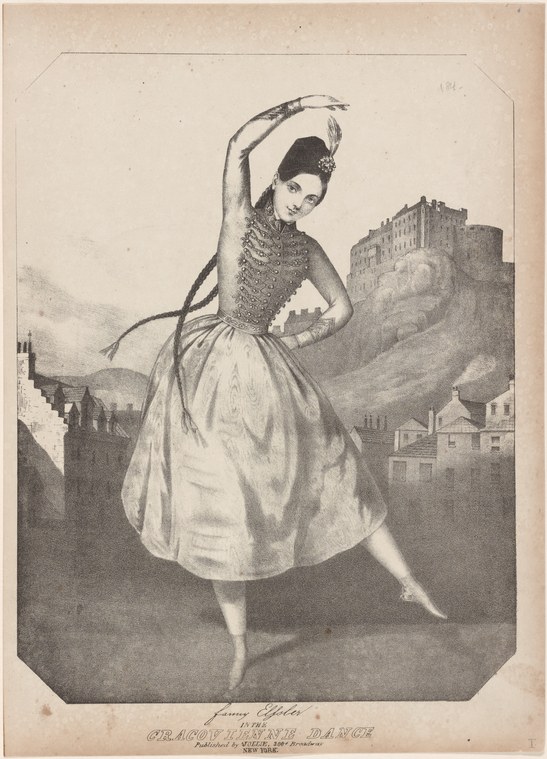
Fanny Elssler [facsim. sig.] in the Cracovienne dance
Unknown artist
- Collection:
- Prints depicting dance
- Source:
- New York Public Library
- Rights:
- Public domain — free to use, share and adapt.
- Recorded as:
- Public Domain
Fanny Elssler was one of the two supreme ballerinas of the Romantic era, and the Cracovienne was the role that established her as a technical and dramatic force distinct from her rival Marie Taglioni. This print is direct evidence of how that role was visualised and marketed, and it shows the costume, setting, and physical vocabulary of a character dance that influenced ballet for decades. The image confirms what we know from written records: that Elssler excelled in sharp, virtuosic footwork and that she brought nationalist pride and earthy vigour to the romantic stage.
What you are looking at
A young woman in Romantic-era theatrical dress performs a solo dance against a theatrical backdrop of a fortified castle or citadel set into mountainous terrain. She wears a fitted, decorative bodice embellished with what appears to be beading or embroidery, and a full skirt caught mid-motion, lifted and billowed around her legs. Her left arm is raised in a graceful arc above her head, while her right arm extends outward; her body is caught in a dynamic pose suggesting rapid rotation or a turning movement. She stands en demi-pointe or on her toes, with her right leg extended or in the air. The setting is rendered in atmospheric perspective—the castle recedes into misty distance, with architectural detail visible in the middle ground—creating theatrical depth. The entire scene is executed as an engraving or lithograph, rendered in black and white with careful attention to the fall of drapery and the play of light across the costume.
The dancing
A single female dancer occupies the composition, positioned frontally but rotated mid-movement. Her frame is upright, with the upper body lifted and elongated. The raised arm position suggests a classical or romantic vocabulary, though the dynamic tilt of her torso and the swept motion of her skirt indicate rapid turning or rotation rather than a held pose. Her legs appear to be working off the floor—either in a jump, a turn, or sustained elevation—with weight concentrated on one foot. The artist demonstrates understanding of the momentum and line-extension demanded by virtuosic footwork.
The dance depicted
The title identifies this as the Cracovienne dance performed by Fanny Elssler, the Austrian prima ballerina of the Romantic era. The Cracovienne (or Krakowiak) is a Polish folk dance characterised by vigorous, rapid footwork and a prideful carriage. Elssler famously performed this as a character dance, likely in a work such as *La Tarentule* or a similar vehicle that showcased her technical facility and dramatic presence. The image captures a moment of intense rotation or allegro work—the billowed skirt and pointed foot suggest the rapid turns and jumps for which Elssler was celebrated. This is not classical ballet in the ethereal Romantic mode, but a more earthbound, character-based dance drawing on European folk idiom.
How it was made
This is an engraving or possibly a lithograph, as indicated by the fine hatching, the tonal gradation achieved through line density, and the characteristic print appearance. The technique allows for precise rendering of costume detail and the sculptor-like definition of the body in space. The image bears a facsimile signature of Elssler and publication information, suggesting it was circulated widely as a theatre souvenir or artistic print during or shortly after her performances—a common practice for promoting star dancers in the 19th century. The tonal subtlety indicates skilled printmaking and suggests an audience of some cultural standing.
About this work
This is a print record of Fanny Elssler performing the Cracovienne, a Polish folk-derived character dance that was one of her signature roles in the 1830s and 1840s. It documents not a classical ballet moment but a more nationalistic, virtuosic piece that drew on European regional idioms and showcased the technical brilliance and dramatic intensity that made Elssler a rival to the more ethereal Romantic ballerinas of her time. The theatrical backdrop, the costume detail, and the captured moment of rapid footwork all testify to the production values and star power of mid-19th-century ballet spectacle.
The work belongs in a dance archive both as a record of Romantic-era performance practice and as evidence of the period's fascination with national character dances. It shows a type of theatrical dance distinct from the weightless sylph aesthetic, grounded instead in folk tradition and bodily virtuosity. For historians of ballet and of Elssler's career, it provides visual documentation of a role that was central to her fame.
How to look at it
Attend to the moment chosen: the artist has captured not a posed attitude but a moment of rapid movement—a turn caught mid-rotation, with the skirt still rising around the dancer's legs. The lifted carriage, the extended arm line, and the pointed foot all suggest the kind of swift allegro work that defines the Cracovienne. Notice how the costume—the fitted bodice and full skirt—is rendered to show how fabric moves in space during rotation. The theatrical setting receding into the distance places the dancer on a stage, not in an abstracted studio. This is a professional performance image, designed to commemorate a specific role and a celebrated interpreter of it.
The period
The Cracovienne belongs to the 1830s and 1840s, the height of Romantic ballet, when the ethereal, weightless aesthetic of works like *La Sylphide* and *Giselle* dominated the Paris Opéra. But alongside the sylph fantasy there was a strong appetite for character dances—works drawing on European folk idioms (Spanish, Polish, Scottish) that allowed ballerinas to display technical brilliance and national pride. Elssler built her reputation on such roles; she was known as the dancer of the earth, in contrast to Taglioni's dancer of air. The Cracovienne in particular capitalized on 19th-century Romanticism's fascination with folk culture and regional authenticity.
Prints of this kind were major vehicles for circulating images of famous dancers. Before photography, engraved and lithographed portraits and scene images were how theatre-goers could own a memento of their favourite performers and how dancers' reputations spread internationally. This print would have been sold in theatres and print shops, contributing to Elssler's celebrity across Europe and beyond.
Where it lives
The image comes from the New York Public Library's collection of prints depicting dance. It bears a facsimile signature of Fanny Elssler and publication information (partially visible), indicating it was issued as a theatre print or artistic souvenir in the mid-19th century. The collection preserves it as evidence of performance history and star culture in the Romantic era.
Dance in this work
Questions about this work
Who was Fanny Elssler and why did she matter?
Fanny Elssler (1810–84) was an Austrian-born ballerina who was one of the two supreme stars of Romantic ballet, the rival and counterpart to Marie Taglioni. Where Taglioni embodied weightless, ethereal grace, Elssler was celebrated for sharp, virtuosic footwork and a more dramatic, earthy stage presence. She was particularly famous for character dances like the Cachucha and Cracovienne, and her career extended her fame across Europe and to the Americas, making her one of the first internationally celebrated ballet stars.
What is the Cracovienne?
The Cracovienne (or Krakowiak) is a vigorous Polish folk dance characterised by rapid footwork, strong rhythm, and an upright, prideful carriage. In the Romantic ballet, it became a vehicle for character dances, allowing ballerinas to display technical brilliance while incorporating elements of European folk culture. Elssler's version was famous for its speed and energy, and it became one of her signature roles.
How do we know this depicts the Cracovienne and not another dance?
The title inscribed on the print itself identifies it: *Fanny Elssler in the Cracovienne dance*. The costume—the fitted, ornate bodice and the full skirt—is consistent with 19th-century theatrical representations of this folk-derived character dance. The dynamic pose, the rapid footwork suggested by the lifted carriage, and the theatrical setting all align with what we know of this role from written accounts and other period images.
What does the theatrical setting tell us?
The fortified castle or citadel backdrop places the dancer on a stage and signals a theatrical, rather than abstract, context. It may reference the setting of the specific ballet in which Elssler performed the Cracovienne, or it may be a generic backdrop meant to suggest a foreign or exotic locale. Either way, it confirms this as a record of professional performance, not a studio image, and reflects 19th-century theatre practice of using painted scenery to create atmosphere.
More dance artwork





