49 works in this view — arrow keys or swipe to move between them.
Dance in Art
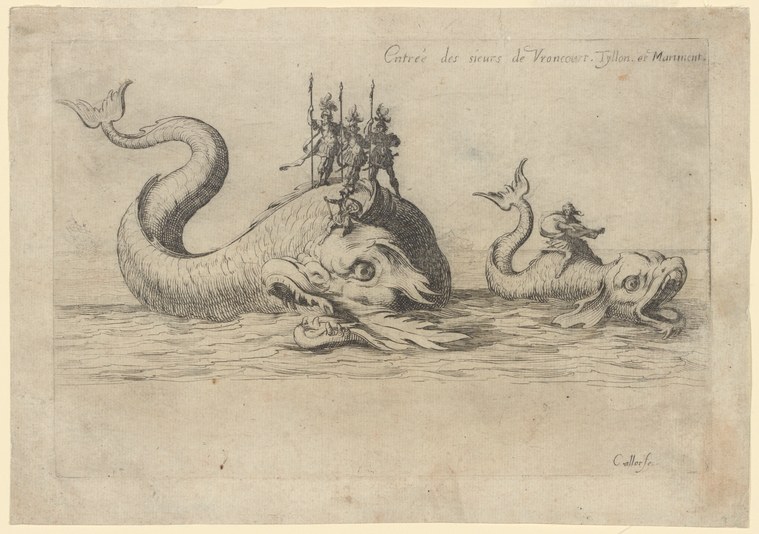
Entrée des sieurs de Vroncourt, Tyllon et Mariment
Unknown artist
- Collection:
- Prints depicting dance
- Source:
- New York Public Library
- Rights:
- Public domain — free to use, share and adapt.
- Recorded as:
- Public Domain
This engraving reveals the court spectacle as a major form of early modern entertainment and cultural expression, in which dance, theater, machinery, and allegory were inseparable. For historians of ballet de cour and theatrical pageantry, it provides a dated visual record of actual participants in an actual event, a rarity in dance history before photography. The work demonstrates how early modern courts used elaborate mechanics and fantastical imagery to stage power and celebrate dynastic occasions.
What you are looking at
This engraving depicts an elaborate aquatic spectacle featuring three grotesque sea creatures serving as platforms for human dancers. The largest creature, a whale-like beast at center, supports three armed figures in what appears to be a choreographed formation. To its left, a serpentine creature with an upturned tail carries additional dancers; to the right, a smaller companion beast mirrors the composition. The water is rendered with parallel hatching lines suggesting a harbor or coastline. The style is fantastical rather than naturalistic—these are clearly theatrical constructs rather than actual marine life. The dancers wear what appear to be military dress or courtly costumes, with plumed helmets visible on some figures. The composition is symmetrical and processional, with the creatures arranged as if in parade or ceremonial display. The engraving's fine detail and careful perspective suggest this documents an actual court spectacle or festival entertainment rather than an imaginary scene.
The dancing
The dancers stand upright or in martial postures atop the creatures, with several holding long pikes or staffs. Their bearing is formal and processional rather than fluid; the bodies are rigid and heraldic, arranged for display and visibility rather than for dancing movement in the modern sense. The figures maintain individual rather than partnered positions, each occupant of a creature occupying its own space. Arms are extended to hold weapons and for balance. The composition suggests a pageant or processional march rather than partnered or ensemble dance steps.
The dance depicted
This is not a conventional dance but a court spectacle or festival procession—a type of entertainment that blurs the boundaries between dance, theater, military display, and pageantry. Such aquatic festivals were popular in Renaissance and early modern courts, particularly in France and Italy, where elaborate mechanical creatures and water-based stages were commissioned for royal celebrations. The title names three gentlemen—Vroncourt, Tyllon, and Mariment—suggesting these were actual participants in a specific historical event. The emphasis on formation, costume, and symbolic display over footwork marks this as a court entertainment (ballet de cour or similar) in which social status and allegory mattered more than technical dance skill. The creatures themselves are likely papier-mâché or wooden constructions on boats or floats.
How it was made
This is a finely executed engraving, identifiable by the parallel hatching used for shading and the crisp lines characteristic of the engraving process. The technique allowed for wide distribution as a print, making it likely a record of an ephemeral court entertainment—a kind of illustrated program or souvenir documenting a single-occasion spectacle. Engravings of court festivals were standard ways to circulate knowledge of royal magnificence across Europe. The care of execution and the specificity of the title suggest this was an official or semi-official record, possibly commissioned to commemorate the event or included in a printed account.
About this work
This engraving documents a court spectacle featuring elaborate mechanical sea creatures carrying armed dancers in procession. It belongs in a dance history because such theatrical pageants were the ancestors of ballet de cour and the larger category of court entertainment. The work shows how Renaissance and early modern courts deployed dance, costume, machinery, and spectacle together as instruments of power and celebration. Though the human figures are not engaged in what we would recognize as dance steps, their formal arrangement, choreographed positions, and participation in a named, documented, occasioned event make this part of dance history—a reminder that dance in the court context included ceremonial procession and spectacular display, not only partnered or ensemble steps. The title fixes this as a historical record of a specific entertainment, lending it documentary as well as aesthetic value.
How to look at it
Examine the composition: note how the creatures are arranged symmetrically, with three figures occupying each one, suggesting a carefully designed tableau. Look at the dress—the plumed helmets and weapons indicate these are not dancers in the sense of performers of steps, but nobles or soldiers participating in a ceremonial display. The mechanical creatures are the real subject; the engraver has rendered them with anatomical precision and allegorical detail (the serpent tails, the whale's mouth). The formality and stillness of the poses suggest this is a moment of static display rather than motion—the moment when the procession pauses for viewing. Notice the hatching technique that creates shadow and volume, making the creatures appear weighty and three-dimensional.
The period
Court spectacles of this kind flourished in the 16th and 17th centuries, particularly in France and Italy. The Ballet Comique de la Reine (1581) is the most famous example, but such entertainments were a regular feature of royal and princely festivals. These spectacles were hybrids: part ballet, part theater, part pageant, part military display. They were occasions for demonstrating engineering ingenuity, allegorical learning, courtly beauty, and dynastic power. Engravings and printed descriptions of such events were produced to circulate the magnificence beyond those who attended. The shift from court spectacle to ballet d'action and eventually to theatrical ballet happened gradually over the 17th and 18th centuries; works like this show the earlier, more ceremonial and machinery-dependent form.
Where it lives
The work is held in the New York Public Library's collection of prints depicting dance. It is catalogued by title, but the artist and date of creation are not recorded. The title is in French, and the engraving style suggests 16th or early 17th century production. The specificity of the names and event suggests this was published or circulated in France as a record of a court entertainment.
Dance in this work
Questions about this work
Were these creatures real?
No. These are theatrical constructs—elaborate floats or mechanical stages built from wood, papier-mâché, and paint. They were designed to create a fantastical, allegorical effect for a court spectacle. The precision of the engraving does not mean the creatures were anatomically plausible; the engraver's skill was in rendering them convincingly enough to astound and delight a courtly audience.
Is this a dance or something else?
It is a court spectacle or festival entertainment—a hybrid form that included dance, theater, machinery, and ceremony. The participants may have danced in the broader sense (moved in formation, processed, performed gestures), but this is not a record of footwork or partnered movement. These spectacles were important ancestors of later theatrical dance forms.
Why would nobles participate in something like this?
Participation in court spectacles was a form of political and social display. It demonstrated loyalty to the ruler, skill in courtly accomplishments, wealth, and good connections. These entertainments were occasions for the nobility to perform their status and allegiance. The fact that the engraving names three specific gentlemen suggests these were people of rank whose participation was notable.
More dance artwork





