49 works in this view — arrow keys or swipe to move between them.
Dance in Art
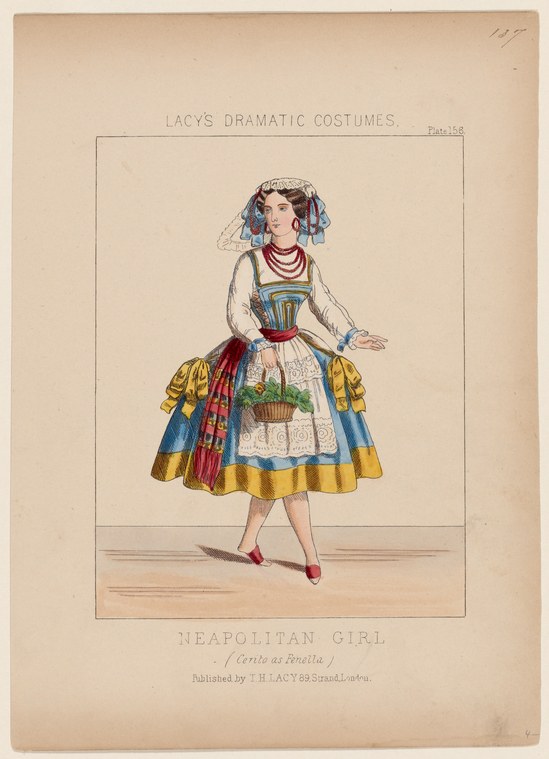
Neapolitan girl (Cerito as Fenella)
Unknown artist
- Collection:
- Prints depicting dance
- Source:
- New York Public Library
- Rights:
- Public domain — free to use, share and adapt.
- Recorded as:
- Public Domain
Costume prints like this document what audiences actually saw in the theater and how dancers themselves were conceived and marketed during the Romantic era. They reveal that the role of the dancer in a narrative ballet was as much about character, mime, and costume drama as about dance technique—a balance that defined the period.
What you are looking at
A young woman in Neapolitan folk costume stands alone against a plain background, posed as if mid-performance. She wears a white apron embroidered with a green basket or decorative motif over a full skirt of brilliant blue and gold panels, with deep red trim at the hem. A tightly laced corset in blue with gold edging structures her bodice over a white long-sleeved chemise. At her neck hangs a triple strand of red coral beads. Her headdress—a white linen cap with blue silk ribbons cascading down her back—frames her face and defines the moment as theatrical rather than everyday wear. Her pose is open and inviting: one arm gestures outward in a relaxed manner, her weight appears to rest on her right leg, and her gaze is direct. Her red heeled slippers are visible beneath the skirt hem. The composition is a formal figure study, lit flatly to display every detail of the costume.
The dancing
A single figure, standing in a three-quarter pose that suggests movement without capturing an active step. Her arm position is open and welcoming rather than engaged in any specific dance hold or frame. Her posture is upright and controlled, with the weight distribution and stance suggesting the bearing of a trained performer comfortable in theatrical dress. There is no partner, no closed hold, no footwork visible in action—this is a costume portrait frozen in a moment of address to the viewer.
The dance depicted
This is a costume print depicting Fanny Cerito, the celebrated Romantic-era ballerina, in the role of Fenella from the pantomime ballet *La Muette de Portici* (The Mute Girl of Portici), a role she made famous in the 1830s–1840s. Fenella is a silent speaking role performed through mime and gesture rather than narrative dance vocabulary. The costume shown here—unmistakably Neapolitan in style—is the character's dress from this opera-ballet. The work documents how ballet of the Romantic period engaged with national costume and dramatic narrative, and how a celebrated dancer was marketed and remembered through costume representation rather than through depiction of technique.
How it was made
This is a hand-colored engraving or lithograph, a reproductive print technique that allowed wide circulation of images of celebrated performers to an audience far beyond those who could attend live performances. The crisp outlines and precise detail of the costume, combined with the flat background and formal presentation, are characteristic of theatrical costume prints from the 1830s–1840s. The hand-coloring has been applied with care to distinguish the various textiles and their richness—the brilliance of the blue and gold skirt panels, the coral beads, the gold trim. This technique allowed the publisher (T. H. Lacey of Strand, London, as the imprint states) to produce affordable souvenirs of famous roles and disseminate knowledge of costume and fashion among an urban middle-class audience.
About this work
This is a theatrical costume print documenting Fanny Cerito in a celebrated role from *La Muette de Portici*, one of the defining works of Romantic ballet. The image is not a record of dance technique or movement but rather a commercial artifact: a souvenir marketed to audiences who had seen the ballet or wished they had. It belongs in a dance gallery as evidence of how Romantic ballet was consumed, remembered, and performed—through costume, narrative character, and pantomime rather than through the display of technical virtuosity. The print tells us that by the 1830s–1840s, a major dancer's fame could be packaged and sold as a portable image, and that national costume had become a central vocabulary of Romantic theatrical spectacle.
How to look at it
Notice how the costume overwhelms the figure—this is not a study of the dancer's body or technique but a display of textile splendor and historical accuracy. The print is designed to be read like a fashion plate: examine the construction of the corset, the layering and color of the skirt, the ornament of the apron, the headdress. The pose is deliberately modest and static, allowing the eye to travel across the costume without distraction. The artist has chosen a moment of pause rather than action, understanding that the garment itself is the subject of interest.
The artist
The artist is not recorded on the print beyond the publisher's imprint (T. H. Lacey, Strand, London). This was typical for reproductive prints of the period; the engraver or lithographer was often uncredited, with the publisher's name serving as the mark of commercial authority. Such prints were produced rapidly and in quantity for the London theater-going public, and the artist's identity was less important than the accuracy and appeal of the costume rendering.
The period
This print dates from the height of the Romantic ballet era (1830s–1840s), when ballet had become a narrative and spectacular art form centered on female dancers, exotic locations, and mime-driven storytelling. *La Muette de Portici*, originally a grand opera by Daniel Auber (1828), had been adapted as a ballet and became one of the era's defining works, revived repeatedly across Europe. Cerito herself was one of the four great ballerinas of the Romantic period, known for her technical brilliance and dramatic presence. During this period, theatrical costume prints were a major form of fan culture and entertainment merchandising, allowing the public to collect and display images of their favorite performers and roles.
Where it lives
This print is held in the New York Public Library's collection of prints depicting dance (Prints collection). It is one of a large body of theatrical costume and character prints produced in London during the 1830s–1840s, many of them recording celebrated roles and dancers of the Romantic era. Such prints were issued by theatrical publishers as commercial souvenirs and are now scattered across institutional collections.
Dance in this work
Questions about this work
Who was Fanny Cerito?
Fanny Cerito (1817–1909) was an Italian-born Romantic-era ballerina, celebrated for both technical mastery and dramatic presence. She was one of the four great ballerinas of her age and danced leading roles in the major works of the period, including *La Muette de Portici*. She was known for her quick footwork, elevation, and ability to embody character.
What is *La Muette de Portici*?
Originally an opera by Daniel Auber premiered in Paris in 1828, *La Muette de Portici* (The Mute Girl of Portici) was quickly adapted as a ballet. The plot concerns Fenella, a mute girl who communicates only through gesture and mime. The role became a favorite for celebrated ballerinas of the Romantic era, as it allowed them to display dramatic acting alongside dance.
How do we know this shows Cerito?
The print is inscribed at the bottom: 'Cerito as Fenella.' The costume—the distinctive Neapolitan dress, the headdress, the style of the pose—matches other documented images of Cerito in this role from the 1830s–1840s. London was a major center for such prints, and Cerito performed frequently there.
Why is the dancer not shown dancing?
This is a costume print, not a dance documentation. Its purpose was to allow the public to admire and collect images of celebrated roles and performers. Showing the full costume required a static pose; action would obscure the details of the dress. These prints functioned like theatrical fashion plates.
More dance artwork





