49 works in this view — arrow keys or swipe to move between them.
Dance in Art
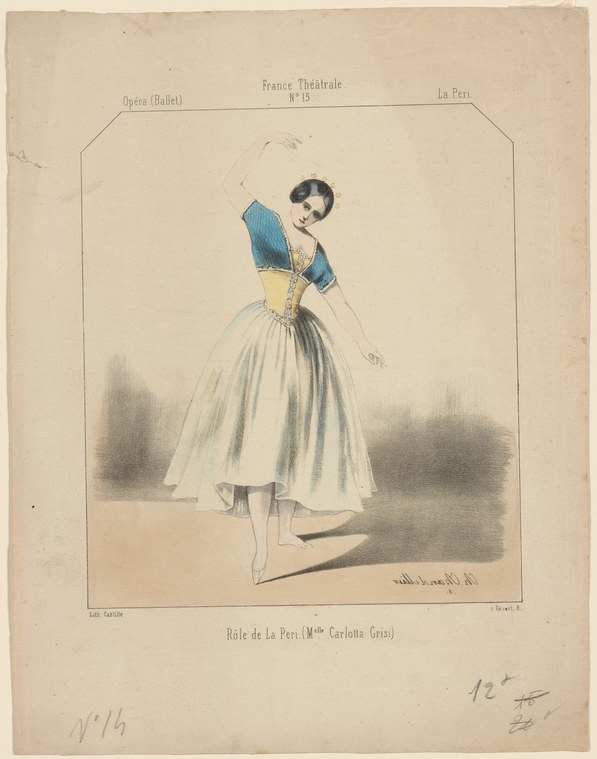
Rôle de La péri. (Melle Carlotta Grisi).: Opéra (ballet) La péri
Unknown artist
- Collection:
- Prints depicting dance
- Source:
- New York Public Library
- Rights:
- Public domain — free to use, share and adapt.
- Recorded as:
- Public Domain
This print preserves the image of one of the 19th century's most influential dancers at the height of her fame, anchoring a specific star performance and costume design to a date and role. For historians of ballet and costume, it is a primary document of Romantic-era aesthetics and stagecraft. For dancers, it models the ideal body and pose that dominated the period, offering a window into how technique and artistry were understood and promoted.
What you are looking at
A young female dancer is shown in a three-quarter standing pose against a neutral background with soft atmospheric shading. She wears a Romantic-era ballet costume: a fitted blue velvet bodice with short sleeves and a white tulle skirt that falls to mid-calf, gathered high at the waist with a defined belt. Her dark hair is styled in the period fashion, parted and pulled back. She stands nearly en pointe, with her weight forward and one leg extended behind in a graceful line, her arms held in a classical port de bras with the nearer arm extended downward and slightly forward. The pose suggests a moment of serene, ethereal stillness—the characteristic suspended quality of Romantic ballet. The figure occupies the upper two-thirds of the composition, leaving ample space below, and the soft modeling of light across her form gives the work an intimate, studiedly elegant character.
The dancing
A single female dancer, shown in profile-to-three-quarter view, stands with her body elongated and weight shifted onto one leg en pointe or demi-pointe. Her free leg extends behind her in a controlled extension, creating a long line from hip through foot. Her arms are held in a soft, classical frame: the nearer arm extends downward with a gentle curve, while the farther arm is positioned in the middle ground. Her head is held upright with a composed, inward-looking expression. The pose demonstrates the balletic principle of ligne—an unbroken elegant line through the body—and the careful balance between tension and ease characteristic of mid-19th-century classical technique.
The dance depicted
This is a portrait of Carlotta Grisi, a celebrated Italian ballerina, in her role as La Péri in the 1841 opera-ballet of the same name. The print documents the costume and persona of one of the 19th century's most famous Romantic ballerinas. Grisi was known for her technical brilliance and her ability to embody the ethereal, otherworldly characters that defined Romantic ballet. The pose shown here—poised, weightless, and introspective—captures the aesthetic ideal of the Romantic era: a dancer who appears to transcend the material world. The inscription confirms both the role and the performer, anchoring this image as a record of a specific star in a specific production.
How it was made
This is a hand-colored lithograph, one of the most practical and economical methods for circulating theatrical imagery in the 19th century. The composition shows the artist's use of soft lithographic line to define the figure, with gouache or watercolor applied by hand—visible in the careful gradation of blue in the bodice and the delicate shading of the white skirt. The technique allowed for rapid production of multiple copies, making such prints accessible to theatergoers and collectors of theatrical memorabilia. The soft atmospheric background, achieved through careful rubbing and blending on the stone, gives the work an intimate quality suited to the promotion and veneration of individual performers.
About this work
This hand-colored lithograph documents Carlotta Grisi in her most celebrated role as La Péri, a supernatural fairy-like being in the 1841 ballet of the same name. The print is a theatrical souvenir—the kind of image that circulated widely during the 19th century as a way of honoring and memorializing star dancers. It presents Grisi in full costume and characteristic pose, capturing the visual essence of Romantic ballet: the ethereal tutu, the pointe work, the elongated line, and the inward, almost trance-like expression of a dancer embodying an otherworldly character. The work is both a document of a specific historical production and a paradigm of how dancers were celebrated and visualized during the high Romantic era.
How to look at it
Look at the pose carefully: the dancer is captured in a moment of apparent weightlessness, with one leg extended behind and the body held in an effortless vertical line. Notice how the artist has rendered the tulle skirt—not as a solid mass but as a delicate, almost transparent cascade of gathered fabric that suggests movement even in stillness. The positioning of the arms—neither dramatically raised nor hanging loose—exemplifies the restrained, controlled expressiveness valued in Romantic technique. The gaze downward and inward, combined with the ethereal quality of the costume, conveys the otherworldly character Grisi was famous for embodying.
The artist
The print is unattributed in the catalogue record, which is typical for mass-produced theatrical lithographs of the period. Such prints were often commissioned by theaters or print publishers and executed by commercial lithographers whose names were sometimes omitted. The style and finish suggest a professional theatrical print shop, likely Paris-based, where such images were produced to capitalize on public demand for portraits of famous performers.
The period
The 1840s were the apex of Romantic ballet in Europe. La Péri premiered in 1841 and became one of the defining works of the era, celebrated for its supernatural subject matter, exotic fantasy, and the technical and interpretive demands it placed on its leading dancer. Carlotta Grisi was one of the four greatest ballerinas of the decade; her rivals—Marie Taglioni, Fanny Cerito, and Lucile Grahn—were similarly commemorated in lithographed portraits. Theatrical prints were a major industry and form of fan culture; collecting such images was a normal practice among those who attended the opera and ballet. The costume shown here—the fitted bodice and billowing tulle skirt—became the visual standard for Romantic ballet roles and remains iconic today.
Where it lives
This print comes from the New York Public Library's collection of prints depicting dance, a broad holding focused on theatrical and choreographic imagery. Such prints were originally commercial products, sold cheaply to theater audiences and collectors, and many examples have been preserved in institutional collections because of their value as historical records.
Dance in this work
Questions about this work
Who was Carlotta Grisi?
Carlotta Grisi (1819–1899) was an Italian-born ballerina who became one of the greatest stars of the Romantic era. She was famous for her technical brilliance, her dramatic intensity, and her ability to convey character and emotion through movement. She created the title role in La Péri and also appeared in other major ballets of the 1840s. She was celebrated across Europe and was one of the four 'prima ballerinas assolute' of her time.
What is La Péri?
La Péri is a ballet in two acts with choreography by Jean-Auguste-Dominique Ingres that premiered at the Opéra in Paris in 1841. The story concerns a supernatural fairy (the Péri) and a mortal man who falls in love with her. It is a quintessential Romantic-era ballet, combining fantasy, exoticism, and the technical display valued in mid-19th-century dance. Grisi's performance became legendarily associated with the role.
How do I know this is a lithograph?
The printing technique is visible in the soft, velvety quality of the lines and the way color has been applied—the blue of the bodice and the shading of the background show the characteristics of hand-colored lithography, where an image was drawn on a stone and then printed and colored by hand. The inscription and date are also characteristic of commercially printed theatrical prints from this period.
Why do so many 19th-century dancers appear in this pose?
This pose—standing nearly en pointe with one leg extended behind and the arms held in a classical frame—became the standard way to portray a ballet dancer during the Romantic era. It displayed the dancer's turned-out legs, the ability to balance on pointe, and the graceful port de bras (carriage of the arms) that defined classical technique. It was the visual equivalent of a professional headshot, instantly communicating the subject's identity as a serious, trained ballet artist.
More dance artwork





