49 works in this view — arrow keys or swipe to move between them.
Dance in Art
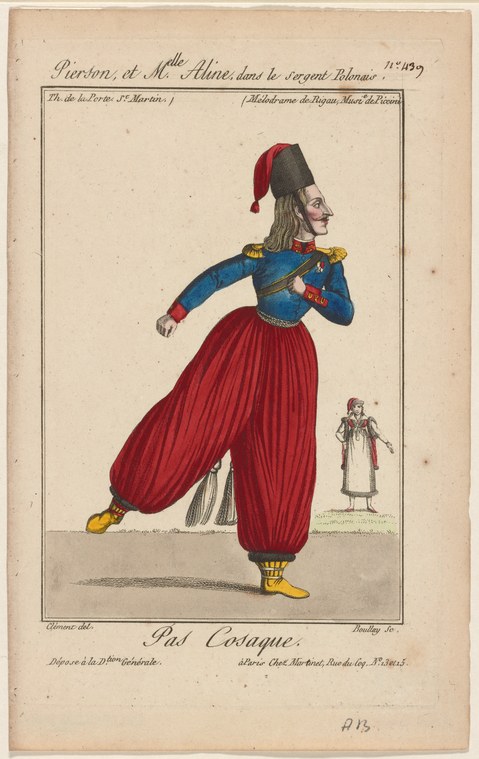
Pierson et Mlle Aline dans le Sergent polonais
Unknown artist
- Collection:
- Prints depicting dance
- Source:
- New York Public Library
- Rights:
- Public domain — free to use, share and adapt.
- Recorded as:
- Public Domain
This print provides visual documentation of how early 19th-century Paris audiences experienced non-classical, character-based dance on the professional stage. It shows the Romantic era's hunger for cultural 'otherness' and the ways that movement vocabulary, costume, and theatrical convention combined to create a legible national identity for audiences unfamiliar with actual Polish dance.
What you are looking at
A single figure in theatrical costume strikes a dramatic pose against a plain background. The dancer wears a vibrant red pleated skirt that balloons outward, gathered at the ankle, paired with a blue military-style jacket with gold epaulettes and red trim. A tall red cap with a dark band sits atop their head, styled in the manner of early 19th-century Polish dress. The figure leans forward in a dynamic, off-balance attitude, with one leg extended behind and arms held in an angular position, suggesting mid-movement. A small inset figure in the lower right corner shows the same costume in a more static pose. The print includes French text above and below, identifying the performers and work.
The dancing
A single figure dominates the composition, captured in a moment of spirited, angular movement. The body is thrown forward dynamically, with weight shifted onto one bent leg while the other extends backward. The arms are held in geometric positions—one swept back, the other extended—creating sharp angles rather than the fluid curves of balletic line. The posture suggests energy and character rather than classical refinement; this is a folk-derived or national dance movement rendered with theatrical exaggeration.
The dance depicted
The title names this as a scene from 'Le Sergent polonais' (The Polish Sergeant), likely a theatrical piece from the early 19th century. The costume—Polish military dress mixed with folk elements—and the dynamic, weight-forward stance suggest a National or character dance of the Romantic era, drawing on Polish folk idioms. The exaggerated posture and off-balance attitude are typical of how European theatrical dance incorporated 'exotic' national material during this period. This was almost certainly a stage piece created for a Paris opera or theatre house, performed by professional dancers in costume roles.
How it was made
This is a hand-colored engraving or aquatint print, characteristic of early 19th-century theatrical documentation. The printed line is fine and precise, while the colors—particularly the vivid red of the skirt and the blue jacket—are applied by hand in broad, flat areas. This technique allowed for affordable mass production of theater images, serving both as souvenirs for theatregoers and as promotional material. The quality and style suggest this was issued by a Paris publisher, likely between 1800 and 1830.
About this work
This print documents a moment from an early 19th-century Paris theatrical production featuring Polish-themed choreography. The work captures the Romantic era's fascination with national and character dances—the incorporation of folk material, exotic costumes, and dramatic gestures into the vocabulary of theatrical dance. The single-figure format, theatrical exaggeration, and hand-coloring technique mark it as a commercial theatrical print, designed to circulate widely among Paris audiences and preserve the memory of a specific performer in a specific role. It belongs in a dance gallery as both visual record and historical evidence of how European theatres staged 'national' identity through movement and costume.
How to look at it
Notice the artist's choice to capture the dancer mid-movement rather than in a posed, symmetrical position. The forward lean, the angular limbs, and the billowing skirt all suggest a moment of action rather than a held position. This was a deliberate artistic choice that emphasizes character and energy over classical line. The inset smaller figure provides a secondary view—a common convention in theatrical prints, allowing viewers to see the costume from multiple angles. The exaggerated posture is not naturalistic; it is heightened for theatrical effect and legibility from a theater audience at distance.
The artist
The print is not signed legibly in the visible portions. The style and format are consistent with Paris theatrical print production of the 1800s–1830s, likely issued by a commercial publisher such as the firms that specialized in 'roles' or costume prints for theatrical souvenirs. The engraver's name, if present, is not clearly visible at standard viewing size.
The period
This print dates to the height of Romantic ballet and theatrical dance in Paris. The early decades of the 19th century saw European choreographers mining national and folk traditions—Polish, Spanish, Hungarian, Scottish—for dramatic material that could be staged in urban theaters with professional dancers in costume. The appeal lay partly in Romanticism's fascination with the 'natural' and 'authentic,' and partly in simple novelty. Theatrical prints such as this one served as primary documentation and marketing, since there was no photography or film; they were how audiences outside the theater learned what the piece looked like, and how performers' likenesses and roles were circulated and commemorated.
Where it lives
This hand-colored engraving is part of a collection of prints documenting theatrical dance held by the New York Public Library. The collection preserves commercial theatrical prints that circulated in Paris and other European cities, serving as both souvenirs and documentation of stage practice.
Dance in this work
Questions about this work
What is 'Le Sergent polonais'?
Likely a theatrical ballet or divertissement performed in Paris in the early 19th century, incorporating Polish military and folk costume and character material. No detailed account survives; this print is primary visual evidence of what the piece looked like on stage. Many such works were short pieces inserted into longer programs or operas.
Who were Pierson and Mlle Aline?
They were likely professional dancers in Paris theaters during the early 1800s, cast in this Polish-themed role. Beyond their names on this print, little is recorded about their careers or lives.
Why does the dancer look so off-balance?
This is theatrical exaggeration. The forward-leaning, angular posture was meant to convey energy, character, and 'foreignness' to Paris audiences. It is also the moment the artist chose to capture—mid-movement, mid-gesture—rather than a stable, finished position.
Is this 'real' Polish dance?
No. This is a European theatrical interpretation of Polish cultural material—costume, military dress, and folk idioms filtered through the aesthetics and conventions of Parisian stage dance. It tells us about what European theater audiences wanted to see labeled as 'Polish,' not about actual Polish dance practice.
More dance artwork





