49 works in this view — arrow keys or swipe to move between them.
Dance in Art
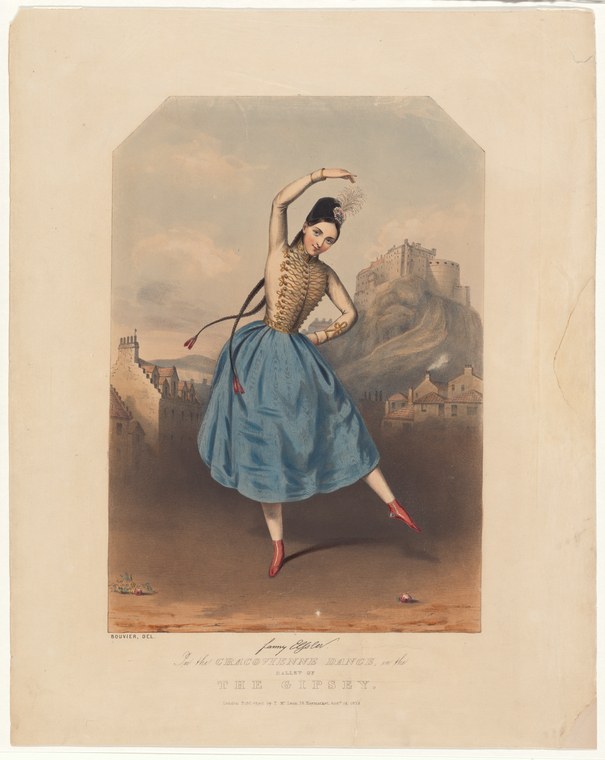
Fanny Elssler (fac. sig.): In the Cracovienne dance, in the ballet of The gipsey
Unknown artist
- Collection:
- Prints depicting dance
- Source:
- New York Public Library
- Rights:
- Public domain — free to use, share and adapt.
- Recorded as:
- Public Domain
Fanny Elssler was a historical pivot: she showed that ballet could carry personality, national character, and human warmth while remaining virtuosic. This image is one of the few we have of her in a specific role, and it captures the Romantic ballet's hunger for the exotic and the national—a hunger that shaped European dance for decades. Dancers and historians studying how ballet engaged with folk and national material in the 1830s–40s will find this an irreplaceable reference.
What you are looking at
A young woman in a pale blue skirt and golden/tan corset stands alone in a rocky, mountainous landscape, her body caught mid-turn in an emphatic gesture. Her left arm reaches overhead in an arc while her right extends to the side, and her torso twists with visible energy; her weight appears shifted to one leg as the other lifts. The setting is dramatic: steep stone fortifications and distant castles rise in the background under a moody, clouded sky, suggesting Eastern European terrain. The ground is bare earth and rock. The woman wears red heeled shoes and has dark hair pinned up in the fashion of the 1830s–40s. The print is hand-colored, with careful attention to the luminosity of her skin and the volume of her costume.
The dancing
A single dancer, isolated in the landscape. Her posture shows a sharp rotation of the torso, with the upper body twisted and both arms raised and extended—a vocabulary of Romantic-era theatrical gesture rather than the tight, contained carriage of Classical ballet. The raised arms and lifted leg suggest a moment of propulsion or climactic gesture. Her stance and the asymmetry of her movement suggest she has just pushed off from one leg; the energy is outward and upward, not restrained.
The dance depicted
The work depicts a moment from *The Gypsy*, a ballet by Jules Perrot (1839), performed by the celebrated Austrian dancer Fanny Elssler. The title identifies this as the *Cracovienne dance*—a Polish-national style dance incorporated into the ballet. The *Cracovienne* (or Krakowiak) is a vigorous, syncopated Polish folk form with sharp accents and rapid footwork, and was famously performed by Elssler as a solo showpiece. This image captures the theatrical, exuberant quality of Romantic ballet's fascination with national and exotic material: a European dance style presented as a vehicle for virtuosity and dramatic effect within a narrative ballet.
How it was made
This is a hand-colored engraving or lithograph, characteristic of 1840s theatrical print production. The technique allowed fine detail in the face and drapery while permitting broad washes of color—visible in the sky and landscape. Such prints were mass-produced for a middle-class market hungry for images of celebrated performers; they functioned as souvenirs and promotional material, circulating widely in Europe and America. The hand-coloring suggests this is from the more expensive end of the market, aimed at collectors and enthusiasts rather than casual purchasers.
About this work
This is a record of Fanny Elssler's performance of the Cracovienne, a Polish national dance woven into the romantic ballet *The Gypsy*. Elssler (1810–84) was one of the two supreme ballerinas of her generation—the rival to Marie Taglioni—and her specialty was exactly this: a dancer who could execute the technical demands of classical ballet but who brought warmth, personality, and connection to character and national style. The print preserves a moment of that performance: a solo turn in which the body's energy and individual gesture take precedence over the ethereal, weightless ideal that Taglioni embodied. It is a valuable document of how Romantic ballet incorporated non-Italian, non-aristocratic material, and how different dancers and audiences understood what the new ballet could do.
How to look at it
Attend to the relationship between the body and the landscape: Elssler is not ethereal or weightless, but planted, energetic, and decisively *present* in the rocky terrain. The moment captured is one of dynamic gesture—not a sustained, frozen pose but a turn caught mid-action, with the arms and torso driving the movement. Compare this to images of Taglioni in the same period: where Taglioni floats, Elssler propels. The costume—the fitted corset and full skirt, the red heeled shoes—is characteristic of Romantic-era stage dress, neither the stiff classicism of earlier ballet nor the pointe work and ethereal costuming that would define later 19th-century ballet.
The artist
The artist is not recorded. However, the print comes from a well-established mid-19th-century theatrical print industry. Prints of Elssler were produced by multiple publishers and engravers in London, Paris, Vienna, and New York; they were often unsigned or bore only a publisher's mark. The quality and inscription of this work suggest it was produced by a professional theatrical print house in the 1840s, possibly in London or Paris, where Elssler performed to great acclaim.
The period
The 1830s–40s were the apex of Romantic ballet. Marie Taglioni had defined the ideal of weightlessness and ethereality in works like *La Sylphide* (1832); Fanny Elssler countered with a style rooted in warmth, character, and virtuosity. Ballet was mining European folklore and national style with unprecedented enthusiasm—*La Gypsy* (1839), *La Tarantule* (1839), and Elssler's later *La Cachucha* (1836) all drew on popular and national forms. At the same time, theatrical lithography and engraving had become a major industry, feeding a growing middle-class audience's appetite for images of celebrated performers. Prints like this one were as important to a performer's fame as performances themselves.
Where it lives
The work is held in the New York Public Library's Prints collection, part of a broader series of theatrical and dance prints from the 19th century. It is labeled as a facsimile signature work and carries the collection mark 'Prints depicting dance,' indicating it was catalogued as part of a thematic rather than artist-based or date-based organizing principle.
Dance in this work
Questions about this work
Who was Fanny Elssler?
Elssler (1810–84) was an Austrian dancer and one of the two supreme ballerinas of the Romantic era, rivaling Marie Taglioni. Where Taglioni embodied weightlessness and the otherworldly, Elssler brought personality, warmth, and virtuosity rooted in character and national style. She was celebrated across Europe and America and retired wealthy and famous—unusual for a female performer of her time.
What is the Cracovienne dance?
The Cracovienne (or Krakowiak) is a vigorous, syncopated Polish folk dance in duple meter, marked by sharp accents and rapid footwork. Elssler performed it as a solo within the larger ballet *The Gypsy*, and it became one of her signature pieces. The dance exemplifies Romantic ballet's enthusiasm for incorporating national and folk material.
How were dancers made famous in the 1840s?
Performances were the primary vehicle, but theatrical prints were nearly as important. Hand-colored engravings and lithographs of celebrated dancers were mass-produced and sold as souvenirs, promotional material, and art objects. They circulated in Europe and America and built a performer's fame far beyond those who had seen them live. A dancer's image became a commodity in itself.
Why is this landscape in the picture?
The ballet *The Gypsy* had a narrative set in eastern Europe, and the rocky, fortified landscape grounds the dancer in that story-world. In Romantic-era dance prints, the setting was rarely merely decorative; it was part of the ballet's romantic geography and the character the dancer embodied.
More dance artwork





