49 works in this view — arrow keys or swipe to move between them.
Dance in Art
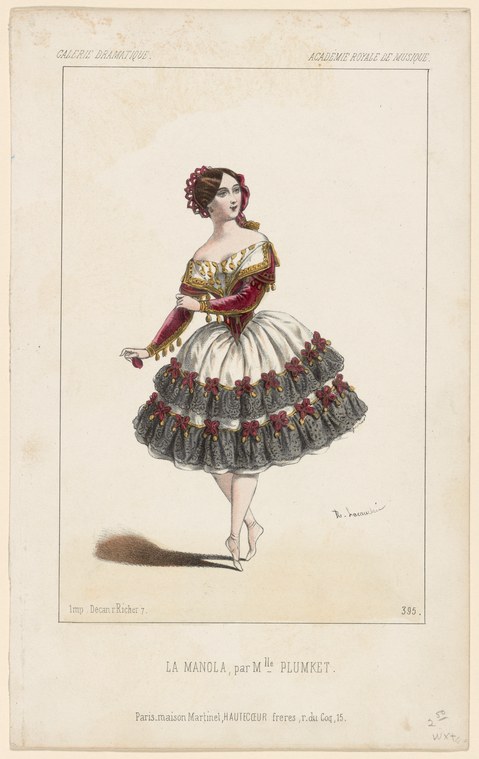
La manola, par Mlle Plumket [sic], Académie royale de musique
Unknown artist
- Collection:
- Prints depicting dance
- Source:
- New York Public Library
- Rights:
- Public domain — free to use, share and adapt.
- Recorded as:
- Public Domain
For dance historians and researchers, this print is a rare direct visual record of how a specific role was costumed and performed by a named dancer at a particular historical moment. It shows the conventions of romantic-era character ballet—the adaptation of Spanish themes and costumes into academic ballet technique—and the high production values of the Opéra's costume and set design.
What you are looking at
A single female dancer stands in three-quarter profile against a plain background, posed in a moment of theatrical stillness. She wears an elaborate mid-19th-century stage costume: a white muslin skirt with deep horizontal flounces trimmed in black lace and burgundy ribbon, a fitted bodice in gold and white with off-shoulder sleeves in deep burgundy, and an ornate belt. Her dark hair is arranged in elaborate ringlets pinned atop her head. Her right arm extends downward holding what appears to be a fan or small prop; her left arm hangs at her side. She stands in a slight contrapposto, with her weight on her left leg and her right leg extended slightly forward, one foot pointed en dehors in ballet position. The figure is rendered with fine hand-coloring over what appears to be a lithographic or engraved base, and casts a soft shadow to the right.
The dancing
The dancer is alone in the frame, depicted in a posed rather than dynamic moment. Her stance shows classical ballet training: weight placed centrally, right leg turned out from the hip, foot articulated in a pointed position typical of academic ballet vocabulary. Her upper body remains upright and composed, shoulders level. The extended arm holding a prop (possibly a fan or handkerchief) and the overall stillness suggest a moment between movements or a formal presentation pose rather than the peak of an active step.
The dance depicted
This appears to be a theatrical ballet costume study or portrait of a named dancer, Mlle Plumket, performing the role of 'La Manola' at the Académie royale de musique (the Paris Opéra). The Spanish-inflected costume—the name 'manola' refers to a Spanish peasant girl or working-class woman—suggests a character ballet or divertissement featuring Spanish themes, popular in romantic-era ballet. The pose and presentation are consistent with mid-19th-century ballet pantomime, where dancers held formal positions between mimed narrative moments. The work documents a specific performer and role in professional theatrical dance of this period.
How it was made
This is a hand-colored print, most likely a lithograph based on the rendering quality and the characteristic soft gradations of tone visible in the background and shadow. The technique allowed for mass production of theatrical costume documentation, which served both as promotion of performers and as a record of stage design. Such prints were collected, pasted into albums, and distributed to audiences and subscribers of theatrical journals. The coloring appears to be applied by hand after printing, using watercolor or gouache, a labor-intensive process that suggests this was a premium publication aimed at an affluent audience interested in Paris's most prestigious theater.
About this work
This is a mid-19th-century hand-colored theatrical print documenting a named performance by Mlle Plumket in the role of La Manola at the Paris Opéra. It belongs to a large genre of ephemeral promotional and documentary prints that recorded the major dancers, roles, and costume designs of European romantic ballet. Such prints are valuable evidence of how roles were realized in performance—the exact costume design, the dancer's stage presence and training, and the mixture of ballet technique with character or national-style movement that defined the era. The work exemplifies the intersection of theatrical documentation, celebrity promotion, and visual art in 19th-century popular culture.
How to look at it
Notice the tension between stillness and potential movement in the pose. The dancer is frozen mid-gesture, one arm extended, the body held in a moment of poise that suggests both trained discipline and narrative character. Look at the footwork: the right foot is clearly pointed and turned outward, indicating a formally trained classical dancer. The costume is rendered in meticulous detail—every flounce, ribbon, and trim is colored by hand—which tells you this was a high-value object, a keeper for someone who loved this dancer or this role. The artist has chosen a pose that displays both the costume and the dancer's figure to maximum advantage rather than capturing explosive movement.
The artist
The artist is not recorded, and the print bears only a signature mark that is not clearly legible in the image. The publisher information at the base indicates the work was produced by the Paris publishing house Martinet, established in the early 19th century as a major publisher of theatrical prints and portrait prints. Martinet's publications were standard documentation of the Paris stage, distributed widely and collected by enthusiasts of theater and dance.
The period
This work dates from the height of the romantic ballet era, when Paris was the center of European dance innovation. The 1830s–1850s saw an explosion of ballet productions featuring exotic, national, and character themes—Spanish, Italian, Swiss, Scottish dancers were stock characters—as part of a broader romantic interest in 'otherness' and theatrical spectacle. Character ballet, performed on pointe but in less formal costumes than classical ballet, was a significant genre alongside abstract ballets like 'La Sylphide.' The Paris Opéra maintained the highest technical and production standards in Europe, and dancers, roles, and costumes from its productions were widely publicized and celebrated.
Where it lives
The work is held in the New York Public Library's Prints collection, specifically in the series 'Prints depicting dance.' The catalogue record lists it as a French theatrical print, likely from Paris, mid-19th century.
Dance in this work
Questions about this work
What is a 'manola'?
In Spanish cultural usage, a manola is a woman of the working or lower-middle classes, often associated with Madrid. In 19th-century European ballet, 'manola' roles were character dances featuring Spanish themes, costume, and stylized movement. They were typically performed by ballet dancers trained in classical technique who adapted their movement vocabulary to suggest folk or national character.
Who was Mlle Plumket?
The catalogue record does not provide biographical information. She was a performer at the Académie royale de musique (Paris Opéra) known to have danced this role. She was celebrated enough to merit a published theatrical portrait, indicating she was a professional dancer of some standing, though she may not have been a principal star. No other details are available from the image alone.
Why is she posed and not dancing?
Theatrical portrait prints of this era typically showed performers in a posed, formal presentation rather than capturing them mid-movement. This allowed the costume and the dancer's body to be displayed clearly, made the print easier to compose, and gave it a portrait-like quality suitable for framing or album pasting. The pose still conveys training and grace; a ballet dancer was recognizable in stillness by her posture and turnout.
What does the prop in her hand suggest?
The fan or handkerchief visible in her extended hand suggests that the 'La Manola' choreography included mimed or gestural elements—character work with properties—rather than pure abstract dance. This mixing of mime and gesture with classical ballet technique was standard in romantic-era theatrical dance and made roles like this narratively legible to audiences.
More dance artwork





