49 works in this view — arrow keys or swipe to move between them.
Dance in Art
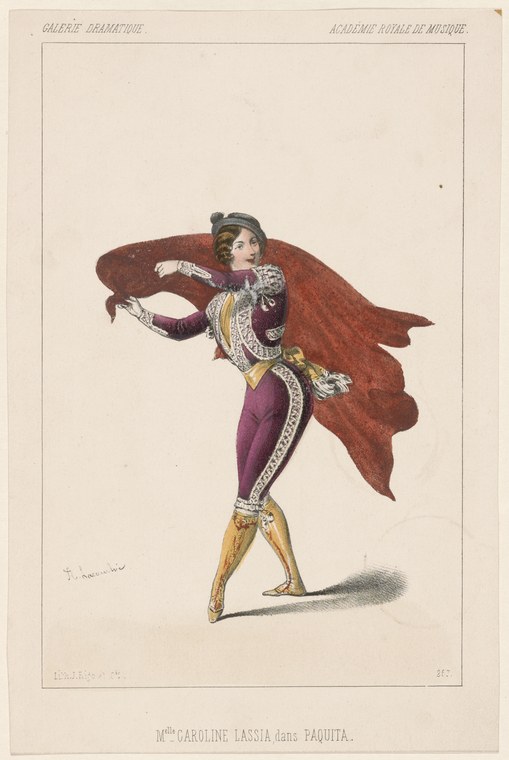
M'elle Caroline Lassia [sic] dans Paquita
Unknown artist
- Collection:
- Prints depicting dance
- Source:
- New York Public Library
- Rights:
- Public domain — free to use, share and adapt.
- Recorded as:
- Public Domain
This is rare documentary evidence of how a specific dancer costumed and presented herself in a celebrated role. *Paquita* survives today in multiple choreographic versions, but we have limited visual records of how it actually appeared on stage in the 19th century — this print, though a formal portrait rather than a stage photograph, preserves material details of costume, silhouette, and presentation. For historians tracking the careers of 19th-century dancers, especially women whose contributions are often underrecorded, named costume portraits like this one are primary sources.
What you are looking at
A single female dancer dominates the composition, posed in a dramatic contrapposto stance against a plain cream background. She wears a striking costume: a tight purple bodice decorated with ornate gold braid trim and gold epaulettes at the shoulders, fitted purple tights or leggings, and gold boots extending to mid-calf. A voluminous rust-red cape or cloak drapes from her shoulders and billows behind her, caught mid-movement and occupying nearly half the image. Her dark hair is styled up and crowned with a small ornament or tiara. Her left arm extends outward and slightly back as if reaching or gesturing; her right arm crosses her torso. Her posture conveys confidence and theatricality — the moment appears to be a pose held for presentation rather than a captured moment of active dance.
The dancing
The dancer stands in a classical balletic pose with turned-out legs and considerable weight shifted onto one side, creating an elongated line from her extended left arm down through her torso. The right arm, held across the body, suggests either a transitional position or an emphatic dramatic gesture. Her torso is upright and dignified, her gaze directed outward over her extended arm. The enormous cape, structured and held away from the body, creates a silhouette more characteristic of theatrical presentation than active choreography — it reads as costume display rather than functional garment in motion.
The dance depicted
This is a theatrical portrait of a performer in a Romantic-era ballet costume, almost certainly from a specific production. The title indicates this is Mlle Caroline Lassia in *Paquita*, a ballet first choreographed in 1846 by Joseph Mazilier with music by Édouard Deldevez. The costume — pseudo-military in its braid and epaulettes, exotic in the scale of its cape — is consistent with the ballet's narrative of Spanish adventure and romance. *Paquita* was frequently performed throughout the 19th century with variations in choreography and staging. The pose here is a formal costume portrait rather than documentation of actual choreography, made to circulate the image of a celebrated dancer in her role.
How it was made
This is a hand-colored lithograph or similar color print, recognizable from the flat tonal areas, the precise contour lines, and the deliberate composition typical of theatrical publicity material. The signature visible at lower left suggests this was a professional production by a commercial print house serving the opera and ballet market. The coloring is applied in discrete areas — the intense purple and gold of the costume contrast sharply with the rust-red cape — creating a vivid, legible image suited to display and collection. The technique and presentation indicate this circulated as a souvenir or promotional print among ballet enthusiasts, a common format for distributing images of celebrated performers in their most celebrated roles.
About this work
This is a theatrical costume portrait documenting the appearance of a named performer — Mlle Caroline Lassia — in a specific role from *Paquita*, one of the great Romantic-era ballets. It is not a depiction of choreography but rather a formal presentation of the dancer in character and costume, made for circulation among the ballet public as a souvenir or advertisement. The print circulated in an economy of celebrity and theatrical consumption that flourished in the mid-to-late 19th century, when ballet was a major form of commercial entertainment and dancers were international stars. This object is valuable precisely because it names its subject and dates the garment and production to a specific moment in the history of *Paquita* and of Lassia's career.
How to look at it
Attend to the scale and drama of the cape: the artist has chosen to emphasize costume and visual presence over active choreographic movement. The pose — formal, frontal, held — is a presentation stance rather than a step or leap captured mid-action. Notice how the light contour lines and flat color areas make the figure legible at a distance and in print, a necessity for a mass-produced souvenir. The signature and title function as labels, identifying both maker and subject — this is documentary art serving the needs of the theatrical market, not subjective artistic interpretation.
The artist
The artist is not recorded. The signature at lower left is difficult to read clearly in reproduction. Theatrical costume portraits of this type were produced by commercial print workshops serving the ballet and opera market, often without attribution or with only a lithographer's mark. These were commercial products rather than fine-art prints, made to satisfy demand from subscribers and fans.
The period
This print dates to the mid-to-late 19th century, an era when ballet was a dominant form of European theatrical entertainment and dancers achieved celebrity status comparable to modern film stars. *Paquita*, first staged in 1846, became a beloved repertory work and was frequently revived and adapted throughout the century. The Romantic era had elevated dance to a high art form, and the female dancer — in particular the dancer in exotic or dramatic costume — became a focus of aesthetic fascination and commercial interest. Prints, engravings, and photographs of celebrated dancers in their roles circulated widely, functioning as both souvenirs for fans and promotional materials for theaters and dancers themselves.
Where it lives
This print is held in the New York Public Library's Prints collection, which includes extensive holdings of 19th-century theatrical prints, dance ephemera, and costume documentation. As a color print of theatrical costume, it belongs to the category of commercial theatrical ephemera — promotional and souvenir material produced in quantity by commercial workshops and distributed through subscriptions, theater sales, and print dealers.
Dance in this work
Questions about this work
Who was Caroline Lassia?
Mlle Caroline Lassia was a 19th-century ballet dancer who performed in Paris and elsewhere in Europe. This print is one of the named records of her career. Beyond her appearance in *Paquita*, little is recorded about her biographical details or her other performances. Like many ballet dancers of her era, particularly those not affiliated with the Paris Opéra's most celebrated ranks, she is better known through images and reviews than through archival documentation.
What is *Paquita*?
*Paquita* is a ballet in two acts choreographed by Joseph Mazilier, first performed in 1846 at the Paris Opéra. The story concerns a Spanish gypsy girl, Paquita, and involves adventure, disguise, and romance. It was one of the great successes of the Romantic ballet era and was frequently revived, adapted, and restaaged throughout the 19th and 20th centuries. The grand pas from *Paquita* remains a popular showpiece in classical ballet repertory today.
How do we know who the dancer is?
The title inscription at the bottom of the print reads 'Mlle Caroline Lassia dans Paquita' — that is, 'Mlle Caroline Lassia in Paquita.' This is a named costume portrait, a standard form of theatrical documentation in the 19th century. The print circulated with this information printed on it, allowing purchasers to identify the performer and role. Without such titles, many theatrical costume portraits would be impossible to identify.
More dance artwork





