49 works in this view — arrow keys or swipe to move between them.
Dance in Art
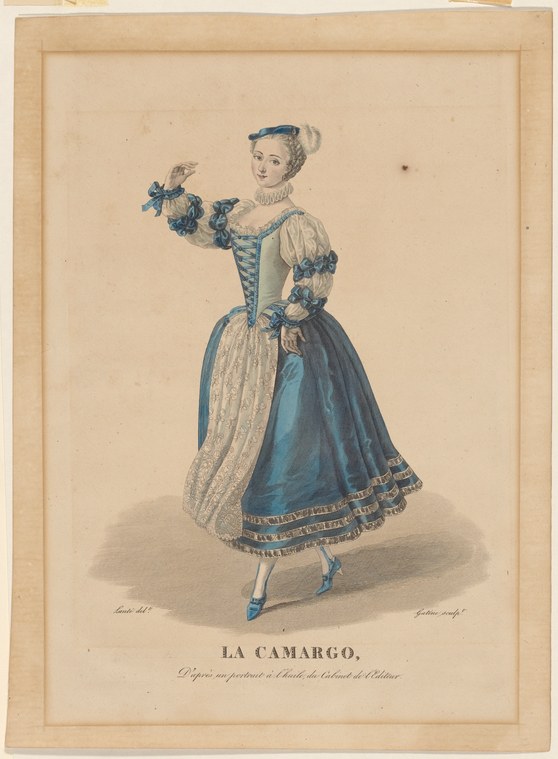
Camargo, d'après un portrait à l'huile, du Cabinet de l'Editeur
Unknown artist
- Collection:
- Prints depicting dance
- Source:
- New York Public Library
- Rights:
- Public domain — free to use, share and adapt.
- Recorded as:
- Public Domain
La Camargo was a revolutionary figure in the history of women in dance, demonstrating that technical brilliance and audience appeal could belong to women, not only to men. This print is evidence of how her innovations in costume and footwork were celebrated and circulated, helping to shift the entire practice and perception of ballet in real time. For anyone interested in the eighteenth-century roots of modern ballet, or in how female performers have claimed authority over their own bodies and technique, this image is a primary document.
What you are looking at
A young woman in elegant eighteenth-century dress stands in a three-quarter pose against a plain background, holding a small bouquet of blue flowers at shoulder height. She wears a pale cream or ivory gown with a fitted blue corset visible at the bodice, and a full skirt with blue trim at the hem. Her hair is styled up with a blue ribbon or ornament. She stands on the ball of one foot in a refined, lifted posture characteristic of aristocratic dance, with her weight distributed to suggest active movement rather than static presentation. The other foot appears to touch the floor lightly. Her expression is pleasant and her gaze directed outward, and she gestures gracefully with the flowers. The print has the soft, hand-colored appearance of an eighteenth-century engraving, with subtle shading that gives dimension to the figure and a faint shadow beneath her feet.
The dancing
The dancer is captured mid-movement in a balletic frame: one leg appears to support her weight while raised on the ball of the foot, while the other remains light and available. Her arms are held with one raised to display the flowers; the overall carriage is upright and elegant, with the torso held square and the head positioned with aristocratic poise. There is a single female figure, shown in isolation rather than partnered, suggesting a moment of individual display or salutation rather than interactive choreography. The body language conveys sprightliness and control rather than weight-bearing effort.
The dance depicted
This depicts Marie Anne de Cupis de Camargo, known as La Camargo, one of the most celebrated dancers of the eighteenth century. Camargo was famous for her technical virtuosity and for being among the first female dancers to shorten her skirt to mid-calf (allowing her feet and footwork to be seen), and to perform the kinds of brilliant petit allegro and jumping steps previously reserved for male dancers. The pose here—on demi-pointe, with the raised bouquet—captures the refined, lifted aesthetic of Romantic-era ballet technique as it was developing during her career (1726–1755). The inscription identifies this as copied from an oil portrait held by the publisher, suggesting this was a commemorative print circulating her image as a star performer.
How it was made
This is a hand-colored engraving or possibly lithograph, a reproductive print technology that allowed multiple copies of a celebrated dancer's image to circulate widely in the eighteenth century. The soft modeling and tonal gradations suggest skilled hand-coloring over a fine engraving; the medium was ideal for reaching a broad audience of aristocratic and middle-class subscribers interested in theatrical celebrity and fashionable culture. The technique's precision allowed the artist to render the delicate detail of the costume and the nuanced posture with clarity, making this a valuable record of how Camargo's physical presence was understood and promoted during her lifetime.
About this work
This is a commemorative portrait engraving of La Camargo, the most technically accomplished female dancer of the mid-eighteenth century, shown in a pose that displays both the refined elegance of court dance and the emerging technical vocabulary of ballet. It is copied from an oil portrait and was produced as a mass-circulated print, indicating Camargo's status as a celebrity whose image had commercial and social value. The work sits at a pivotal moment in dance history—the transition from court spectacle to public theatrical performance, and from female dancers as ornamental figures to female dancers as technical virtuosos. The isolation of the figure and the emphasis on her posture and costume record how Camargo herself was seen: not as one dancer among many, but as an individual artist worthy of portraiture and memory.
How to look at it
Observe the position of the feet and the lifted quality of the torso: the artist has frozen Camargo mid-movement, on the ball of one foot, demonstrating the elevation and ethereal quality that made her famous. Notice the shortened skirt (visible in the trim detail), which was Camargo's signature innovation and appears here as a marker of her modernity and daring. Look at the flowers: they are not merely decorative but part of a performance gesture, suggesting she is caught in a moment of salutation or display—a common motif in eighteenth-century dance imagery. The hand-coloring and the soft background emphasize the figure itself, presenting Camargo not as one element in a theatrical scene but as an individual worthy of attention and remembrance.
The artist
The engraver is not identified in the catalogue record. The inscription credits the image to a portrait "in the Cabinet of the Editor" (presumably a Parisian publisher), indicating this was a commercial reproductive print made after an oil painting. Such prints were typical of eighteenth-century theatrical promotion and celebrity culture, allowing performers' images to be standardized, distributed, and collected. The quality of the engraving and hand-coloring suggests a professional workshop rather than an amateur effort.
The period
Camargo's career (1726–1755) coincided with the codification of ballet technique and the emergence of the ballerina as a central figure in European theatrical culture. In the 1730s and 1740s, when this print was likely made, ballet was transitioning from the court spectacle of Louis XIV's era to the public theater of the Enlightenment. Female dancers had traditionally been secondary to male performers and to the visual spectacle of costume and machinery; Camargo changed this by demonstrating that a woman could perform the technically demanding jumps and footwork that had been considered masculine prerogatives. Her shortened skirt—a radical innovation—made her feet visible and thus made her technical achievement legible to the audience. This print circulated during her lifetime or shortly after, capturing her at the height of her fame and helping to establish her as a model for future generations of dancers.
Where it lives
This print is held in the New York Public Library's collection of prints depicting dance. It is described as a hand-colored engraving or lithograph, copied from an oil portrait in a publisher's collection (identified only as "Cabinet de l'Editeur"), suggesting it was a commercial product of the eighteenth-century Parisian print market.
Dance in this work
Questions about this work
Who was La Camargo?
Marie Anne de Cupis de Camargo (1710–1770) was a French ballet dancer and one of the most celebrated performers of the eighteenth century. She was famous for her technical virtuosity—particularly her jumping and footwork—at a time when such brilliance was considered the province of male dancers. She also shortened her skirt to mid-calf, a revolutionary move that made her feet visible and allowed audiences to appreciate her technique.
Why was Camargo's shortened skirt so important?
The standard ballet skirt of the time reached the floor, hiding the dancer's legs and feet. By shortening hers, Camargo made her footwork visible, allowing audiences to see and appreciate the technical difficulty of her dancing. This was a practical innovation that also served as a statement: her feet, and therefore her technique and artistry, were worth looking at.
What does this print tell us about dance in the eighteenth century?
It shows that by the mid-eighteenth century, individual dancers had become celebrities whose images were worth reproducing and circulating in print. It also documents the emerging aesthetic of ballet technique—the lifted posture, the rise onto the ball of the foot, the refined arm positions—that would define classical ballet for the next two centuries.
Is this engraving contemporary with Camargo's career?
The catalogue record does not specify a date, but stylistically and based on the inscription (identifying it as a copy of an oil portrait), it is likely from the mid-eighteenth century, either during Camargo's active performing years (until 1751) or shortly after her retirement. Without confirmation from the holding collection, the exact date remains uncertain.
More dance artwork





