49 works in this view — arrow keys or swipe to move between them.
Dance in Art
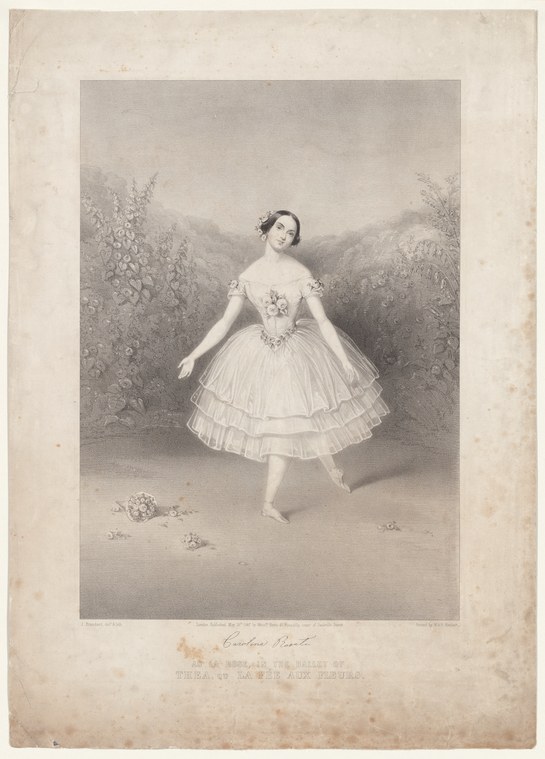
Carolina Rosati as La Rose, in the ballet of Thea, ou La Fée aux fleurs
Unknown artist
- Collection:
- Prints depicting dance
- Source:
- New York Public Library
- Rights:
- Public domain — free to use, share and adapt.
- Recorded as:
- Public Domain
Carolina Rosati was a major interpreter of Romantic ballet repertory, and this print preserves a record of her performance in a ballet by the choreographer Joseph Mazilier—a figure central to the development of the full-length ballet d'action in mid-nineteenth-century France. The image is rare evidence of how a specific dancer inhabited a specific role, and what the Victorian-era audience understood by grace, weightlessness, and the feminine ideal in dance.
What you are looking at
A young woman in a white Romantic-era ballet costume stands in a lightly shaded garden or wooded setting. She wears a fitted bodice with a corseted waist, short puffed sleeves, and a voluminous tulle skirt with multiple deep flounces, rising to about mid-calf. Her dark hair is styled close to the head with a decorative arrangement at the crown. She stands in a three-quarter pose, her weight shifted onto her left leg with a slight turnout, her right leg bent with the foot pointed behind her. Her arms are extended gracefully at shoulder height, slightly forward, with hands relaxed. The background shows soft, shadowy foliage and shrubs rendered in grey tones. Several scattered flowers or floral elements appear on the ground near her feet. The overall effect is ethereal and romantic, emphasizing grace and weightlessness.
The dancing
The dancer stands alone, balanced primarily on her left leg, with her right leg drawn back in a pose suggesting the preparation or execution of a movement like an attitude or développé. Her arms are held in a soft, open position consistent with classical ballet port de bras, slightly lifted and forward. Her torso is upright and elongated. The stillness of the pose—weight held, leg extended with pointed foot—demonstrates the balletic vocabulary of stillness and control rather than a moment of rapid motion. The composition emphasizes vertical line and the extension of the limbs into the surrounding space.
The dance depicted
This is a Romantic-era ballet, most likely featuring the title role in a mid-nineteenth-century ballet d'action. The costume, pose, and stylization all point to a ballerina performing a flower or fairy character—classical subjects of the 1840s–1850s. The image is identified in the caption as Carolina Rosati performing the role of La Rose (the Rose) in the ballet 'Théa, ou La Fée aux fleurs' (Thea, or The Fairy of the Flowers). Rosati was an Italian-Austrian prima ballerina active in the mid-nineteenth century. The pose and setting—a garden, the floral imagery—support this reading as a character piece within a longer ballet narrative. The gentle, lifted quality of the leg and the soft arm carriage are hallmarks of how the Romantic ballet represented delicacy and otherworldliness.
How it was made
This is a lithographic print, a process well-suited to mid-nineteenth-century theatrical publicity and fine art reproduction. The tonal gradations in the background and the fine detail in the figure's dress suggest a skilled hand at the lithographic stone. Lithography allowed rapid, economical circulation of images of popular dancers and roles, making this the kind of print that would have been sold in theaters, collected by enthusiasts, and distributed to theater-goers. The soft, romantic aesthetic of the technique—with its capacity for subtle grey tones and fine line—is perfectly matched to the subject. The inscription at the base indicates this was a published work, likely with artist credits or production information that has become difficult to read.
About this work
This is a lithographic print of a mid-nineteenth-century Romantic ballet dancer in character costume, frozen mid-performance. It documents both the visual ideal of Romantic ballet—the ethereal, gravity-defying ballerina in tutus and pointe work—and a specific role in a now-obscure ballet by Carolina Rosati, one of the leading dancers of her generation. The image captures the aesthetic and technique of a pivotal moment in ballet history, when the medium had shifted from court spectacle to narrative pantomime performed for a paying public, and when dancers and choreographers were deeply invested in the representation of otherworldly, supernatural, and natural-world characters through costume and controlled, elongated movement.
The work belongs in a dance archive because it is both a historical document of how a specific role was costumed and performed, and a record of the artistic values and body ideals of the Romantic ballet period. It shows what audiences of the era saw and admired, and how the dance itself was understood and visualized.
How to look at it
Look at the dancer's balance and weight distribution: she is not posed with feet together, but rather stands on one leg with the other extended and pointed—a moment of sustained control, not a moment of motion. This was a core value of Romantic ballet, which emphasized the ability to hold an extended line against gravity. Notice how the tulle skirt, with its multiple flounces, creates a sense of vertical lift and ethereality; the layers catch light and create depth. The soft, almost imperceptible smile and the upward gaze suggest a character moment—a rose or fairy lost in reverie. The garden setting grounds the fantasy: the dancer is not performing in an abstract space, but within a narrative world of nature and magic.
The artist
The artist is unrecorded on the catalogue. However, the lithograph carries a signature or printer's mark that may be legible on the original impression and would identify the printmaker. Mid-nineteenth-century theatrical prints of this quality were typically produced by established Paris or London printing houses specializing in stage imagery, such as Lemercier or Hanhart. These prints were often drawn from life or from rehearsal sketches, and distributed quickly to capitalize on a dancer's fame.
The period
This print dates to the 1840s–1860s, the golden age of the Romantic ballet. This was the era of 'La Sylphide' (1832) and 'Giselle' (1841), when ballet had shifted decisively away from court entertainment toward theatrical narrative performed for a paying public. The aesthetic valued weightlessness, otherworldliness, and the illusion of weightlessness achieved through technique—chiefly the use of pointe work, which had become standard during this period. Mazilier's 'Théa, ou La Fée aux fleurs' (premiere 1849) was part of a genre of ballets featuring supernatural and fantastical subjects, often organized around a succession of character dances and scenes of spectacle. The tulle skirts visible in this print are among the defining visual markers of the Romantic ballet; the short, layered 'romantic tutu' allowed audiences to see the dancer's legs and the articulation of her feet, while the material created the illusion of weightlessness and otherworldly grace.
Where it lives
This print is held in the Prints depicting dance collection at the New York Public Library. It is a published theatrical print, likely issued for sale to the theater-going public in the mid-nineteenth century, making it an object of both artistic and commercial circulation.
Dance in this work
Questions about this work
Who was Carolina Rosati?
Rosati (1826–1905) was an Italian-Austrian prima ballerina who performed throughout Europe in the mid-nineteenth century. She was particularly celebrated in Paris during the 1840s–1860s and was known for her technical virtuosity and her performances in Romantic ballet roles. She danced roles created by leading choreographers of the era, including Joseph Mazilier and Marius Petipa.
What is a romantic ballet?
The Romantic ballet (c. 1830–1870) was a style and aesthetic centered on otherworldly, supernatural, and fantastical subjects—sylphs, ghosts, fairies, and enchanted beings. It emphasized weightlessness, grace, and the illusion of effortlessness achieved through pointe work and soft, flowing movement. The short tutu and the development of toe shoes are defining features.
What is this print showing that a photograph might not?
The lithographic medium allowed the artist to select, refine, and idealize the figure in ways a mechanical photograph could not. The soft handling of the background, the clarity of line in the costume, and the subtle modulation of tone create a romanticized, ethereal effect that emphasizes beauty and grace. A photograph would show more literal detail but less interpretive vision.
More dance artwork





