49 works in this view — arrow keys or swipe to move between them.
Dance in Art
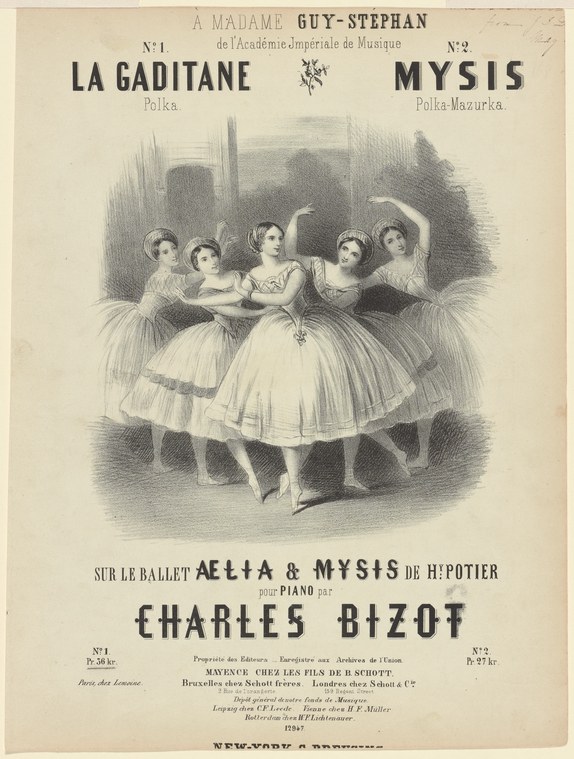
La gaditane polka, Mysis polka mazurka sur le ballet Aelia & Mysis de Hy. Potier, pour piano par Charles Bizot
Unknown artist
- Collection:
- Prints depicting dance
- Source:
- New York Public Library
- Rights:
- Public domain — free to use, share and adapt.
- Recorded as:
- Public Domain
This work documents the intersection of theatrical ballet and social dance in the 19th-century music market, showing how ballet spectacle was translated into domestic entertainment through piano arrangement. It also provides rare visual evidence of how Romantic ballet bodies were understood and rendered for a mass audience, stripped of specific narrative detail but heightened in atmospheric and emotional effect.
What you are looking at
A lithographed title page for sheet music shows six female dancers arranged in a tight semicircle around a central standing figure. The dancers wear classical ballet costumes—diaphanous tulle skirts that fall to mid-calf, fitted bodices, and pointe shoes—typical of the Romantic era. The composition is intimate and theatrical, with the figures rendered in tonal gradations that suggest both the weightlessness of the fabric and the soft lighting of the stage. The dancers' poses vary: some lean inward toward the center, arms raised or extended, while others gesture expressively. The background is deep and atmospheric, with loose hatching that evokes stage depth without defining literal scenery. The title appears in elegant script at top and bottom, framing the dancers as the visual centerpiece. The overall effect is one of coordinated grace and narrative suggestion—these are not frozen individuals but a group caught in a moment of connection or relationship.
The dancing
Six dancers occupy the composition, their bodies arranged in overlapping planes and varied attitudes rather than in rigid symmetry. Several have raised or extended arms in Romantic poses—épaulement and port de bras are evident in the tilt of shoulders and reach of hands. The nearest figures are rendered with anatomical clarity, showing the lifted carriage of the torso and engaged core typical of trained classical dancers. The poses suggest turn, elevation, or sustained balance rather than earthbound movement. The clustering creates a sense of ensemble work, possibly a lift or supported sequence, though the exact choreography is not legible; the artist emphasizes the visual poetry of the group rather than the mechanics.
The dance depicted
This is a title page for sheet music accompanying the ballet *Aelia & Mysis*, with music by Charles Bizot. The genres listed are polka and polka mazurka—suggesting that the ballet itself, or the dances extracted from it for piano performance, combined classical ballet vocabulary with the rhythmic character of these social dances. The title page dates to the mid-19th century, an era when European theaters frequently created entertainments that blended narrative ballet with popular dance forms. The image shows the ballet repertoire as it existed for the theater: a vehicle for corps de ballet spectacle and romantic tableaux. The specific choreography is not recoverable from the image alone, but the classical tutus, pointe work, and Romantic grouping confirm the ballet idiom.
How it was made
This is a lithograph, a print technique that allowed for tonal modeling and atmospheric effects impossible in engraving or woodcut—evident here in the soft gradations of the dancers' forms and the deep background. Lithography was the dominant medium for music publishing in the 19th century, allowing for rapid and economical production of illustrated title pages that could reach a wide audience of piano players and theater-goers. The technique's capacity for subtle shading and flowing line made it ideal for capturing the ephemeral beauty of dance—the tulle, the poses, the stage atmosphere—while still serving a commercial function. This piece circulated as a consumable object: a woman purchasing the sheet music could take home this image of stage elegance.
About this work
This lithographed title page is a commercial document and an artwork of considerable grace. It advertises sheet music for dances derived from or inspired by a mid-19th-century ballet, but it is also a visual record of how ballet and ballroom dance converged in the popular imagination of its time. The image captures the classical ballet corps in a Romantic mode—not in virtuosic isolation but in coordinated ensemble, their bodies unified in pose and emotion. It belongs in a dance history collection as evidence of how choreography was promoted, consumed, and imagined by the non-dancing public. The lithograph preserves not a performance but a promise: the offer to recreate, at the piano, the visual and emotional experience of the stage.
How to look at it
Attend first to the poses and the hands—the artist has rendered classical ballet vocabulary with specificity, not as generic prettiness. Notice how the figures are massed but not identical: the varied arm positions and head carriage suggest an understanding of ballet composition as the art of unified difference. The lithographic tone—soft, atmospheric—is itself part of the meaning: this is not the hard clarity of engraving but the romantic softness of stage light and tulle. The title page was designed to be held in the hand and studied; look at how the typography frames the dancers, treating image and text as a unified whole.
The artist
The artist is not recorded in the catalogue. The work is attributed to a title page for Madame Guy-Stephan of the Académie Impériale de Musique. The lithography was likely produced by a commercial music publisher (the imprint suggests Paris or Brussels), where title-page illustration was a specialized craft. Such pages were often unsigned or attributed only to the publisher; the draftsperson's identity was not considered essential to the commodity.
The period
The mid-19th century saw an explosion in music publishing and the rise of the piano as the primary domestic musical instrument. Ballet, once the province of royal courts and elite theaters, was increasingly consumed through imagery and arrangement. The Romantic era (approximately 1830–1870) had elevated ballet to high theatrical art—pointe work, tutus, and the white sylphs of works like *La Sylphide* (1832) were the cultural ideal. This title page reflects that moment: ballet as spectacle, refined, accessible through the drawing room, and inseparable from the music that animated it.
Where it lives
The work is held in the New York Public Library's prints collection depicting dance. It is a commercial music publication, likely printed in Paris or a European music-publishing center in the mid-19th century. Such objects survive in quantity and are often dispersed among libraries, private collectors, and archives; their survival depends on institutional preservation.
Dance in this work
Questions about this work
Who choreographed the ballet *Aelia & Mysis*?
The record attributes the ballet to Hy. Potier, but no further details are recorded. The work appears to have been a mid-19th-century entertainment, possibly ephemeral, and its choreographic legacy is not documented in this image or its catalogue record.
Did people actually dance the polka in ballet?
Yes. The polka (1830s) and mazurka were hugely popular social dances that appeared regularly in ballet and operatic entertainment. Composers often arranged or created polka-themed music for ballets, and choreographers incorporated the characteristic rhythms and steps into theatrical works. This title page is evidence of that practice.
What is a polka mazurka?
A hybrid social dance form that combined the 2/4 tempo and characteristic hop of the polka with the flowing, rotational character of the mazurka. Such hybrids were common in 19th-century dance and music, reflecting the period's fascination with mixing national dance forms.
How can you tell this is ballet and not ballroom dancing?
The pointe shoes, the tutus, the lifted carriage of the torso, and the Romantic aesthetic (soft, ethereal, massed in ensemble) are all classical ballet conventions. Ballroom dancers of the era wore heeled shoes and street dress, even in entertainment contexts, and were typically pictured in couples. The theatrical costume and grouping here are unmistakably stage ballet.
More dance artwork





