49 works in this view — arrow keys or swipe to move between them.
Dance in Art
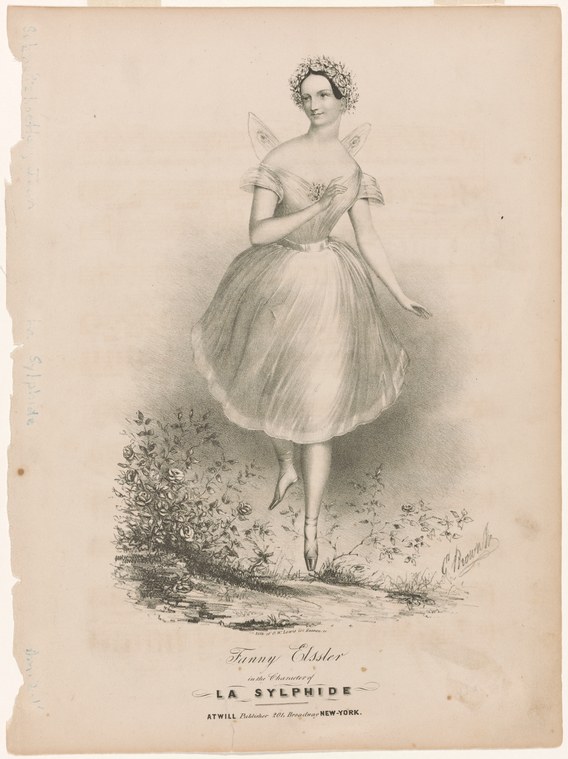
Fanny Elssler in the character of La sylphide
Unknown artist
- Collection:
- Prints depicting dance
- Source:
- New York Public Library
- Rights:
- Public domain — free to use, share and adapt.
- Recorded as:
- Public Domain
This image documents not only a celebrated performer and a landmark work of Romantic ballet, but the visual language through which that era understood and celebrated the female dancer: as weightless, otherworldly, and defined by technical perfection and emotional restraint. For historians of dance and performance, it is direct evidence of how a canonical role was posed and presented to the public.
What you are looking at
A young woman in early-to-mid 19th-century dress stands in a balletic pose against a plain background, her body weight shifted onto one slender leg while the other extends behind her in an attitude. She wears a white tulle skirt that rises to just below the knee—characteristic of the Romantic era—with a fitted bodice and off-shoulder sleeves. A wreath or crown adorns her hair. At the bottom left of the composition sits a rocky outcrop or grotto, suggesting a sylvan or supernatural setting. The figure is drawn in fine pencil or engraving, with soft shading that models the gauzy quality of the skirt and the delicate contours of the dancer's form. The entire composition emphasizes lightness, ethereality, and the illusion of weightlessness—the dancer appears nearly airborne.
The dancing
The dancer stands in a clear balletic attitude derrière: the supporting leg is nearly straight, the free leg bent and raised behind her, the torso upright and elegant. Her arms frame her body with the raised arm extended in a graceful port de bras. The pose conveys the technical vocabulary of early 19th-century ballet—a moment of perfect balance and line, requiring considerable strength and training to achieve. The posture and line make clear that the artist understood classical ballet technique.
The dance depicted
This is Romantic ballet, almost certainly depicting the title character from *La Sylphide*, the 1832 Parisian ballet in which Fanny Elssler achieved fame in the role of the sylph. *La Sylphide* was one of the defining works of the Romantic movement in dance, typified by ethereal female characters, supernatural themes, and the use of pointe work. Elssler's interpretation of the sylph became legendary; the image captures the essential fantasy of the role—a supernatural creature more spirit than woman, literally rising above the earth.
How it was made
This is a lithographic print or fine pencil engraving, dated to approximately the 1830s–1840s based on style. The soft modeling and delicate line work are characteristic of lithography of this period, a technique that allowed for subtle gradations of tone and made theatrical portraiture accessible and widely reproducible. The signature visible at the lower right suggests the work was issued as a commercial theater portrait, probably by a New York publisher (Atwell, whose imprint appears at the base). Such prints circulated widely among theater audiences and documented celebrated performers for admirers who had seen them on stage.
About this work
This is a lithographic theater portrait documenting Fanny Elssler in one of her most celebrated roles, that of the Sylph in *La Sylphide*. Elssler was one of the most famous dancers of the Romantic era, celebrated for her technical brilliance and interpretive power. The image freezes her in a signature moment—the ethereal, weightless pose that defined the Romantic ideal of the female dancer as supernatural and otherworldly. Published in New York, it testifies to the international reach of Romantic ballet and to the cultural appetite for theatrical celebrity imagery in the mid-19th century.
How to look at it
The viewer should attend to the pose itself: it is not naturalistic or everyday, but a moment of supreme technical and aesthetic control—the attitude is a vocabulary word in ballet, and Elssler's body is arranged to demonstrate both strength and the illusion of effortlessness. The wreath, the gauzy skirt, and the sylvan grotto all work together to create a fantasy of the supernatural; the viewer is being invited to see the dancer as a creature not quite earthly. The print's soft focus and delicate line work reinforce this effect of ethereality and dreamlike quality.
The artist
The artist is not recorded in the catalogue. The signature is not clearly legible in the image. The work was published by Atwell of Broadway, New York, suggesting it may have been made by a theater or portrait lithographer working in New York in the 1830s–1840s. Many such prints were produced without the lithographer's name prominently displayed.
The period
Fanny Elssler performed *La Sylphide* throughout the 1830s and toured internationally, including to the United States in 1840–1842, bringing Romantic ballet to American audiences. The Romantic era (1820s–1850s) privileged the female dancer and the ethereal, supernatural subject; male dancers receded, and pointe work became standard. Lithographic portraiture of celebrated dancers was a flourishing commercial art form, creating accessible images of theatrical celebrities for a theater-going public. This print was almost certainly created to commemorate one of Elssler's performances or a specific run of the ballet.
Where it lives
This lithographic print is held in the New York Public Library's collection of prints depicting dance. It was published by Atwell of Broadway, New York, a theatrical print publisher. The work is part of the commercial circulation of theater portraiture in the mid-19th century, made for sale to theater audiences and admirers.
Dance in this work
Questions about this work
Who was Fanny Elssler?
Fanny Elssler (1810–1884) was an Austrian dancer and one of the most celebrated ballerinas of the Romantic era. She was known for her technical brilliance, dramatic presence, and international fame. She performed across Europe and toured the United States in 1840–1842, bringing Romantic ballet to American audiences. *La Sylphide* was one of her most celebrated roles.
What is *La Sylphide*?
*La Sylphide* (1832) is a Romantic ballet first choreographed by Filippo Taglioni for his daughter Marie Taglioni at the Paris Opéra. The ballet tells the story of a man who falls in love with a sylph—a supernatural forest spirit—to tragic effect. It became the defining work of Romantic ballet and established many conventions of the period, including ethereal female characters, pointe work, and supernatural themes.
What does the attitude pose show?
The attitude is a foundational ballet pose in which one leg is lifted and bent behind the body, the supporting leg nearly straight. It requires significant strength, balance, and control. The pose here suggests both technical mastery and the ethereal weightlessness that was the ideal of Romantic ballet—the dancer appearing to float or hover rather than stand.
Why was this print made and sold?
Theatrical prints of celebrated performers were a major commercial art form in the 19th century, analogous to celebrity photographs or postcards today. Theater-goers could purchase these images to commemorate performances they had seen and to keep mementos of their favorite performers. The print circulated widely and helped build and maintain a performer's fame and public image.
More dance artwork





