49 works in this view — arrow keys or swipe to move between them.
Dance in Art
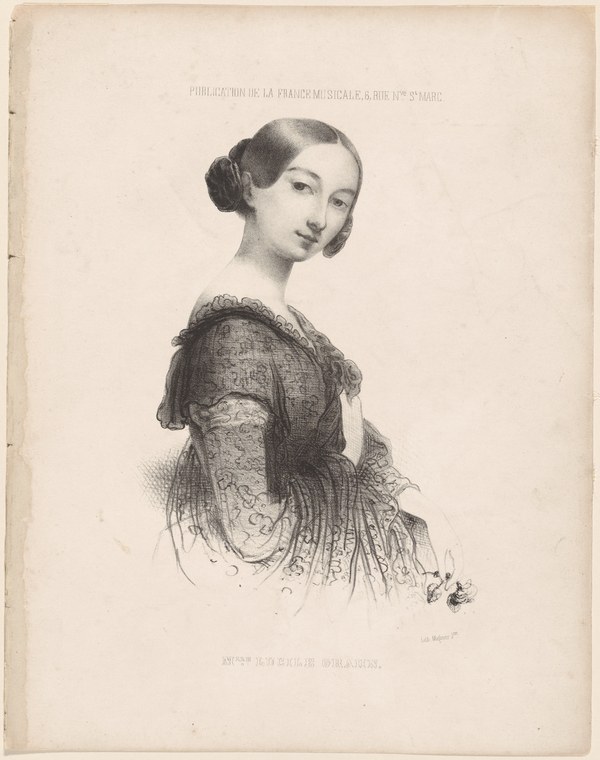
Mlle. Lucile Grahn
Unknown artist
- Collection:
- Prints depicting dance
- Source:
- New York Public Library
- Rights:
- Public domain — free to use, share and adapt.
- Recorded as:
- Public Domain
Grahn was a key figure in the dissemination of Romantic ballet beyond Paris and Copenhagen; she danced across Europe and helped establish the Romantic style as an international standard. This portrait offers material evidence of how a celebrated dancer was visualized and marketed to the public, and how the ideals of Romantic ballet—otherworldly grace, refinement, delicate femininity—were projected into fashion and into the public sphere. For anyone studying the visual culture of Romantic ballet or the celebrity of nineteenth-century dancers, this is a primary document.
What you are looking at
A three-quarter-length portrait of a young woman in fashionable 1840s dress, turned to her right and gazing over her shoulder toward the viewer. She wears a dark off-shoulder dress with a deep lace bertha and short puffed sleeves, the bodice fitted and the skirt beginning to billow at the hip—a silhouette characteristic of Romantic-era fashion. Her dark hair is arranged in a fashionable style, parted and swept back into a knot at the nape with some strands curling at the temples. The background is plain and neutral, throwing the figure into sharp relief. She holds a graceful pose, her weight shifted subtly, her bare shoulders and the tilt of her head conveying elegance and poise. This is a finished engraved portrait, finely detailed and completed with careful cross-hatching to model form and shadow.
The dancing
The woman stands in an easy contrapposto, her weight slightly favoring one leg, creating a gentle S-curve through the torso. Her shoulders are relaxed and dropped, the off-shoulder neckline exposing the slope of her neck and upper back—a hallmark of Romantic fashion and a silhouette often associated with ballroom and theatrical costume. Her arms are positioned naturally at her sides, one hand visible in the lower frame. The pose suggests the studied grace and upright carriage required of dancers of the period rather than a casual stance.
The dance depicted
The sitter is identified in the French inscription as Mlle. Lucile Grahn, a major Romantic ballet dancer of the 1830s–1840s. Grahn was a Danish dancer trained in the Bournonville tradition, celebrated across Europe for her roles in Romantic ballet. The image captures her in the fashionable dress of her era rather than in stage costume, but the elegance of her bearing and the care taken in recording her likeness suggest an artist conscious of her status as a performer. The portrait documents how a celebrated dancer of the Romantic age presented herself to the public.
How it was made
This is a finely executed lithographic engraving, a reproductive medium that allowed the distribution of celebrity portraits among middle-class audiences and theaters across Europe. The technique is evident in the subtle gradations of tone achieved through careful cross-hatching, the precision of the line work defining her features and the textures of lace and fabric, and the formal composition typical of commercial portraiture of the period. Such prints circulated widely and were likely sold as souvenirs and as collectible images of celebrated performers.
About this work
This is a formal portrait engraving of Lucile Grahn, a star of Romantic ballet in the 1830s–1840s. The print documents both her celebrity status—she was famous enough to warrant a commercial portrait distributed to the public—and the aesthetics of Romantic femininity that shaped both fashion and ballet of the era. Her pose, her dress, and the careful attention to her appearance all reflect the ideals of grace, refinement, and elongated elegance that Romantic ballet embodied and celebrated. The work sits at the intersection of theater history, fashion history, and the history of celebrity culture in nineteenth-century Europe.
How to look at it
Note the artist's choice to show Grahn not in stage costume but in fashionable day dress, which allowed for a subtle demonstration of her training and poise. Her upright carriage, the slope of her shoulders, and the elongated line of her neck all signal the posture demanded by ballet training of the period. Observe the careful attention to the textures of lace, the modeling of her face and shoulders through subtle hatching, and the precision of the engraved line—these are signs of a skilled reproductive engraver working to convey the delicacy and refinement that made Grahn a star. The plain background focuses attention entirely on her figure and face, a convention of formal portraiture designed to emphasize the subject's importance.
The artist
The artist is not recorded. The inscription attributes the work to the publisher of the *Galerie de la Presse Musicale*, a French periodical focused on musical and theatrical subjects. Such prints were typically engraved by professional reproductive engravers working from drawings or paintings by commissioned portraitists; the quality of execution here suggests a skilled hand working within an established commercial enterprise devoted to circulating images of musical and theatrical celebrities.
The period
This portrait belongs to the height of Romantic ballet in Europe, roughly 1835–1845, when dancers like Marie Taglioni, Carlotta Grisi, and Lucile Grahn were international celebrities. Romantic ballet emphasized ethereal, otherworldly qualities, elongated lines, and an aesthetic of fragility and refinement—all evident in the fashionable dress depicted here. The off-shoulder neckline and corseted silhouette were both fashionable dress conventions and the basis of stage costume; there was significant overlap between high fashion and theatrical wear. The mass production of celebrity portraits through lithography and engraving was new and booming in the 1830s–1840s, driven by public appetite for images of famous performers. Such prints were sold individually, bound into albums, and distributed through subscription periodicals.
Where it lives
This print is held in the New York Public Library's collection of prints depicting dance. It is part of a broader archival effort to preserve visual documentation of dancers and performance from the nineteenth century onward.
Dance in this work
Questions about this work
Who was Lucile Grahn?
Lucile Grahn (1819–1907) was a Danish Romantic ballet dancer trained in the Bournonville style. She was an international star of the 1830s and 1840s, celebrated for her roles in major Romantic ballets and for her technical skill and grace. She performed across Europe, helped establish Romantic ballet as an international standard, and was one of the most celebrated dancers of her era.
Why is she shown in street dress rather than stage costume?
Celebrity portraits of the period often depicted performers in fashionable contemporary dress rather than theatrical costume. This allowed the image to appeal to a broader audience and to emphasize the performer's grace and elegance in everyday contexts. The careful attention to her posture and the fashionable silhouette still conveyed her status as a trained dancer.
What is the *Galerie de la Presse Musicale*?
This was a French periodical and portfolio devoted to images of celebrated musicians and theatrical performers. It circulated commercial engravings and lithographs of celebrities, much like modern magazines and fan publications do today. Such periodicals were an important medium for distributing images of famous performers to the middle-class public.
How was this print made?
This is a lithographic engraving, a reproductive print technique that allowed multiple copies to be made and distributed. An artist would draw or paint a portrait, which a skilled engraver would then transfer to a lithographic stone or copper plate through careful line work and cross-hatching. The result was a finely detailed image that could be printed and sold to the public.
More dance artwork





