49 works in this view — arrow keys or swipe to move between them.
Dance in Art
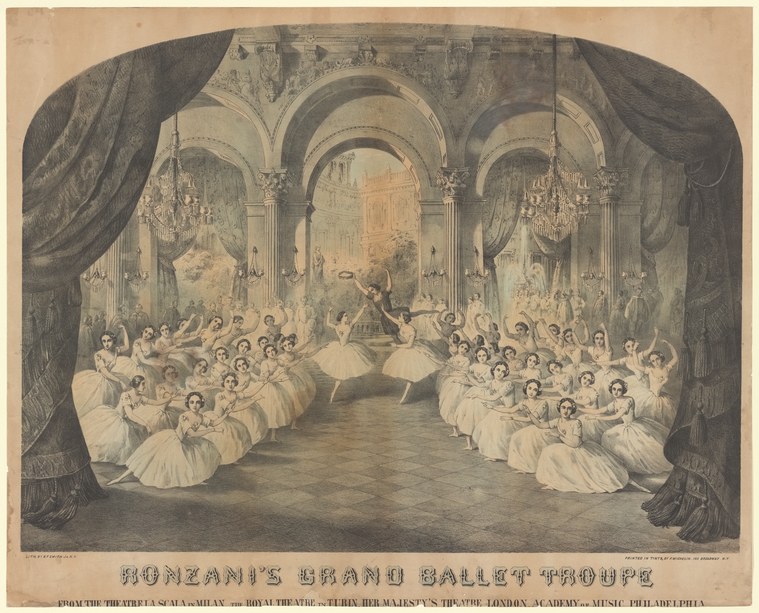
Ronzani's Grand Ballet Troupe: from the theatre La Scala in Milan, the Royal Theatre in Turin, Her Majesty's Theatre London, Academy of Music Philadelphia
Unknown artist
- Collection:
- Prints depicting dance
- Source:
- New York Public Library
- Rights:
- Public domain — free to use, share and adapt.
- Recorded as:
- Public Domain
This is direct pictorial evidence of Romantic ballet performance practice—how the corps de ballet was arranged, how tutus actually fell and spread on stage, and how the visual space of the theater was used to frame and elevate the principals. The specificity of the venues named in the title makes it possible to tie the image to actual historical performances and to trace the circulation of Romantic ballet through the major opera houses of Europe and America.
What you are looking at
A grand neoclassical interior with soaring barrel-vaulted ceilings supported by fluted columns opens onto a deep stage space. Dozens of dancers in pale tutus are arranged in two facing rows flanking a central axis, their bodies angled toward the viewer in a composed, symmetrical formation. At the far end of the space, silhouetted against architectural perspective, a pair of principal dancers occupies the stage center in an elevated pose. Heavy swags of dark drapery frame the proscenium arch; ornate chandeliers hang from the ceiling. The composition suggests a tableau or processional moment rather than active movement—the corps de ballet holds a static, decorative arrangement while the principals command the vanishing point. The print technique has rendered the architectural space with precise linearity while softer toning suggests the pale fabric and dim theatrical lighting.
The dancing
The corps de ballet dancers stand in relaxed, upright positions with arms at their sides or softly posed, their tutus spreading in bell shapes around their hips and thighs. The arrangement is fundamentally frontal and symmetrical: two columns of dancers create a visual corridor leading to the stage. The two principal dancers at center stage appear to be in a supported lift or embrace, their silhouettes dark against the architecture. The bodies throughout are vertical and composed rather than in flight; this is a moment of stillness, presentation, or tableau rather than dynamic movement.
The dance depicted
This is Romantic ballet as performed by a major international touring company in the mid-nineteenth century. The symmetrical massed arrangement, the tutus, the neoclassical setting, and the highlighted central pair all conform to the spectacle conventions of Romantic ballet—likely a finale, a coda, or an ensemble variation. Ronzani's Grand Ballet Troupe was a celebrated touring company that performed works in the French Romantic idiom across Europe and America in the 1860s–1870s. The print appears to document an actual stage configuration and costume, making it valuable evidence of how Romantic ballets were spatially composed and how the corps de ballet was deployed as architectural mass rather than as dramatic ensemble.
How it was made
This is a hand-colored lithograph or tinted engraving, evident from the fine linear work defining the architecture and the subtle tonal gradations in the coloring. The technique allowed precise rendering of architectural perspective—essential to conveying the grandeur of the theaters where Ronzani's company performed (La Scala, the Royal Theatre in Turin, Her Majesty's Theatre London, and the Academy of Music in Philadelphia are named in the title). The hand coloring emphasizes the pale tutus and flesh tones against the darker interior, creating a legible focal hierarchy. This was a popular and economical way to produce theatrical publicity prints and souvenir images for a mass audience of theater-goers.
About this work
A hand-colored lithographic or engraved print documenting a stage tableau from Ronzani's Grand Ballet Troupe, a celebrated international Romantic ballet company active in the 1860s–1870s. The work captures the spectacle conventions of Romantic ballet: symmetrical mass choreography, pale tutus, elevated principals, and a grand neoclassical interior that frames the dancers as decorative elements within architectural space. The image circulated as promotional material and souvenirs across the major opera houses of Europe and North America, advertising both the company's prestige and the technical sophistication of Romantic ballet staging. It is a rare visual document of how a mid-nineteenth-century touring ballet company presented itself and how corps de ballet formations were spatially organized for maximum visual impact.
How to look at it
Observe the mathematical symmetry of the corps formation and how it creates a corridor of space leading to the principals; this was a deliberate staging strategy meant to isolate and elevate the stars. Notice the shape and volume of the tutus—how they spread around the hips and create a unified visual mass—and the vertical composure of the dancers' bodies; Romantic ballet was about ethereal, elongated line, not dynamic action. Look at how the architectural frame (the columns, the arches, the ceiling) is as much a subject as the dancers; the grandeur of the setting was part of what audiences paid for. The choice to show a moment of stillness or tableau rather than an active step tells us that this print was designed to convey prestige, spectacle, and the stature of the company, not narrative or dramatic movement.
The artist
The artist is not recorded, which is typical for commercial theatrical prints of this era. Such prints were produced rapidly by print workshops to capitalize on touring companies' visits; attribution to individual artists was often not a concern. The technical quality and precision suggest a skilled theater lithographer or engraver working in the mid-nineteenth century, likely someone familiar with operatic and balletic subjects.
The period
This print dates to the height of Romantic ballet in the 1860s–1870s, a period when Romantic ballet was being systematized and commercialized as international entertainment. The Romantic movement in ballet (c. 1830–1870) had by this date become a standardized spectacle: ethereal female dancers in tutus, symmetrical corps formations, elevated male principals, and grand architectural settings derived from opera. Ronzani's company was one of several touring troupes that took Romantic ballet outside the major capital cities and opera houses, bringing it to provincial theaters and American cities. The print medium—lithography and hand coloring—was the primary mode of mass theatrical publicity and was being used extensively to advertise touring companies and to create collectable images for theatergoers.
Where it lives
This print is held in the New York Public Library's collection of prints depicting dance. The inscription on the print identifies the venues where the troupe performed, suggesting it was issued as promotional material or a souvenir during the company's tour.
Dance in this work
Questions about this work
Who was Ronzani and what was significant about his company?
Antonio Ronzani was an Italian ballet master and impresario active in the mid-nineteenth century. His Grand Ballet Troupe was one of the major touring companies that brought Romantic ballet from Europe to provincial theaters and North America. The troupe performed the standard Romantic ballet repertory—works in the French idiom—and was celebrated for the quality of its dancers and the grandeur of its productions. The company's international reach (Italy, France, England, United States) made it a significant vehicle for standardizing and popularizing Romantic ballet outside the capital cities.
What does the print tell us about how Romantic ballet actually looked on stage?
The symmetrical corps formation, the pale tutus, the vertical carriage of the bodies, and the emphasis on the architectural grandeur of the stage all confirm what we know from written accounts: Romantic ballet was about ethereal, geometrically ordered spectacle. The image shows us that the corps de ballet was deployed as visual mass—creating frame and hierarchy—rather than as dramatically active ensemble. The theater itself was as much a focus as the dancers, and the overall effect was meant to be one of sublime, otherworldly beauty.
Why would this print have been made and who would have bought it?
Theater prints like this were issued as promotional material advertising a touring company's upcoming performances, and as souvenirs for theatergoers to take home. They were inexpensive and accessible to a middle-class audience, making them a key way that Romantic ballet was circulated and consumed as popular entertainment. The print both celebrated the company and helped create the mythology around Romantic ballet—the image of ethereal, elevated, supremely cultured performance that made ballet a mark of sophistication.
More dance artwork





