49 works in this view — arrow keys or swipe to move between them.
Dance in Art
Rodope
Unknown artist
- Collection:
- Prints depicting dance
- Source:
- New York Public Library
- Rights:
- Public domain — free to use, share and adapt.
- Recorded as:
- Public Domain
This work documents the visual language of classical ballet at a precise historical moment and shows how the human form was stylized and idealized in theatrical representation. For dancers and historians, it reveals the posture, frame, and aesthetic values of mid-19th-century ballet—the emphasis on verticality, arabesque, and formal presentation to the audience.
What you are looking at
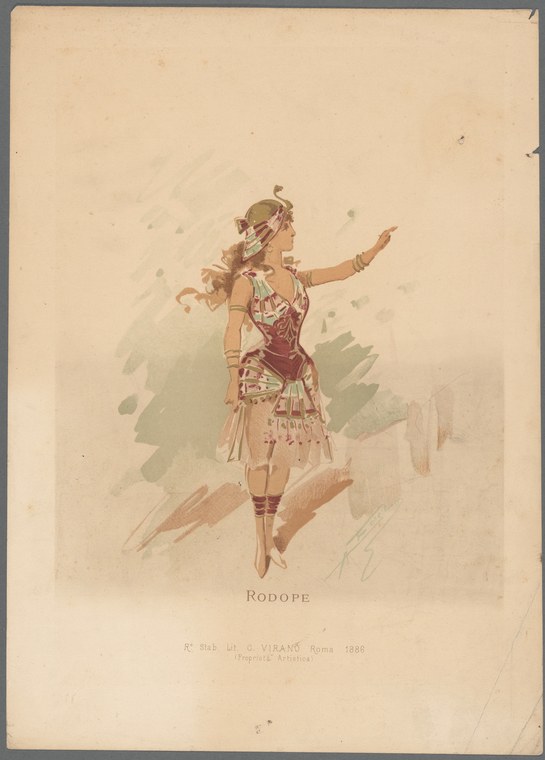
A single female dancer dominates the composition, rendered in watercolor or gouache against a pale cream ground with soft green and brown wash accents suggesting atmospheric depth. She stands in a classical contrapposto pose, her weight on one leg, the other extended behind her in a graceful arabesque line. Her head turns toward the raised arm, which extends diagonally upward and outward in a gesture of elegant address or acknowledgment. She wears a short tunic dress in deep red-brown with gold trim and classical drapery, gold bracelets on both wrists, and her hair is styled in long waves pinned up in a classical manner. The figure has the proportions and idealization of theatrical convention rather than naturalism. The artist has used economical brushwork, leaving much of the paper bare, which gives the figure an almost ethereal quality—suspended rather than grounded.
The dancing
The dancer's frame is fully extended in a classical line, with the torso upright and the free leg drawn high behind the body in an arabesque. The upper body faces front while the head turns toward the raised arm, creating a spiral of energy through the figure. Her arms frame the body symmetrically—one extended overhead, the other at shoulder height—and the hands are delicately articulated. The weight appears concentrated on the supporting leg, with the dancer appearing to float rather than stand. This is a single isolated figure, not part of an ensemble, and the pose suggests a moment of presentation rather than a step being executed.
The dance depicted
This depicts theatrical ballet in the Romantic or early classical style, most likely from the mid-19th century. The arabesque, the classical tunic costume, the idealized proportions, and the pose of formal presentation all point to Romantic ballet vocabulary. The figure's relationship to the viewer—turned toward the audience with an open gesture—suggests this is a representation of a moment from a performed work, possibly a moment of acknowledgment or apotheosis. The title *Rodope* references the Thracian maiden from classical mythology, and this figure almost certainly represents that character. The style of the costume and the dancer's bearing suggest European theatrical ballet of the 1860s–1880s, when classical mythology was a common source for ballet narratives.
How it was made
This is a watercolor or gouache study on paper, executed with restraint and delicacy. The artist has used the white of the paper as a primary compositional element, allowing it to suggest light and space around the figure. The technique is economical—the dress and jewelry are indicated with a few precise strokes, while the hair and facial features are rendered with minimal detail. This approach is typical of theatrical design studies or cast portraits from the period, which needed to capture the essential character and silhouette quickly for purposes of documentation, publication, or costume reference. The soft modeling and atmospheric washes suggest the work was made for reproduction as a theatrical print or to document a dancer in a specific role.
About this work
This is a watercolor study or cast portrait of a classical ballet dancer in the role of Rodope, a figure drawn from classical mythology. The work dates from the era of Romantic ballet, probably the 1860s–1880s, and represents a moment of formal presentation within a theatrical performance. The dancer is captured in the arabesque, one of the fundamental positions of classical ballet, and the costume—a classical tunic with gold ornament—signals both the mythological source and the balletic convention of the period. The work belongs to the tradition of theatrical documentation and portraiture that surrounded professional dance in the 19th century, when printed cast images served both as souvenirs for audiences and as records of celebrated dancers in signature roles.
How to look at it
Attend to the arabesque and the way the figure's extended line creates a sense of suspension and grace. The artist has chosen the moment of presentation—when the dancer faces the audience with an open gesture—rather than a moment of dynamic movement, suggesting that this is a portrait of a role or a record of a specific pose rather than an action. Notice how the sparse handling of the medium and the use of white paper creates an effect of immateriality appropriate to the Romantic period's fascination with ethereal, otherworldly female dancers. The classical costume and jewelry place the figure in a specific narrative tradition, and the positioning and bearing speak to the period's understanding of feminine elegance and formal theatrical presentation.
The period
This work dates from the height of Romantic ballet in Europe, when classical mythology and sylphide narratives dominated the stage. Dancers such as Marie Taglioni, Fanny Elssler, and their successors were celebrated across Europe, and their performances were documented in prints and published cast images. The style of theatrical portraiture seen here—the idealized single figure in costume, captured at a moment of formal presentation—was a common mode of promoting dancers and preserving records of celebrated performances. The watercolor technique and the choice of a mythological subject reflect the aesthetic values of the period, which favored classical references and ethereal, weightless movement as the ideal.
Where it lives
The work is held in the New York Public Library's Prints collection and is catalogued as part of a broader collection of dance-related printed materials. The inscription at the foot of the sheet indicates the collection and date of publication or recording. This type of theatrical print was widely circulated in the 19th century as both a commercial product for audiences and a record for dance historians and practitioners.
Dance in this work
Questions about this work
What is an arabesque and why does it matter?
An arabesque is one of the fundamental positions of classical ballet, in which the dancer stands on one leg with the other leg extended behind the body in a straight line. It appears repeatedly in ballet vocabulary and has remained essentially unchanged since the Romantic period. This work shows how the arabesque was understood and valued in the 19th century—as a position of grace, extension, and formal beauty.
Who was Rodope and why would she be danced?
Rodope was a figure from classical Greek mythology, typically portrayed as a beautiful maiden who was transformed into stone. Classical mythology provided the narrative and thematic material for many ballets of the Romantic and classical periods, appealing to audiences' taste for idealized beauty and tragic transformation.
Is this a costume design or a portrait of a dancer?
This appears to be both—a theatrical portrait that documents a specific dancer in a specific role and costume. Such images served multiple purposes: they were sold as souvenirs to audiences, used to promote dancers, and preserved as records of celebrated performances and roles. The style suggests it was made for publication as a theatrical print.
More dance artwork





