49 works in this view — arrow keys or swipe to move between them.
Dance in Art
Schiava
Unknown artist
- Collection:
- Prints depicting dance
- Source:
- New York Public Library
- Rights:
- Public domain — free to use, share and adapt.
- Recorded as:
- Public Domain
This work documents the visual language of late-19th-century theatrical dance, particularly the exoticizing and orientalizing aesthetics that dominated European ballet and opera of the period. For historians of dance costume, theatrical practice, and the visual representation of non-European characters in European theaters, this image is a concrete record of what audiences saw and how performers were costumed and presented.
What you are looking at
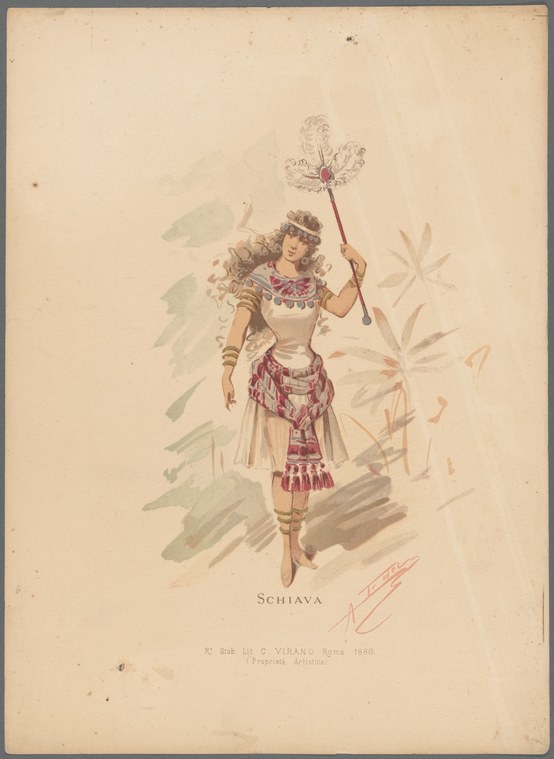
A single female figure stands against a softly rendered naturalistic background of foliage and flowering plants. She wears an elaborate costume suggesting classical or mythological dress: a pale draped skirt with deep wine-red drapery at the hip, decorated with fringe and pleating; a fitted bodice with embroidered or jeweled ornament across the chest; and what appears to be arm wraps or bracers in a darker shade. Her hair is styled up with curls, and she wears a decorative headdress. Most strikingly, she holds aloft a light wand or baton topped with delicate lace or feathered ornament—possibly meant to suggest a magical or supernatural prop. Her pose is elegant and statuesque, weight balanced on one leg, the raised arm extended as though in the midst of a gesture or flourish. The overall effect is theatrical and romantic, the kind of costume and pose one would expect from a European stage dancer of the late 19th century.
The dancing
The single dancer stands in an upright, poised position with her weight shifted to one supporting leg, creating a sense of balletic elongation. Her raised arm—the one holding the ornamental wand—is extended upward and forward in a gesture of presentation or magical summoning. The other arm hangs naturally or is placed on her hip, framing the elaborate skirt. Her frame is erect and formal, the body arranged for maximum visual display. There is no partner, no interplay with another body; the entire composition reads as a portrait of a costumed performer rather than a moment of dance interaction.
The dance depicted
This appears to be a costume study for a character from a European theatrical work, most likely a European opera or ballet of the late 19th century. The title 'Schiava' (Italian for 'slave' or 'enslaved woman') suggests the character may be from an operatic or ballet narrative involving enslavement or servitude, possibly a slave girl in a harem or exotic setting. The costume and pose are consistent with theatrical ballet and opera of the 1880s–1890s, when such orientalizing narratives were popular. The figure herself does not appear to be captured mid-movement; rather, this is a presentation of costume, character, and pose for a performer. Without further documentation, the specific dance style cannot be securely identified, though the elegance and format suggest classical theatrical dance.
How it was made
This is a hand-colored lithograph or chromolithograph, evident from the soft washes of watercolor or gouache overlay on a printed lithographic base. The technique allowed for broad areas of pale background color and fine detail work on the costume; the foliage is rendered loosely and impressionistically in greens and ochres, while the dancer's dress receives precise attention to pattern and ornament. The artist has signed the work in red crayon or pencil at lower right. This medium was common for theatrical costume studies and promotional imagery in the late 19th century, allowing relatively inexpensive production and circulation to theaters, costume shops, and collectors of theatrical ephemera.
About this work
This is a costume study for a theatrical character named Schiava, a work of the late 19th century depicting a female dancer or performer in elaborate stage dress. The inscription and verso information (partially visible) suggest a connection to European opera or ballet production—likely Italian, given the Italian title and the script notation below. The work sits at the intersection of theatrical documentation and fashion illustration, serving both as a record of a specific costume and as promotional or archival material for a stage production. It belongs in a dance archive as evidence of late-Victorian theatrical practice, costume design, and the international circulation of European theatrical imagery.
How to look at it
Notice the deliberate arrangement of the costume for maximum display: the figure is neither moving nor interacting, but posed as if on a pedestal or stage apron. The emphasis on ornament—the embroidered bodice, the fringed drapery, the jeweled headdress, the delicate wand—tells you that this is a study of costume detail and visual splendor rather than a study of movement. The soft naturalistic background (foliage, flowers) was a standard convention for theatrical costume studies, intended to soften and romanticize the figure without distracting from the dress. The statuesque pose and upright carriage are classical theatrical conventions, designed to make the costume read clearly from the auditorium.
The artist
The artist is not recorded in the catalogue, but the style and technique are consistent with late-19th-century theatrical illustrators and lithographers who specialized in costume studies and operatic imagery. Such works were typically produced for theater archives, costume reference collections, and the print market for operatic and balletic ephemera. The hand-coloring and attention to costume detail suggest a professional theatrical illustrator rather than a fine artist.
The period
This work dates to the height of European Romanticism and the age of grands ballets and operas with exotic and orientalizing themes. The 1880s and 1890s saw an explosion of theatrical tourism and international circulation of ballet and opera companies. European theaters drew heavily on orientalist narratives, harem scenes, and depictions of non-European characters, often reflecting colonial attitudes and aesthetic taste. Lithographed costume studies like this one were produced in large numbers to document and promote these productions, and many were collected or filed as reference material by costume makers, scenic designers, and theater administrators.
Where it lives
This work is held in the New York Public Library's collection of prints depicting dance. It is typical of the theatrical ephemera and costume documentation that were collected by major libraries and museums in the 20th century as records of stage practice and design.
Dance in this work
Questions about this work
What is a Schiava in the context of 19th-century theater?
In Italian and European opera and ballet of the 19th century, a schiava (enslaved woman or slave girl) was a standard character type, often depicted in harem or exotic palace settings. Such roles drew on orientalizing narratives popular in European culture and were typically danced or sung by European performers in costume. The character was usually presented as decorative and subordinate, serving to create a sense of exotic otherness for European audiences.
Is this a study for a specific ballet or opera?
Without further documentation, the specific production cannot be identified from the image alone. The inscription below the figure provides a partial reference (partially visible as 'VIRANO Roma 1880' or similar), which may point to an Italian opera house or production, but this would require archival research to confirm. The work may be from any of dozens of European operatic or balletic productions featuring schiava characters during this period.
How was this image used in theatrical practice?
Costume studies like this one served multiple purposes: as reference material for costume makers, as archival records of past productions, as promotional images for theater companies, and as items for collectors of theatrical ephemera. They circulated among theaters, opera houses, and costume shops, and were often bound into costume reference books or filed systematically for easy access by designers and seamstresses preparing new productions.
Why is the background naturalistic rather than theatrical?
The soft floral background was a standard convention for late-19th-century costume studies, intended to provide a pleasing, neutral frame that would not distract from the costume itself. Unlike stage scenery, which would compete for visual attention, a light naturalistic background allowed viewers to focus on the dress, ornament, and pose of the figure, making it a more effective design reference.
More dance artwork





