49 works in this view — arrow keys or swipe to move between them.
Dance in Art
Schiava
Unknown artist
- Collection:
- Prints depicting dance
- Source:
- New York Public Library
- Rights:
- Public domain — free to use, share and adapt.
- Recorded as:
- Public Domain
This work preserves the visual language of a character type that shaped how female dancers were costumed, posed, and understood in Romantic-era performance. For historians and dancers, it demonstrates how character roles were communicated visually and what visual codes—exotic drapery, the held mirror or prop, the frontal presentation—signified otherness and femininity on the early 19th-century stage.
What you are looking at
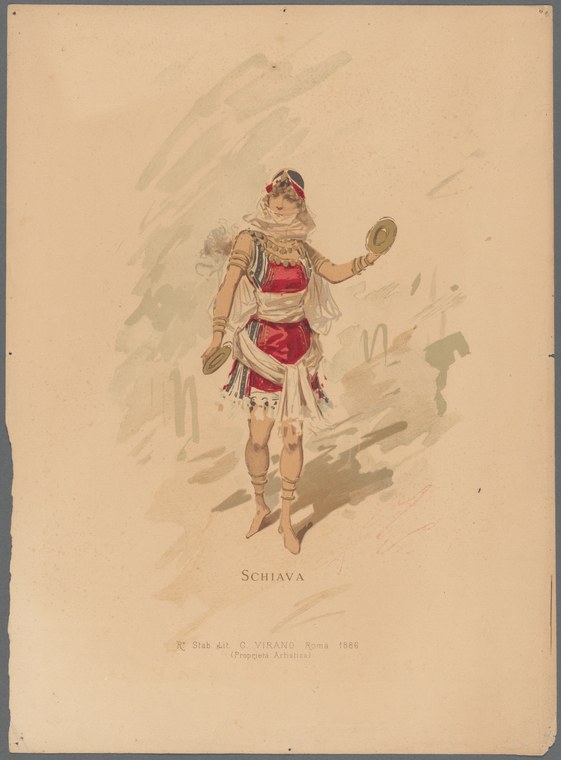
A single female figure occupies the center of a cream-colored sheet, posed in a standing position that suggests theatrical performance. She wears a costume combining classical and exotic elements: a draped white garment across her torso with two prominent red rectangular panels at the hips, leg wraps or bindings in tan and white, and what appears to be a headdress with red ornamental details. In her raised right hand she holds a circular object, possibly a mirror or shield; her left hand rests near her body. The figure is rendered with wash and line, creating volume through shading on the drapery and soft shadow work on the background. The drawing style is economical but assured, capturing the weight and posture of a standing dancer mid-gesture. At the base, the title "Schiava" (Italian for "slave") is inscribed in a careful hand.
The dancing
The dancer stands upright with one arm raised to shoulder height, holding an object that draws the eye—a prop integral to the pose. Her weight appears centered, with legs slightly apart in a stable stance; the visible legs are bare or wrapped, without obvious turnout or pointed-foot extension. The raised arm creates an open frame, and the overall silhouette suggests a moment of display or presentation rather than active movement. Her posture is frontal and composed, facing the viewer directly.
The dance depicted
This is a costume study for a theatrical female character role, likely from early 19th-century ballet or pantomime performance. The title "Schiava" refers to a stock character type—often a slave or captive woman—that appeared in European theatrical spectacles and ballets of the Romantic era. The red hip panels and draped white tunic suggest orientalizing or exotic styling common to Romantic ballet, where such costumes signified otherness or fantasy. The pose is one of presentation and gaze, consistent with how such roles were visualized for an audience.
How it was made
This appears to be a watercolor and pen drawing on paper, executed in the convention of theatrical costume studies or designs produced for performers. The medium—economical in its use of color (concentrated in the costume details, with the figure emerging from a neutral ground) and efficient in line—suggests a working document created for circulation among dancers, choreographers, or theater management. Such drawings were produced rapidly and in quantity during the Romantic period, and their style indicates a professional theatrical atelier rather than fine art practice.
About this work
This is a costume design or character study, not a representation of dance in action. It documents the visual appearance of a female character role from early 19th-century European theater, likely ballet or pantomime. The figure titled "Schiava" (Slave) embodies the Romantic era's fascination with exotic and orientalized female characters—roles that were visually distinct through costume and pose, even when depicted stationary. The drawing's precision and the inscribed title suggest it served as a reference for performers, costumers, or the historical record of theatrical production.
How to look at it
Observe the pose first: the raised arm and frontal stance create a moment of display or revelation, not movement. Notice the costume detail—the bold red panels anchor attention to the body's center, while the draped white tunic and leg wrappings suggest an imagined geography. The held object (likely a mirror) is central to the character's meaning, a prop that defines her role. The drawing's clarity and confident line suggest this was a practical document, intended to be understood quickly by busy theaters and performers.
The period
The drawing belongs to the Romantic era of European ballet and theater (roughly 1820–1850), when interest in exotic locales, fantasy, and supernatural themes drove both choreography and costume design. Female characters—sylphs, odalisques, slaves, and maidens from imagined distant lands—proliferated in ballet and pantomime. Costume studies like this one were a standard tool of theatrical production, created by designers or studio assistants to communicate character appearance to dancers and costumers. The inscribed Italian title suggests either Italian origin or the circulation of Italian opera and ballet practices across European theaters.
Where it lives
The work is held in the Prints collection of the New York Public Library, indicating it is part of a larger collection of theatrical and commercial prints. The inscription "R Stab del / G. VIHANO Roma 1866" at the base suggests it was published or reproduced as a print in Rome in 1866, possibly a later reproduction of an earlier design.
Dance in this work
Questions about this work
Who was the 'Schiava' or slave character in Romantic ballet?
The Schiava was a stock female character role in 19th-century European ballet and theater, often depicted as an exotic, captive, or enslaved woman. These roles were part of the Romantic era's fascination with orientalism and distant, imagined places. Dancers in such roles were costumed distinctively, as this design shows, to signal their character type and social position within the narrative.
Why would theaters commission costume designs like this?
Costume designs served multiple practical purposes: they communicated the character's appearance to the dancer who would wear it, guided the costumers who constructed it, and recorded the production for future reference or reproduction. In busy theaters, a single clear design could be reused across multiple productions and performers, making it an efficient tool of production.
What does the held object tell us about the character?
The circular object—likely a mirror—was a common prop for female character roles in Romantic performance, signifying vanity, allure, or narcissism. It gave the character something to do with her hands and drew attention to her face and body, positioning her as an object of aesthetic display.
More dance artwork





