49 works in this view — arrow keys or swipe to move between them.
Dance in Art
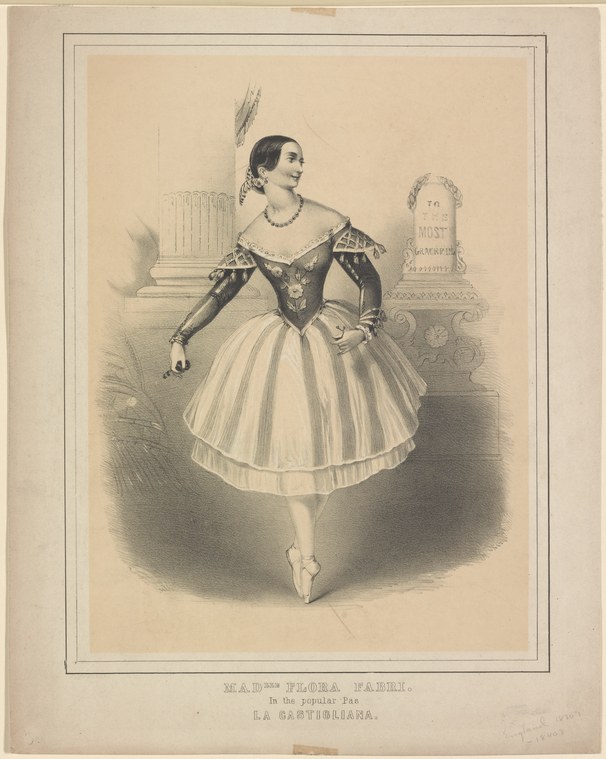
Madlle. Flora Fabri in the popular pas La Castigliana
Unknown artist
- Collection:
- Prints depicting dance
- Source:
- New York Public Library
- Rights:
- Public domain — free to use, share and adapt.
- Recorded as:
- Public Domain
This print is a primary document of Romantic-era ballet as it was actually performed and promoted. It shows us not a narrative scene but the solo showcase—the *pas de danse*—that was a staple of mid-nineteenth-century performance, and it preserves the name and image of a dancer whose work would otherwise be lost to history. The image also demonstrates the standardization and commerce of ballet imagery in this period: this is a product designed to circulate, a mass-produced record of a star dancer.
What you are looking at
A young woman in mid-nineteenth-century theatrical costume stands alone on stage in a pose of balletic repose. She wears a dark corseted bodice with elaborate off-shoulder sleeves and a voluminous white skirt falling to mid-calf, gathered into deep pleats that suggest recent motion. A pearl necklace adorns her neck. The setting is minimal but grand: a classical column rises behind her on the left, and on the right a stone pedestal or monument bears an inscription (partially legible as "LA CASTIGH..."). The background recedes into shadow, emphasizing the figure. The lighting is soft and diffused, typical of the theatrical imagery of the period. Her posture is upright and composed, her weight settled onto her right leg in the supporting position, her gaze directed away from the viewer in a conventional pose of romantic reverie.
The dancing
A single female dancer stands in a classical pose with her weight centered on her right leg. Her left leg is relaxed and slightly bent at the knee, with the foot resting near the floor—characteristic of romantic ballet's emphasis on ethereal lightness and repose rather than active extension. Her arms hang naturally, one by her side and one slightly extended, in a pose suggesting momentary stillness within a sequence. Her upper body is upright and her posture conveys the controlled tension and alignment taught in formal ballet training of the era.
The dance depicted
This is a portrait of the French-Italian dancer Flora Fabri in *La Castigliana*, a pas de danse that would have been part of the Romantic ballet repertory of the 1840s–1850s. *La Castigliana* (literally "the Castilian woman") was a popular vehicle for prima ballerinas, typically a short solo or partnership showcasing technique and the fashionable Spanish or Spanish-flavored vocabulary that appealed to mid-nineteenth-century audiences. The title identifies this as a named solo rather than a scene from a larger ballet. The pose here is characteristic of Romantic ballet's aesthetic: grounded, dignified, and composed rather than displaying virtuosity.
How it was made
This is a lithograph, a technique that allowed for rapid reproduction and wide circulation of theatrical imagery. The tonal rendering—built from carefully layered greys and blacks to model form and suggest atmosphere—is characteristic of lithographic practice. The combination of fine portraiture and theatrical setting suggests this was a commercial print made for sale to audiences and theater-goers, a standard practice for promoting dancers and their most celebrated roles in the mid-nineteenth century. Lithography's capacity for both detail and broad tonal effect made it ideal for this kind of theatrical publicity.
About this work
This lithograph documents a moment in the performance life of Flora Fabri, a dancer active in the mid-nineteenth-century European theater. It captures her in a famous solo role, *La Castigliana*, presented here not as narrative drama but as a formal portrait of the dancer in her finest costume and most elegant pose. The image is both a record of a specific performance vehicle and a statement of balletic ideal: the upright carriage, the romantic silhouette of the white tulle skirt, the composed stillness that suggests both control and the performance of effortless grace.
As a theatrical print, it belongs to a vast archive of such images that served as both advertisement and souvenir. Audiences would have purchased these to commemorate favorite dancers and roles. The care taken with the inscription and the theatrical framing indicates this was an official promotion, not a casual sketch.
How to look at it
Notice the deliberate stillness of the pose: the artist has frozen the dancer at rest, not in the midst of a jump or turn. This is intentional—the photograph is a formal portrait that emphasizes her beauty, carriage, and the visual splendor of her costume rather than capturing action. The white skirt and its pleating are important; the lithographer has taken care to render the weight and volume of the fabric, which would have been the visual signature of the dancer on stage. The pedestal and column behind her elevate her to a classical ideal, a convention that was standard in theatrical portraiture of the era.
The artist
The artist is not recorded. The print was produced by commercial theatrical publishers who worked from choreographers' and dancers' descriptions, costume designs, and sometimes live sketches taken from performances. Such prints were often published in series celebrating the dancers and roles of a given season, and the anonymity of the printmaker was typical—these were collaborative commercial products rather than signed artworks.
The period
The mid-nineteenth century was the height of Romantic ballet in Europe. The *pas de danse*—a short, standalone solo or duet featuring a particular dancer and showcasing their technique and beauty—was one of the most popular forms in the theater. Flora Fabri would have been active during the 1840s–1860s, when such roles were central to a prima ballerina's repertory. Lithographic prints of dancers in their celebrated roles were among the most widely circulated theatrical images of the period, part of the emerging star system in dance. The Spanish or Castilian flavor suggested by *La Castigliana* reflects the exoticism that appealed to Romantic audiences, even when, as here, the performance was presented as a refined solo rather than as theatrical narrative.
Where it lives
This lithograph is held in the New York Public Library's collection of prints depicting dance. It is a commercial theatrical print from the mid-nineteenth century, likely published in France or Italy and distributed to audiences as a souvenir or promotional image.
Dance in this work
Questions about this work
Who was Flora Fabri?
Flora Fabri was a French-Italian dancer active in the mid-nineteenth century. She performed in the major European theaters and was celebrated enough to have theatrical prints commissioned in her honor. Beyond her work in roles such as *La Castigliana*, little detailed biographical information survives, which is typical for dancers of the era. Her name in print records and images like this is part of her legacy.
What is a 'pas de danse'?
A *pas de danse* is a short solo or duet in ballet, typically showcasing a dancer's technique, beauty, and style. Unlike a full-length ballet with plot, a *pas de danse* is a set piece—a few minutes of pure dance, often with music tied to a theme or location. These were hugely popular in the nineteenth century and were often the highlight of an evening's entertainment.
What does 'Castigliana' mean?
*La Castigliana* means "the Castilian woman" or "the woman from Castile," referring to the region of Spain. The title suggests the role drew on Spanish or Spanish-flavored dance vocabulary and aesthetic, reflecting the Romantic fascination with exoticism and regional color. Whether the choreography was actually Spanish in origin or simply inspired by Spanish themes is unclear from the title alone.
Why was this printed?
Lithographic prints of dancers in their celebrated roles were commercial products designed for sale to theater-goers as souvenirs and promotional images. Publishing a portrait of a famous dancer in a famous role advertised the theater, the choreography, and the dancer herself. These prints were among the most widely distributed theatrical images of the era.
More dance artwork





