49 works in this view — arrow keys or swipe to move between them.
Dance in Art
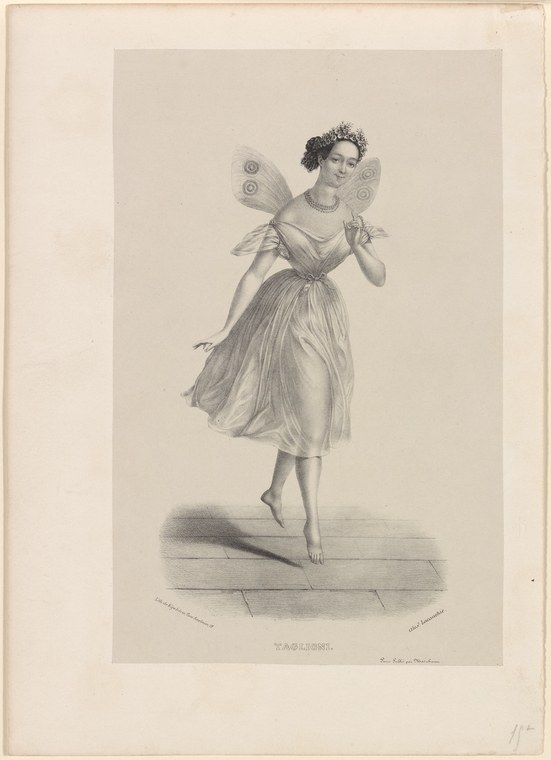
Taglioni
Unknown artist
- Collection:
- Prints depicting dance
- Source:
- New York Public Library
- Rights:
- Public domain — free to use, share and adapt.
- Recorded as:
- Public Domain
This image crystallizes the Romantic era's transformation of ballet into a vehicle for the supernatural. It shows us how the Romantic ballerina was visualized and marketed—not as a virtuoso athlete but as an otherworldly being. For historians of dance, it is documentary evidence of the fantasy aesthetic that shaped the most influential ballet tradition in history.
What you are looking at
A young woman in Romantic-era dress stands alone against a plain background, posed in a moment of ethereal levitation. She wears a pale, diaphanous gown with a fitted bodice and voluminous skirt that falls to mid-calf, leaving her feet bare. Her dark hair is crowned with flowers or a wreath. Most strikingly, she has large, delicate butterfly or moth wings attached to her shoulders—rendered with intricate detail showing circular patterns like eyespots. Her body is tilted slightly backward, her weight apparently on one extended leg, the other lifted, her arms held out to the sides in a gesture that suggests both flight and abandonment. The pose captures a moment of impossible grace: the dancer appears to be suspended, weightless, as if the wings are bearing her aloft. The composition is spare and focused, with no setting beyond the neutral ground plane beneath her feet, directing all attention to the figure and the fantasy she embodies.
The dancing
The figure stands in a pose of supported arabesque or attitude, with her weight on one leg and the other lifted behind. Her arms are extended laterally from the shoulders in a soft, open position suggesting both flight and the classical épaulement of ballet. The torso leans back slightly, creating an arc that suggests upward motion. Her head is tilted and turned, gazing toward the lifted arm. The barefoot stance and the extreme delicacy of the limbs—narrow shoulders, slender arms, elongated legs—are characteristic of the Romantic ballet silhouette of the 1830s–1840s. The wings are the dominant feature: large, symmetrical, and anatomically detailed, dominating the composition and fundamentally changing how we read the body's gesture from one of dancing to one of flying.
The dance depicted
This is almost certainly a depiction of the Romantic ballet as it was performed in the 1830s and 1840s, most likely representing a fairy or supernatural sylph character. The title 'Taglioni' (or a variant spelling) strongly suggests this is Marie Taglioni, the Swedish-Italian dancer who became the iconic Romantic ballerina of her era, especially through her role as the Sylph in *La Sylphide* (1832). The wings, the weightless pose, the ethereal costume, and the bare feet are all hallmarks of the supernatural female roles that defined Romantic ballet. The image captures the fantasy of the Romantic movement in dance: the impossible grace of a non-human female figure, part dancer, part spirit. Whether this is a specific portrayal of Taglioni as the Sylph or a generic image of the Romantic sylph type, it documents a pivotal moment in dance history when the ballerina became an otherworldly creature rather than a human performer.
How it was made
This is a lithograph or engraving, executed in fine black line on cream paper. The technique creates a delicate, precise image well-suited to the subject's ethereal quality. The medium—likely lithography, given the softness of the line and the tonal shading, especially in the wings and drapery—was the dominant print technology of the 1830s–1840s, accessible, reproducible, and affordable. Such prints were circulated widely as souvenirs of famous dancers and performances, collected in albums, and pasted into scrapbooks. The signature or inscription at the lower left is partially legible but worn. The fine hatching and linear precision suggest the work of a professional theatrical lithographer, though the artist remains unrecorded in the present catalogue.
About this work
This is a portrait of the Romantic ballet dancer, almost certainly Marie Taglioni, represented not as a woman dancing but as a supernatural creature—a sylph with wings. It documents the fantasy aesthetic of Romantic ballet: the dancer as ethereal, weightless, barely human. The image is frozen in a moment of levitation, the dancer's body arranged in a classical ballet pose but made impossible and magical by the wings. The lithograph is a souvenir of the age of the Romantic ballerina, when the stage became a realm of spirits and fairies, and the dancer's body was the means of expressing the inexpressible. The work sits at the intersection of dance history and the visual culture of the 1830s–1840s: it is both a record of how a famous dancer was imagined and promoted, and evidence of what the Romantic movement meant to contemporaries—a longing for transcendence, for the body to escape its own weight.
How to look at it
Focus on the impossible balance: the figure is frozen at the apex of a leap or in the moment before descent, yet the wings suggest she will not fall. Notice how the artist has chosen a pose that is grammatically a ballet position—the open arms, the lifted leg, the elongated line—but rendered it weightless through the wings and the backward tilt of the torso. The bare feet are crucial: they signal modernity, theatrical artifice, and the Romantic rejection of court formality. Look at how the wings are rendered with anatomical care, almost scientific detail, which paradoxically makes the fantasy more credible. The spare setting emphasizes that this is not a scene but a portrait of a dancer-creature in pure form.
The period
This print dates from the 1830s or 1840s, the height of the Romantic movement in Europe. Marie Taglioni's *La Sylphide* (1832) revolutionized ballet by centering the narrative on a supernatural female character and establishing the sylph as the archetypal Romantic ballet role. The role demanded new techniques—pointe work, weightlessness, a pale costume, wings—that became codified as the language of Romantic femininity. Prints of famous dancers in their iconic roles circulated widely during this period, sold at the theater, in print shops, and collected obsessively by fans. The style of dress and the artistic convention of the barefoot, winged figure reflect the Romantic era's aesthetic across all the arts: an embrace of the Gothic, the supernatural, the emotional, and the transcendent, set against the industrial and rational world of the nineteenth century.
Where it lives
The work is held in the New York Public Library's collection of prints depicting dance, a foundational collection for the visual documentation of performance history. It is a lithograph or engraving, typical of the theatrical souvenirs produced and distributed during the Romantic era.
Dance in this work
Questions about this work
Is this definitely Marie Taglioni?
The title 'Taglioni' on the print strongly suggests it, and the image—particularly the wings and ethereal costume—matches contemporary descriptions and other portraits of Taglioni as the Sylph. However, without a signature or more complete inscription, absolute attribution is not certain. It may also be a generic image of the Romantic sylph type, inspired by Taglioni's famous role.
Did dancers actually wear wings like this?
Yes. Wings were part of the costume for supernatural female roles in Romantic ballet. They ranged from delicate to substantial and were designed to enhance the illusion of weightlessness and flight. They were typically made of gauze, silk, or paper stretched over a wire frame and attached to the dancer's shoulders.
Why are the feet bare?
Bare feet were a marker of the Romantic theatrical convention: they signaled that the character was not a mortal human but a spirit or fairy. Bare feet also displayed the dancer's technique and the lines of the leg, central to the aesthetic of Romantic ballet. Pointe work—dancing on the tips of the toes—became the defining technical feature of the Romantic ballerina.
What makes this Romantic ballet and not something else?
The combination of supernatural elements (wings, the ethereal figure), the classical ballet pose, the pale diaphanous costume, and the barefoot stance are all hallmarks of Romantic ballet. The image documents the aesthetic that emerged in the 1830s, when ballet became a vehicle for depicting the fantastic and the otherworldly.
More dance artwork





