49 works in this view — arrow keys or swipe to move between them.
Dance in Art
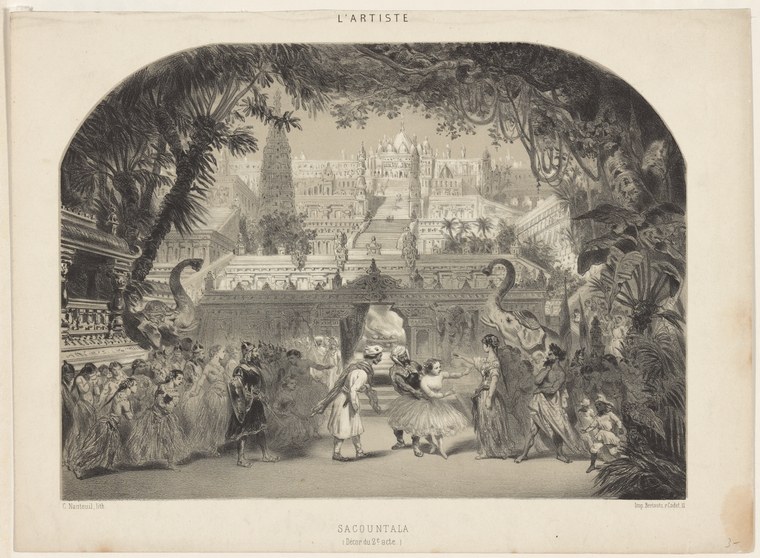
Sacountala, décor du 2e acte
Unknown artist
- Collection:
- Prints depicting dance
- Source:
- New York Public Library
- Rights:
- Public domain — free to use, share and adapt.
- Recorded as:
- Public Domain
This work documents the phenomenon of orientalist ballet in the 19th century, a defining mode in which European companies staged exotic narratives using classical ballet vocabulary. For historians of colonial visual culture and dance, it shows how South Asian literature was reinterpreted through a European theatrical and balletic lens, and how scenic design could dominate the visual composition of a dance moment. The engraving's circulation means it likely influenced public perception of both ballet and 'the Orient' as much as the live production itself.
What you are looking at
This is a theatrical set design for the second act of a dramatic production, rendered as an engraving in the romantic-era style. The composition is framed by an arch of lush foliage—overhanging palms and flowering vines on both sides—that creates a proscenium effect and draws the eye to the scene within. Beyond the arch lies an elaborate palatial setting with fortified walls, towers, and a cascading cityscape or palace complex rising toward the horizon, rendered in atmospheric perspective. In the immediate foreground, beneath the arch, a small group of figures in light classical or orientalist dress occupy a stage. The central figures appear to be young women or dancers, their costumes suggesting a production informed by classical or South Asian themes. To the left, seated figures watch the action; to the right, standing figures gesture and observe. The lighting is even and clear, typical of 19th-century engraving, with the foliage creating deep shadow pockets that frame the brightly lit stage action. The overall mood is one of theatrical spectacle and romantic exoticism.
The dancing
The central dancers are upright and posed rather than captured mid-leap, suggesting a moment of narrative stillness rather than vigorous movement. At least two or three light-skinned figures in the centre appear to be in classical costume—possibly wrapped garments—with one figure apparently turning or pivoting. The postures are graceful but controlled, with arms positioned to suggest both classical ballet vocabulary and orientalist theatre gesture. The figures are relatively small in the composition, subordinate to the architectural and vegetative framing, which suggests this is a dance scene within a larger theatrical tableau rather than a dance-focused work.
The dance depicted
This engraving documents a 19th-century theatrical production, most likely a Romantic ballet or orientalist drama set in an exotic location. The title *Sacountala* (more commonly romanized as *Shakuntala*) refers to a classical Sanskrit drama, which was a fashionable subject for European theatre and ballet in the 19th century. The architectural setting and botanical framing point toward a European staging of an Indian or South Asian narrative, a mode typical of Orientalism in dance and theatrical design. The dancers' upright, posed stance and light costume suggest classical ballet training, but the setting and narrative subject position this as a theatrical drama with dance elements rather than a pure ballet work. Without the ability to identify the specific production (Paris Opéra, London, or elsewhere), the date remains uncertain, though the style of the engraving and the Romantic theatricality suggest the 1840s–1860s.
How it was made
This is an engraving, a relief printing process that allowed for mass production and wide circulation in the 19th century. The fine detail visible in the architectural elements and foliage, along with the delicate cross-hatching used to create shadow and depth, are characteristic of skilled engraving. Such prints were commonly distributed as part of theatrical ephemera, touring publicity, or collectors' portfolios of stage designs and scenic effects. The circulation of engraved theatre designs served to publicize productions, record memorable scenic moments, and reach audiences beyond the theatre itself. The technique required a skilled reproductive engraver, not necessarily the original set or scenic designer, which explains why no artist is recorded for this work.
About this work
This engraving documents a scene from a 19th-century European theatrical production of *Shakuntala*, a classical Indian drama that captivated Romantic-era audiences and choreographers. The work is primarily important as a record of orientalist theatre design and the intersection of exotic narrative with classical ballet form. The arch of framing foliage and the miniaturized dancers within an elaborate architectural setting exemplify the period's theatrical practice of overwhelming visual spectacle. For dance history, it provides evidence of how non-Western narratives were adapted for European stages, the role of scenery in creating an orientalist fantasy, and the visual convention of posing rather than capturing dynamic movement. The engraving's wide distribution would have shaped public imagination about both classical dance and the Orient.
How to look at it
Observe the relationship between the framing arch of vegetation and the miniaturized action within: the theatrical design aims to overwhelm the viewer with scenic grandeur rather than highlight choreography. The posture of the central figures—upright, composed, posed—indicates a narrative or theatrical moment rather than a moment of kinetic dance. Note the artist's attention to architectural detail and atmospheric perspective in the distant palace, which would have been realized as painted scene drops in the actual theatre. The engraving technique creates an almost dreamlike quality through its fine lines and controlled light, characteristic of how 19th-century prints represented stage illusion.
The period
The 19th century saw a sustained European fascination with Indian and South Asian culture, refracted through a colonialist and Orientalist lens. *Shakuntala*, drawn from the classical Sanskrit play *Abhijñānaśākuntalam*, had been translated into European languages and adapted for theatre and ballet throughout the century. European ballet companies, particularly the Paris Opéra and London theatres, frequently mounted productions with exotic themes as a means of displaying scenic innovation and attracting audiences with spectacle. Romantic ballet (1820s–1860s) privileged ethereal, otherworldly settings—forests, palaces, dream kingdoms—and the orientalist setting aligned perfectly with this aesthetic. The engraving format allowed theatrical designs to circulate as high-quality prints, turning sets and scenes into collectible objects and promotional tools.
Where it lives
This engraving is held in the New York Public Library's collection of prints depicting dance, a collection that documents theatrical and dance imagery from its inception through the present. Such collections often contain ephemera, set designs, and production records that document performances that would otherwise leave no trace.
Dance in this work
Questions about this work
What is Sacountala?
*Shakuntala* (romanized variously) is a classical Sanskrit drama by Kālidāsa, written around the 4th or 5th century. It tells the story of a king and a hermitage-raised girl. The play was widely translated into European languages in the 18th and 19th centuries and adapted into operas, ballets, and dramatic productions. European companies were drawn to the exotic setting and romantic narrative as vehicles for spectacular staging.
Who danced in this production?
The engraving does not identify the dancers or the producing company. Without additional archival research or a signature on the print, it is not possible to determine which theatre mounted this production or who performed the principal roles. The style and technique of the engraving suggest a major European theatre, possibly in Paris or London.
Is this ballet or drama?
This production appears to be a theatrical drama with dancing, rather than a pure ballet. The narrative prominence of *Shakuntala* and the posed, non-kinetic postures of the figures suggest that dance was one element of a larger dramatic spectacle. The setting and genre align with 19th-century orientalist theatre, where exotic narratives were staged with classical ballet dancers but orchestrated as theatre rather than ballet.
How was this engraving made and used?
An engraver carved fine lines into a metal plate, inking it to create the image. Engravings could be printed many times, making them affordable and distributable. Theatre companies would commission engravings of successful productions to publicize performances, sell to audiences, and circulate to other theatres. This engraving served both as a souvenir and as a form of theatrical marketing.
More dance artwork





