49 works in this view — arrow keys or swipe to move between them.
Dance in Art
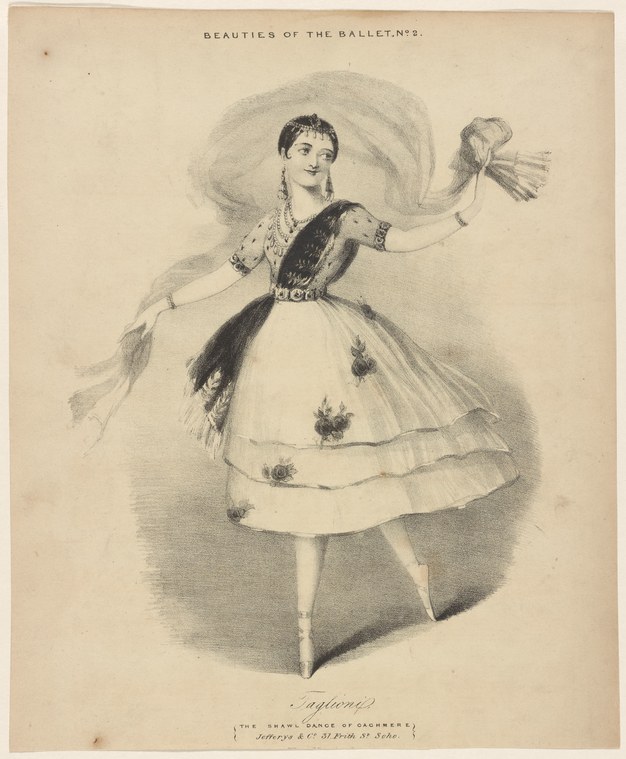
Taglioni, (The shawl dance of Cachmere)
Unknown artist
- Collection:
- Prints depicting dance
- Source:
- New York Public Library
- Rights:
- Public domain — free to use, share and adapt.
- Recorded as:
- Public Domain
Taglioni and the Cachmere were definitive for Romantic ballet—the moment when ballet became a major art form in Europe and the dancer (particularly the female dancer) became a focus of fascination and idealization. This image is a primary document of that transformation, showing us not only how the dance looked but how it was marketed and consumed by the public. Understanding Taglioni's role and this particular solo is essential for any history of ballet or theatrical dance in the nineteenth century.
What you are looking at
A solo female dancer in Romantic-era theatrical dress dominates the composition, positioned in a three-quarter turn against a soft, atmospheric background created by subtle tonal gradation. She wears a bell-shaped skirt decorated with dark ornaments or appliqués arranged around the hem, a fitted bodice with a dark diagonal sash or ribbon, and short puffed sleeves; her dark hair is styled close to the head in the fashion of the 1830s-40s. Most strikingly, she holds aloft a gossamer shawl or scarf in her raised right hand, the fabric rendered as a delicate, floating veil that extends behind and above her head, creating a sense of movement and ethereal lightness. Her left arm is extended gracefully to the side. She stands en demi-pointe or en pointe, her weight poised on her right leg in a moment of arrested motion. The entire figure is bathed in a diffused light that emphasizes the fabric textures and the dancer's carefully composed pose.
The dancing
The dancer's frame is upright and elongated, with shoulders held back and the spine extending through a lifted torso—a hallmark of Romantic ballet technique. Her right arm reaches upward and back, wrist relaxed and fingers extended, holding the shawl with an air of proprietorship; her left arm extends to the side in a gentle curve, neither rigidly straight nor fully curved. The legs are concealed by the full skirt, but the forward inclination of the torso and the apparent height of her stance suggest a rise onto the balls of the feet or full pointe. The overall impression is of weightlessness and fluid elegance, with no sense of strain or exertion—the aesthetic ideal of Romantic ballet.
The dance depicted
This is a representation of the famous "Shawl Dance" or "Cachmere Shawl Dance," a showpiece of Romantic ballet associated with the legendary dancer Maria Taglioni in the 1830s-40s. The Cachmere was a solo characterized by the dramatic and virtuosic use of a large, luxurious shawl as both costume element and prop, integral to the choreography. The dance showcased the dancer's ability to move with apparent effortlessness while manipulating the fabric, creating visual compositions that emphasized grace, elevation, and the illusion of weightlessness—core values of Romantic ballet. The title and inscription confirm this is a portrayal of Taglioni herself, the dancer most closely identified with this role and the Romantic ballet aesthetic more broadly.
How it was made
This is an engraving or lithograph (the record does not specify, but the medium can be inferred from the tonal modeling and line work visible in the image). The technique employs soft tonal passages created through fine hatching or crayon work to model the figure and create the atmospheric background; the gossamer shawl is rendered through delicate, feathery marks that suggest transparency and movement without hard outlines. This reproductive print technique allowed for wide distribution of theatrical imagery and was the standard means of circulating portraits of celebrated performers to the theatregoing public and collectors in the 1830s-40s. The softness of the medium suits the subject matter, as it mirrors the ethereal quality the Romantic ballet aesthetic sought to convey.
About this work
This engraving or lithograph records Maria Taglioni in her iconic role as the dancer in the "Shawl Dance of Cachmere," one of the defining spectacles of Romantic ballet. Taglioni (1804–1884) was the pre-eminent ballerina of her era, and the Cachmere was among her most celebrated vehicles—a solo that showcased not only her technical facility but the Romantic ideal of the dancer as an ethereal, almost supernatural being. The print testifies to Taglioni's enormous fame and the cultural prestige of ballet in the 1830s-40s, when theatrical prints were a major medium for celebrity portraiture and the circulation of artistic imagery. Works such as this one shaped public understanding of what ballet was and what it could express.
How to look at it
Attend to the moment captured: this is not a snapshot of a single step, but rather a composed, almost statuesque pose that shows the dancer in an attitude of maximum grace and elegance—the body held in a position that would be difficult to maintain in motion, suggesting that this is a moment of repose within the dance, or an idealized synthesis of the dancer's characteristic appearance. The shawl is positioned at the moment of greatest visual drama—held aloft and billowing, framing the figure and creating a sense of movement around the static pose. The soft, atmospheric background and the absence of a stage setting emphasize the dancer herself as the sole subject, a convention of theatrical portraiture that asks the viewer to focus on the body and the costume, not on narrative or setting. This is how Romantic ballet wanted to be seen and remembered—as an art of weightless, effortless grace.
The artist
The artist is not recorded. The print was published by Sarony & Co. (based on the inscription visible at the foot), a major London printmaker specializing in theatrical portraiture in the 1830s-40s. Sarony published numerous images of celebrated performers, including multiple portraits of Taglioni; these prints were sold to theaters, collectors, and the general public as affordable color lithographs or engravings, serving both as souvenirs and as documentation of stage fashion and celebrity.
The period
This print dates to the height of the Romantic ballet era (1830s-40s), when ballet had become the dominant theatrical art form in Europe, particularly in London and Paris. The Romantic movement in the visual arts and literature found perfect expression in ballet's aesthetics of weightlessness, otherworldliness, and emotional expressivity. Female dancers became the focus of unprecedented public attention and idealization. The technology of color lithography and engraving allowed theatrical management and publishers to profit from the fame of celebrated dancers like Taglioni by mass-producing their portraits. These prints were displayed in shop windows, sent to provincial theaters, and collected by enthusiasts, making them a central medium for the dissemination of dance culture.
Where it lives
The print is held in the New York Public Library's collection of prints depicting dance. The inscription at the foot reads "Taglioni" and credits "Sarony & Co., St. Piccadilly, London," indicating it is a London publication by a professional theatrical print publisher of the 1830s-40s.
Dance in this work
Questions about this work
Who was Maria Taglioni?
Maria Taglioni (1804–1884) was an Italian-born ballerina who became the pre-eminent dancer of the Romantic ballet era. She performed in London, Paris, and other major European cities, and was celebrated for her technical skill, ethereal presence, and the range of her roles. She retired from the stage in 1847 and lived until 1884, continuing to teach. Her father, Filippo Taglioni, was a major choreographer who created many of her most famous roles.
What was the Shawl Dance of Cachmere?
The Cachmere was a solo choreographed for Taglioni, showcasing her ability to combine virtuosic footwork and elevation with the graceful, expressive use of a large, flowing shawl. The shawl was integral to the choreography, manipulated by the dancer to create visual effects that emphasized movement, weightlessness, and elegance. It was one of her signature roles and epitomized the Romantic ballet ideal of the dancer as a weightless, almost supernatural being.
Why are there so many prints of Taglioni?
Taglioni was a celebrity of enormous international fame, and theatrical prints were the primary medium for circulating images of celebrated performers to the public. Publishers like Sarony & Co. produced and sold these prints in large quantities—they were displayed in theater lobbies, sent to provincial theaters, and collected by enthusiasts. For dancers and their managers, prints were valuable for publicity and profit; for the public, they were affordable memorabilia and a way of staying connected to beloved performers.
How do you know this depicts ballet rather than another form of dance?
The title inscription explicitly identifies this as Taglioni in the Cachmere; the body position, the pointe work, the tutu-like skirt, the ethereal pose, and the overall aesthetic are all characteristic of Romantic ballet. Taglioni was a ballet dancer, and the Cachmere was a ballet solo. The style of dress, the print medium, and the date are all consistent with theatrical ballet documentation of the 1830s-40s.
More dance artwork





