49 works in this view — arrow keys or swipe to move between them.
Dance in Art
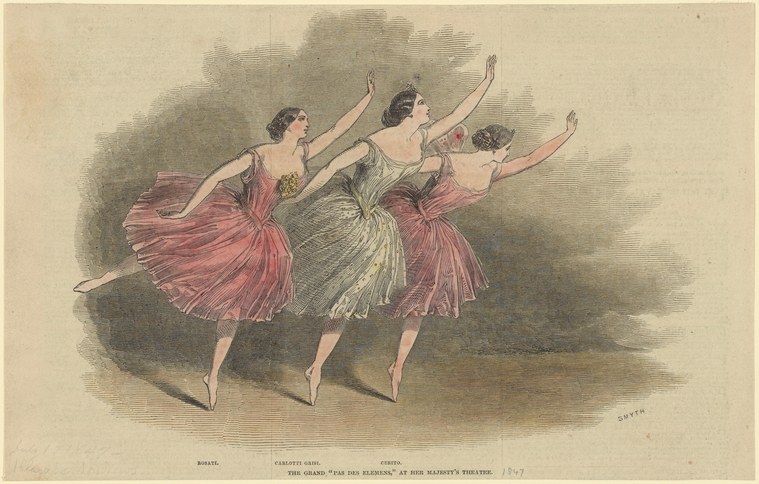
The grand Pas des élémens, at Her Majesty's Theatre
Unknown artist
- Collection:
- Prints depicting dance
- Source:
- New York Public Library
- Rights:
- Public domain — free to use, share and adapt.
- Recorded as:
- Public Domain
This print is evidence of how Romantic ballet was actually staged and danced in London, not how it was later mythologized. It shows the typical corps de ballet aesthetic—decorative, synchronized, ethereal—and the precise costume silhouettes audiences expected. For dancers and historians, it documents the physical reality of mid-19th-century performance: body line, port de bras, and ensemble practice that no written account could convey.
What you are looking at
Three female dancers in a classical theatrical tableau, arranged diagonally across the composition in a unified pose of balletic grace. Each wears a voluminous knee-length skirt—two in coral or salmon pink, one in pale sage green—with corseted bodices and bare shoulders in the Romantic ballet idiom. Their arms are raised in a gentle arc, bodies en arabesque or attitude, creating a harmonious line of movement frozen mid-phrase. The setting is indistinct, rendered in soft gray wash that emphasizes the figures; a darker atmospheric background suggests an interior stage or draped theatrical space. The three dancers occupy different depths, creating a diagonal recession that guides the eye through the composition. The engraving technique—fine cross-hatching and stipple—renders the translucent fabric of the skirts with particular delicacy, showing the voluminous folds in motion.
The dancing
All three dancers occupy the same extended pose, suggesting a synchronized ensemble movement rather than individual variations. Each body is held in classical ballet alignment: straight spine, lifted carriage, the supporting leg extended in arabesque or attitude while the working leg reaches with pointed foot. The arms are raised softly to shoulder height or slightly above, with gently curved elbows and relaxed wrists—a characteristic Romantic ballet port de bras. The heads are turned slightly, following the line of the body. The grouping, though three dancers deep in space, creates a unified visual statement of grace and ethereal lightness rather than technical display.
The dance depicted
This is almost certainly a scene from a mid-19th-century Romantic ballet, most likely *Les Éléments* or similar spectacle with mythological or elemental themes (the title suggests 'the grand Pas of the Elements'). The choreographic moment appears to be a corps de ballet ensemble passage or a three-dancer formation from the corps—a standard feature of Romantic ballet structure. The pose itself—soft arabesque with raised arms—is characteristic of the Romantic vocabulary, emphasizing effortlessness and ethereal presence rather than technical virtuosity. The unified gesture across three bodies suggests the kind of symmetric, decorative ensemble work typical of mid-Victorian ballet stagecraft.
How it was made
This is a hand-colored engraving, likely produced using steel or copper plate engraving with subsequent hand application of watercolor or gouache tints. The technique is evident from the fine parallel hatching lines visible in the drapery and background, and the precision of the line work defining the dancers' forms. The subtitle visible at the base of the print identifies it as depicting a specific performance at Her Majesty's Theatre, suggesting this was a commercial theatrical print—a souvenir or promotional image for the ballet. Such prints circulated widely in mid-19th-century London among theatre-goers and dance enthusiasts, making them important documents of how these ballets were actually performed and costumed.
About this work
This is a theatrical souvenir print documenting a moment from a ballet performed at Her Majesty's Theatre (likely the 1840s–1850s, based on costume and aesthetic). It records a specific choreographic arrangement—three dancers in synchronized Romantic pose—from a spectacle ballet, probably with an elemental or mythological theme. The print is a valuable historical document because it captures actual stage practice: the costume silhouettes, the compositional choices made by the choreographer, and the visual spectacle audiences paid to see. The engraving technique allowed for mass production and wide circulation, making this the kind of image that shaped public understanding of ballet during the Romantic era.
How to look at it
Notice the precision of the raised-arm port de bras: the angle is soft and rounded, not angular or sharp—this is the aesthetic difference between Romantic and Classical ballet. Watch how all three bodies occupy the same pose; the artist has chosen a moment of perfect ensemble symmetry rather than a dynamic transition, which tells us this was the moment of greatest visual impact in the choreography. The treatment of the skirts—the fine parallel lines suggesting translucent, fluid fabric caught in motion—was a particular achievement of the engraving technique and a selling point of theatrical prints. The soft, diffuse background keeps focus entirely on the dancers' bodies and their costume.
The period
This engraving was produced during the height of the Romantic ballet era in London, when continental European ballets were being imported and adapted for English audiences. Spectacle ballets with mythological or elemental themes were enormously popular, offering a synthesis of choreography, costume design, and stagecraft. The 1840s–1850s saw intense competition between London's theatres to produce ever more elaborate ballets, with printed souvenirs and publicity images playing an important role in marketing. The hand-colored engraving technique, while labor-intensive, was still the standard for theatrical prints before the advent of lithography and photography, making these prints the primary visual record of how these ballets actually appeared on stage.
Where it lives
This print is held in the New York Public Library's Prints collection documenting dance in art. It is catalogued as a theatrical souvenir print from a specific London production, identifying it as part of the archive of commercial theatrical imagery that circulated as program illustrations and promotional prints.
Dance in this work
Questions about this work
Which ballet is this from?
The title indicates it depicts 'the grand Pas des éléments' (Pas of the Elements) from a production at Her Majesty's Theatre, London. The exact ballet and date are not recorded in the catalogue, but the costume and style strongly suggest the 1840s–1850s Romantic ballet era. Several ballets with elemental themes were performed in London during this period.
Why are all three dancers in the same pose?
This was standard ensemble choreography in Romantic ballet. Corps de ballet dancers typically moved in perfect synchronization, creating a visual picture rather than demonstrating individual technique. The artist chose to freeze a moment of maximum visual unity and symmetry, which would have been the most impressive moment of the passage.
How do we know this is an engraving and not a painting?
The fine parallel hatching lines visible throughout—especially in the fabric and background—are characteristic of hand-colored engraving technique. The precision of line, the uniform pressure, and the way color sits on top of the engraved lines all confirm this was produced by engraving rather than painted directly.
What does this tell us about how Romantic ballet actually looked?
It shows that the ethereal, effortless aesthetic we associate with Romantic ballet was very deliberate: soft arm positions, elongated lines, and unified ensemble movement. It also documents actual costumes—the specific silhouettes, the skirt length and fullness, the bare shoulders—which differ from later revivals and reconstructions.
More dance artwork





