49 works in this view — arrow keys or swipe to move between them.
Dance in Art
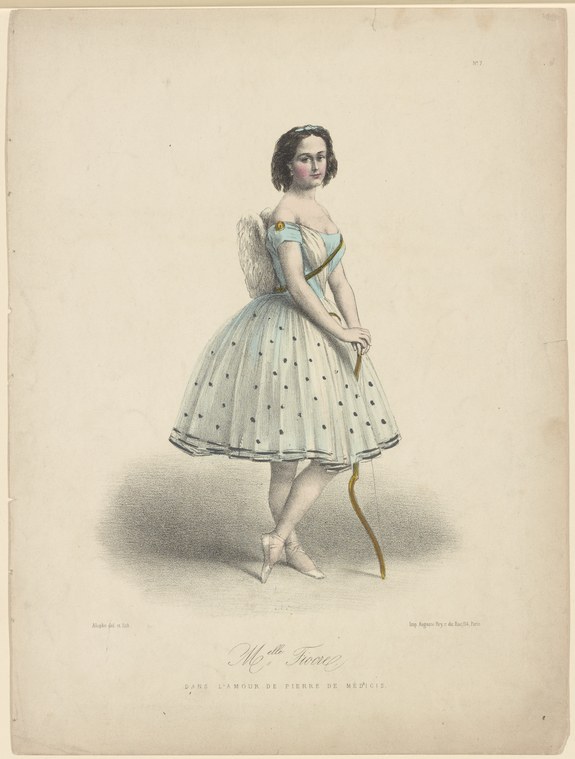
Melle. Fiocre dans L'amour de Pierre de Médicis
Unknown artist
- Collection:
- Prints depicting dance
- Source:
- New York Public Library
- Rights:
- Public domain — free to use, share and adapt.
- Recorded as:
- Public Domain
This work shows how ballet was visualized and sold to the public at the height of Romanticism, capturing the silhouette, posture, and costume conventions that defined the era. The engraving format reveals that dance was not only an elite courtly or theatrical experience but a subject of mass-market visual culture, with dancers treated as celebrities whose likenesses were commodified and circulated widely.
What you are looking at
A young woman in theatrical costume stands alone against a neutral background, posed in a classical ballet attitude. She wears a pale blue corset bodice with off-shoulder construction and delicate lace sleeves, paired with a full skirt of white tulle trimmed with dark ribbon and scattered with small decorative elements—possibly sequins or embroidered motifs. Her dark hair is styled in the 1840s fashion, parted and swept back. She stands en attitude derrière on her right leg, her left leg raised and bent behind her, with the classical turnout and lifted carriage expected of ballet. Her right arm extends gently downward while her left arm curves gracefully upward. She holds a thin cane or pointer—likely a stage prop or conductor's baton—in her right hand. The composition is spare and frontal, focusing entirely on the dancer's form and costume without narrative context or setting.
The dancing
A single dancer in proper ballet posture: weight centered on the supporting right leg with clear turnout from the hip, the free left leg raised in a flexed attitude position behind the body. Her upper body remains upright with the formal carriage of classical ballet, shoulders level and aligned. The arm positions follow ballet convention: one arm rounded and extended, the other held lower. The elongated line of the figure, the precise turnout, and the deliberate positioning of the free leg all indicate an artist well acquainted with ballet's formal vocabulary.
The dance depicted
This is a portrait of a professional ballet dancer, likely from a major European opera house or ballet company, caught in a formal pose rather than a moment of active performance. The style and costume place the work in the Romantic era of ballet (1830s–1850s), when the ballerina was the central attraction and tutus, pointe work, and ethereal costuming became standard. The woman's elevated position, the lightness implied by the tulle skirt, and the formal presentation all align with the aesthetics of Romantic ballet, though the image does not depict a specific choreographic moment.
How it was made
This is a hand-colored engraving or lithograph—a print made for wide circulation rather than a unique artwork. The technique allowed for affordable reproduction and distribution to the theater-going public, particularly fans of celebrated dancers. The precise line-work and delicate color application (hand-applied watercolor or tint over the printed base) suggest a professional theatrical print house, likely French given the French text at the foot of the image. The size and format indicate this was a souvenir or promotional image sold in theaters or shops, a standard format for circulating images of celebrated performers.
About this work
This is a souvenir portrait engraving of a named ballet dancer from the 1840s–1850s, issued to satisfy public appetite for images of celebrated theatrical performers. The print records both the costume and the classical posture that defined Romantic ballet, while its hand-coloring and distribution method place it firmly in the commercial theatrical culture of the era. The formal pose and professional presentation indicate a dancer of note, though the image functions primarily as a record of fashion and fame rather than as documentation of choreography. Within the broader history of dance imagery, it exemplifies how ballet was marketed and consumed as celebrity spectacle in the mid-nineteenth century.
How to look at it
Attend first to the precision of the ballet posture: the turned-out supporting leg, the height and placement of the free leg, the carriage of the spine and head. This pose was not neutral; it was the language through which ballet announced its claims to classicism and elegance. Note also the costume details—the tulle, the ribbon trim, the lace sleeves—which reflect the actual stage dress of the period. The neutral background and formal frontality are deliberate: they isolate the dancer's body and costume, presenting both as objects of study and admiration rather than as participants in a story.
The artist
The artist is not recorded in the catalogue. The print bears a publisher's mark at the foot, suggesting it was produced by a Parisian print house specializing in theatrical portraiture. Such establishments employed both engravers and colorists to meet demand from the theatergoing public, and while individual signatures varied, the quality and consistency of this work indicate a professional shop with access to dancers and backstage costume knowledge.
The period
This print dates to the golden age of Romantic ballet in France, when the ballerina became the dominant figure in European dance and theaters competed to attract celebrated performers. The 1840s–1850s saw an explosion in printed theatrical souvenirs, as lithography and engraving made dance imagery affordable and collectible. This was also the era when ballet moved decisively toward narrative spectacle, technical display, and the idealization of the female form—values fully reflected in both the costume and the formal, elongated pose of this portrait.
Where it lives
The work is held in the New York Public Library's collection of prints depicting dance. It is catalogued by the subject (the named dancer) and genre (theatrical dance) rather than by artist or publisher, typical of institutional holdings where prints serve primarily as documentary sources on performance rather than art-historical objects.
Dance in this work
Questions about this work
Who was Melle. Fiocre?
The catalogue identifies her only by name. She appears to have been a professional ballet dancer of sufficient prominence to merit a published engraved portrait, likely performing in Paris in the 1840s–1850s. Without further research, the engraving itself is the primary document of her existence and fame.
What is she holding in her hand?
A thin cane or baton, likely a stage prop. It was common for Romantic-era ballet dancers to be portrayed holding attributes—a fan, a flower, a staff—that referenced their costume's narrative or simply added elegance to the pose. This object's exact function within any specific ballet is not documented.
Is this a real ballet position or an invented pose?
This is a genuine ballet position—attitude derrière—one of the foundational poses of classical ballet. It appears in combination work and as a moment of stillness in many ballets. The artist has rendered it accurately, suggesting either direct observation or careful study of ballet technique.
Why is the image hand-colored if it's a print?
Hand-coloring allowed printmakers to produce colored images before mechanical color printing became standard. It was labor-intensive and therefore reserved for high-value subjects like celebrity dancers. Each print was individually tinted, making slight variations in tone normal.
More dance artwork





