49 works in this view — arrow keys or swipe to move between them.
Dance in Art
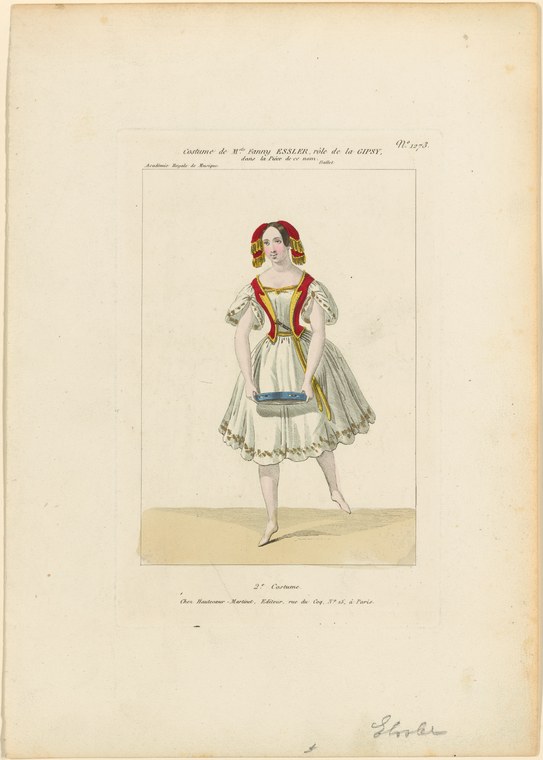
Costume de Melle Fanny Essler [sic], rôle de la Gipsy, dans la pièce de ce nom. Ballet. Académie Royale de Musique
Unknown artist
- Collection:
- Prints depicting dance
- Source:
- New York Public Library
- Rights:
- Public domain — free to use, share and adapt.
- Recorded as:
- Public Domain
Fanny Elssler was one of the two dominant female dancers of the Romantic era, rivalling Marie Taglioni, and was celebrated for her Spanish and national dances as well as her classical technique. This image documents a specific iconic role and shows how Romantic ballet constructed 'Gypsy' or Spanish character through costume, a visual and dramaturgical practice that shaped ballet's engagement with ethnicity and exoticism. For historians of dance, costume, and Romantic theatre, it is a primary document of how a celebrated role looked in performance and how it was marketed to audiences and collectors.
What you are looking at
A young female dancer stands alone against a plain background in a three-quarter frontal pose. She wears a white muslin dress with a full skirt that reaches mid-calf, trimmed with lace at the hem and sleeves. A short red velvet or silk jacket with gold braid trim fits closely at the bodice; a blue sash or belt cinches her waist. Her dark hair is styled close to her head with red velvet bows or ornaments at each temple. She holds her arms at shoulder height with elbows bent and hands near her chest in a relaxed, naturalistic position. Her weight appears evenly distributed on both legs, with one foot slightly forward. The pose suggests a moment between movements—a still from performance rather than an active step. The figure is rendered in hand-coloured engraving or lithograph with careful attention to the texture of fabrics, the fall of the skirt, and delicate facial features. The bare background emphasizes the costume and figure.
The dancing
A single female figure in a frontal, upright stance with relaxed arm carriage. The weight is placed evenly, neither in motion nor in a conventional balletic alignment. Her arms hang at approximately shoulder height with bent elbows, hands loosely positioned near the body—a posture between rest and action. The costume is the dominant visual element: the full white muslin skirt, short fitted jacket, and ethnic or folk-inspired trim suggest a character role rather than classical line. Her gaze is directed outward, engaging the viewer, as if presenting the costume for inspection or as a portrait of her role.
The dance depicted
The title identifies this as a costume worn by the dancer Fanny Elssler (note the spelling error in the catalogue) in the role of la Gipsy (the Gypsy) from a ballet or theatrical piece of that name, performed at the Académie Royale de Musique (Paris Opéra). Elssler was a celebrated Romantic-era ballerina known for character dances and national dances alongside classical technique. The costume—simple white muslin, red velvet trim, and gold braid—suggests a Gypsy or Iberian character, consistent with the fascination of 1830s–1840s Romantic ballet for exotic or 'oriental' roles. The image appears to be a costume design document or a record of an actual stage costume, not a representation of Elssler in motion. Without the active pose of a dancer mid-step, the image functions as a portrait of the role itself.
How it was made
This is a hand-coloured engraving or possibly a lithograph, executed with fine detail and delicate tonal work. The primary image is monochrome line work, likely engraved, with watercolour or gouache applied by hand to define fabrics, skin, and trim. The technique was standard for theatrical costume documentation in the 1830s–1840s, allowing multiple impressions to be coloured individually for circulation to patrons, other theatres, or collectors. The precision of the line work and the careful rendering of dress fabric suggest professional theatrical documentation rather than imaginative illustration. Such prints served both as records of performance and as marketing: they circulated widely and were collected as mementos of celebrated roles and performers.
About this work
This is a hand-coloured engraving documenting the stage costume of Fanny Elssler in the Romantic ballet role of la Gipsy, performed at the Paris Opéra. It belongs to the visual culture of 1830s–1840s theatrical dance, when dancers and ballet companies commissioned and distributed costume prints to celebrate successful productions and to immortalize celebrated performers in iconic roles. The work is neither a representation of active dance nor a portrait of the dancer herself, but rather a formal record of a costume—a genre that bridges fashion documentation, theatrical history, and dance iconography. It survives as evidence of how Romantic ballet created and performed 'character' through dress, colour, and ethnic or national costume vocabulary.
How to look at it
Look first at the costume and its details: the simple white muslin, the red velvet trim, the gold braid, the arrangement of the fabric and the fall of the skirt. These elements communicate 'Gypsy' or Spanish character through a vocabulary of folk or 'ethnic' dress available to mid-19th-century European theatre. The pose is deliberately frontal and static—a presentation of costume rather than an action shot. The restraint of gesture and the neutral background make the dress itself the subject. Note the rendering of texture: the fine line work defines the muslin's transparency and the weight of the velvet, suggesting that the artist understood both fabric and theatrical spectacle. The direct gaze and formal stance position this as a portrait of a role, not a document of movement.
The period
This print dates to the height of Romantic ballet (1830s–1840s), a period when European ballet moved from neoclassical formality toward narratives of passion, the supernatural, and the exotic. Fanny Elssler (1810–1884) was a principal figure in this shift: trained in classical technique but celebrated for her character and national dances, she became an international star, touring to the United States and undertaking extended seasons in London and Paris. The fascination with 'Gypsy' and Spanish character in Romantic ballet reflected both the period's interest in cultural 'otherness' and the practical repertory of a performer such as Elssler, who built her fame partly on such roles. Costume prints like this circulated widely in Europe and the Americas, functioning as both theatrical publicity and fashion documentation, and were collected by theatre patrons and dance enthusiasts.
Where it lives
This print is held in the New York Public Library's Prints depicting dance collection, catalogued with minimal information but attributed in the inscription to the Académie Royale de Musique. Such costume prints were produced by theatres, dancers, or print publishers and distributed to patrons and collectors; this example is consistent with professional theatrical documentation of the mid-19th century.
Dance in this work
Questions about this work
Who was Fanny Elssler?
Fanny Elssler (1810–1884) was an Austrian dancer who became one of the two greatest ballerinas of the Romantic era, rivalling Marie Taglioni. She was celebrated for both classical technique and character dances, especially Spanish and national dances. She had an international career and was known for her dramatic presence and technical virtuosity.
What is 'la Gipsy' and why would a ballet dancer perform it?
La Gipsy was a character role in early 19th-century ballet, part of the Romantic interest in exotic and folk characters. Such roles allowed dancers to perform character-driven narratives and to showcase national or 'exotic' dance styles and costumes. Elssler was particularly celebrated for such roles, which complemented her classical technique and gave her a distinctive place in the repertory.
Why was this costume printed and circulated?
Theatrical costume prints served multiple functions: as records of successful productions, as souvenirs for audiences and patrons, as documentation of celebrated roles, and as publicity for dancers and theatres. This print would have been sold or distributed after performances, allowing people who saw Elssler or heard of her to own a visual record of an iconic role.
How do we know this is a real costume and not an imaginative design?
The precision of the documentation, the title's specific attribution to Elssler and the Opéra, and the style of the print all suggest this is a record of an actual stage costume. Costume prints were commissioned by theatres and performers as documents of what was performed, not as imaginative designs; this one has the hallmarks of professional theatrical documentation.
More dance artwork





