49 works in this view — arrow keys or swipe to move between them.
Dance in Art
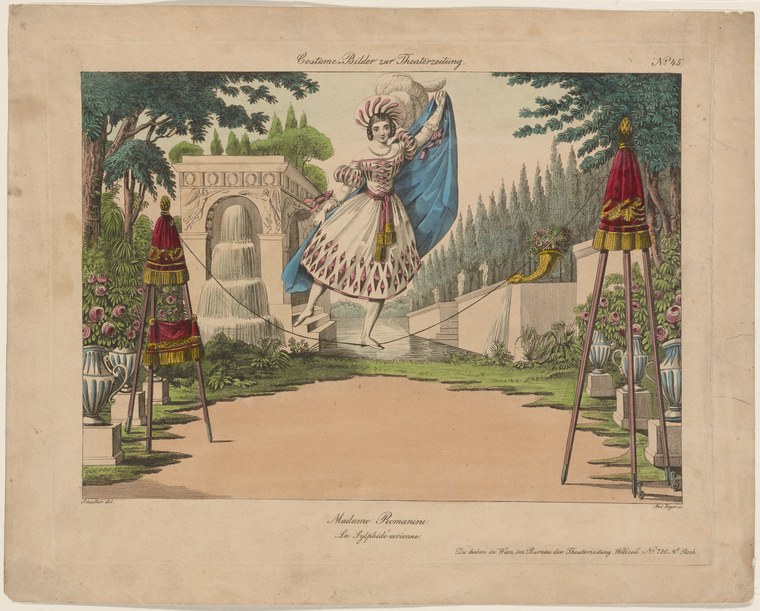
Madame Romanini, la sylphide aerienne
Unknown artist
- Collection:
- Prints depicting dance
- Source:
- New York Public Library
- Rights:
- Public domain — free to use, share and adapt.
- Recorded as:
- Public Domain
Madame Romanini is otherwise poorly documented in dance history, making this print a rare visual record of her artistry and her reputation for aerial lightness and technical mastery. The work is essential evidence for understanding how Romantic ballet was performed, marketed, and experienced by audiences in the nineteenth century, showing us exactly what 'aerienne' meant in practice—not acrobatic height, but a quality of sustained, effortless-looking elevation that defined the era's aesthetic.
What you are looking at
A woman in an elaborate white ballet dress stands in an ornamental garden pavilion or theatrical garden setting, her body caught in a weightless aerial pose suggestive of flight. Her skirts are voluminous and decorated with a distinctive patterned border (possibly feathers or scaled detail), and she wears her hair up in the Romantic era style with curls piled high on her head. Her arms are raised and extended, one holding what appears to be a gauzy blue drapery or wings that billows around her figure. The garden setting features classical architectural elements—a domed pavilion or rotunda in the background, tall cypress trees, flowering plants in ornamental urns with red fabric decoration, and manicured hedges. The composition suggests a moment of supernatural levitation: the dancer appears to float rather than stand, her feet barely touching the ground. The setting and costume evoke the Romantic ballet's supernatural aesthetic, with its emphasis on ethereal, otherworldly female figures. The hand-colored engraving captures an idealized vision of aerial grace and lightness.
The dancing
The dancer's body is elongated and weightless, with both arms raised in an open, expansive frame. One arm extends upward while the other holds the flowing blue fabric, which reads as either decorative drapery or a stylized representation of wings. Her torso is lifted, and her posture suggests upward momentum rather than grounding—the kind of suspended moment Romantic choreography prized. There is a single figure, presented as a solo dancer rather than part of an ensemble, emphasized by the large-scale setting around her solitary form. Her feet are turned out and her lower body is obscured by the voluminous skirt, making precise footwork impossible to assess from the image alone.
The dance depicted
This appears to document or memorialize a specific performance by 'Madame Romanini,' identified in the title as 'la sylphide aerienne' (the aerial sylphide). The Sylphide was one of the most celebrated roles of Romantic ballet, famously premiered in 1832, and this print almost certainly refers to a performance or solo variation within that work or in the Romantic ballet idiom generally. The title's emphasis on 'aerienne' (aerial) suggests that this particular performer was known for a distinctive quality of lightness and elevation—or that this print commemorates a signature moment of flying or floating within her interpretation. The image itself does not depict an actual aerial apparatus; rather, it captures the *illusion* of weightlessness that Romantic ballet technique and stagecraft aimed to create. The garden setting may be the actual stage setting for the performance, or it may be an allegorical garden representing the supernatural realm inhabited by sylphs.
How it was made
This is a hand-colored engraving or possibly a hand-tinted lithograph, identifiable by the precise linear work, the refined parallel hatching in shaded areas, and the evidence of separate application of watercolor or gouache tints over a printed base. The technique allowed for mass production with hand-finishing—each print would be individually colored, accounting for slight variations in tone and intensity. This method was standard for theatrical prints and commercial dance imagery in the nineteenth century, making this work accessible to a broader audience than a single painting could reach. The quality and detail of the engraving suggest a professional theatrical publisher or print maker, likely based in Europe (German or French, given the Germanic title inscription).
About this work
This is a hand-colored engraving commemorating a celebrated performance by Madame Romanini in the role of a sylph—the quintessential Romantic ballet character. The print captures not a narrative moment but an iconic pose of weightlessness and ethereal beauty, the dancer suspended in mid-air above an ornamental garden stage setting. It is both a document of mid-nineteenth-century Romantic ballet aesthetics and a tribute to a specific performer whose name and artistry were significant enough to merit publication and circulation. The work sits at the intersection of theatrical documentation, celebrity portraiture, and the visual promotion of dance as a respectable art form for mixed public audiences.
The image exemplifies how nineteenth-century dance was circulated and remembered before photography: through hand-colored prints that idealized the dancer's form and froze a moment of virtuosity into a commemorative image. The emphasis on Romanini's name in the title suggests that by this period, individual dancers (particularly women) were becoming stars in their own right, with their performances recorded and sold as souvenirs.
How to look at it
Attend to the precise moment the artist chose: not a jump or a step, but a pose of perfect suspension and weightlessness, with the body lifted and the arms in an open, welcoming frame. The artist has exaggerated the sense of elevation by rendering the dancer's feet barely visible beneath the skirt, emphasizing the illusion that she hovers rather than stands. The blue fabric is crucial—watch how it reads simultaneously as a theatrical drapery and as a suggestion of wings or supernatural agency, never quite resolving into one or the other. The scale of the setting relative to the dancer reinforces her centrality: this is a star turn, a moment of individual virtuosity within a theatrical apparatus.
The period
This print dates to the height of Romantic ballet, the era between approximately 1830 and 1860 when sylphs, spirits, and ethereal female figures dominated European and American stages. The Sylphide (1832) premiered in Paris and swept across Europe, establishing the archetype of the weightless, supernatural female dancer that this image exemplifies. By the 1840s-1850s, hand-colored theatrical prints had become a major commercial enterprise, with dancers' portraits and memorable poses sold at theaters and through print shops as souvenirs and promotional material. The garden setting and the idealized, romantic landscape reflect broader Romantic-era taste in visual art—nature as a site of beauty, emotion, and (in this case) the supernatural. The print's circulation suggests that Romanini performed in a major European city, likely Paris, Vienna, or another major cultural center.
Where it lives
This print is held in the New York Public Library's collection of prints depicting dance. It is catalogued with minimal metadata, typical of theatrical prints of this era, which were produced in quantity and often lacked formal publishing information or artist attribution.
Dance in this work
Questions about this work
Who was Madame Romanini?
Madame Romanini was a Romantic-era ballerina known particularly for her aerial technique and her performance in roles based on The Sylphide, the signature work of the period. Beyond what this print records, little is documented about her career, date of activity, or biographical details. The print itself is one of the primary remaining records of her artistry.
Was this a real aerial apparatus or trick?
No. This was the illusion of weightlessness created through ballet technique, costuming, and staging conventions. Romantic ballet used actual flying apparatus (wire work and pulleys) in some productions, but the pose here reads as a dancer's achievement of extraordinary elevation and the sustained illusion of effortlessness, not mechanical flight.
Why are there urns and buildings in a ballet image?
These elements represent the stage set for the performance—likely the outdoor garden or supernatural garden setting that was standard in Romantic ballet. They may also be allegorical, representing a realm beyond the everyday. The ornamental garden was a common setting for encounters between mortals and sylphs or other supernatural beings.
How was this image printed and colored?
This is a hand-colored engraving or lithograph, printed in black and white and then hand-tinted with watercolor or gouache by individual colorists. This technique allowed theatrical prints to be mass-produced and sold at theaters and through print shops, making them affordable souvenirs and promotional tools for performers and dance companies.
More dance artwork





