49 works in this view — arrow keys or swipe to move between them.
Dance in Art
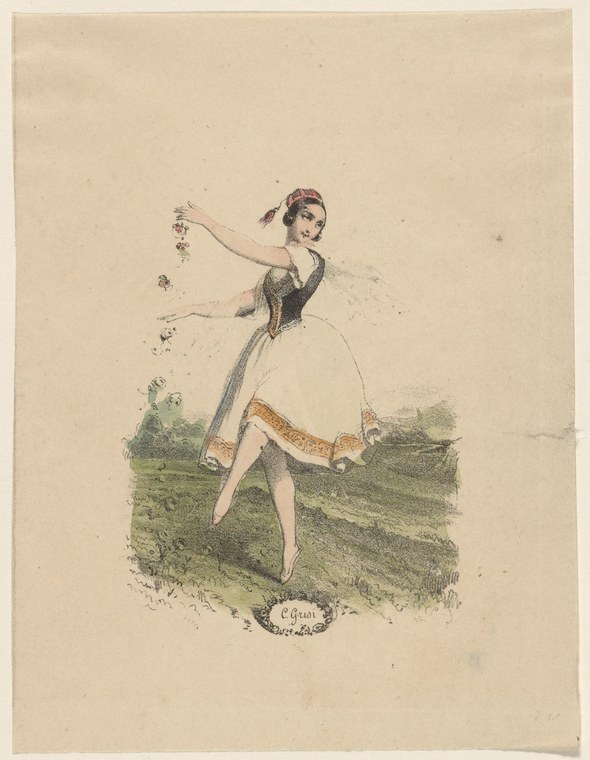
C. Grisi [within wreath]
Unknown artist
- Collection:
- Prints depicting dance
- Source:
- New York Public Library
- Rights:
- Public domain — free to use, share and adapt.
- Recorded as:
- Public Domain
Carlotta Grisi was one of the most celebrated dancers of her age, and this print is a direct artifact of her celebrity—a souvenir that documents her appearance, costume, and the pose that defined her public image. For historians of Romantic ballet, it is both evidence of the movement vocabulary of the period and a window into how dancers were commodified and circulated as images before photography became dominant.
What you are looking at
A young female dancer in mid-leap occupies the center of this hand-colored engraving. She wears a dark corseted bodice with a white skirt caught mid-swirl, one leg extended high behind her in an arabesque or similar attitude, her arms raised and extended with palms turned outward in a gesture of sprightly animation. She wears pointe shoes and has dark hair pinned up with what appears to be a decorative comb or ornament. The setting is a natural landscape rendered in soft greens and ochres—a hillside or garden with shrubs and distant terrain—placed behind her as though she dances in open air. The composition is vertical and intimate; the landscape does not dominate but frames her as the sole subject. Her pose conveys the weightless, effortless elevation characteristic of romantic ballet. A wreath bearing the name 'C. Grisi' in script anchors the bottom of the composition, grounding the image as a portrait or tribute.
The dancing
The dancer is isolated and en relevé, balanced on the ball of one foot with the other leg raised high behind her in a fully extended line. Her upper body is held upright and proud, her arms opened to the sides with fingers extended and palms facing outward—a gesture of joy or display rather than formal frame. The pose suggests a moment of suspension: the lifted leg, the raised arms, and the apparent absence of a partner all point to a solo turn or traveling step in which the dancer pauses for effect. The artist has captured her at the apex of the movement, where maximum extension is achieved.
The dance depicted
This is almost certainly a portrait of the Italian-French dancer Carlotta Grisi, one of the great Romantic ballerinas of the mid-nineteenth century, famous for her role in Giselle (1841). The wreath inscription confirms the subject; the engraving is a souvenir or publicity image of the dancer, likely circulated during her active years or shortly after. The pose and costume—pointe work, fitted bodice, gauzy skirt, natural setting—are consistent with Romantic ballet of the 1840s–1850s. The open arms and exultant gesture suggest a moment of triumph or celebration within a choreographed piece, possibly a solo variation. The lack of partner or ensemble context is typical of celebrity portraits of individual ballerinas of this era.
How it was made
This is a hand-colored engraving or possibly hand-colored lithograph, printed on laid paper with watercolor or gouache applied by hand to select areas—the flesh tones, the green landscape, the gold and cream tones of the wreath. The technique allowed mass circulation of celebrity images while maintaining the fine detail required to flatter the dancer and document her costume and pose with accuracy. The hand coloring both elevated the image's value and allowed each impression to be subtly unique. The quality of the line work and the tonal subtlety suggest a skilled reproductive print rather than a crude broadsheet; this was a premium souvenir sold to admirers and collectors.
About this work
This is a hand-colored engraving commemorating Carlotta Grisi, the Romantic ballerina most famous for creating the role of Giselle. The print captures her in a moment of elegant suspension—en relevé on one leg with the other extended high behind her, arms open in a gesture of joy. The pose and costume are consistent with the aerial, weightless idiom of Romantic ballet in its heyday. As a celebrity portrait in print form, it documents both a specific dancer and the visual conventions by which the Romantic ballet was circulated and celebrated in the mid-nineteenth century. The work belongs in a dance gallery as evidence of how individual dancers were marketed and remembered through reproductive imagery.
How to look at it
Attend to the moment the artist chose: the dancer is captured at the peak of her leap, held in an attitude of apparent ease and grace. Her upturned palms and open posture suggest not strain but triumph—she is showing off, displaying the skill that made her famous. The natural setting (rather than a theater interior) emphasizes the Romantic aesthetic ideal of dancers as creatures of nature and feeling rather than mere technicians. The wreath inscribing her name elevates her to the status of a celebrated individual, much as wreaths were used to honor classical heroes.
The artist
The artist is not recorded. The print was almost certainly produced by a commercial reproductive printmaker or print shop working in France or Italy, likely based on a painted or drawn portrait. The quality and finish suggest a mid-nineteenth-century urban print house catering to the theater-going public and ballet enthusiasts. Such celebrity images were routine products of the theatrical print trade and were sold in theaters, through print dealers, and by subscription.
The period
This print dates to the heyday of Romantic ballet, a period (roughly 1830–1860) in which ballet emphasized ethereal, weightless movement, supernatural themes, and the cult of the individual ballerina. Carlotta Grisi was among the greatest dancers of this era; she created the role of Giselle in 1841 and danced across Europe to immense acclaim. The circulation of her image in prints was part of a larger industry of ballet celebrity that paralleled and supported the success of the dance itself. Printed portraits served as souvenirs, advertisements, and cultural artifacts that kept dancers in public memory between seasons and performances.
Where it lives
The work is held in the New York Public Library's collection of prints depicting dance. It is a commercial reproductive print, likely printed and hand-colored in France or Italy in the 1840s–1850s, and would have been one of many such images circulating among ballet enthusiasts and theater patrons of the period.
Dance in this work
Questions about this work
Who was Carlotta Grisi?
Carlotta Grisi (1819–1899) was an Italian-French ballet dancer and one of the greatest Romantic ballerinas of the nineteenth century. She is most famous for creating the role of Giselle in the 1841 ballet of the same name, choreographed by Jules Perrot. She danced across Europe and was celebrated for her technical skill, lightness, and dramatic presence.
Why is this a valuable historical document?
This print is valuable because it documents the appearance, costume, and movement vocabulary of a celebrated dancer at the height of the Romantic ballet era. It shows us not only what Grisi looked like but also the pose and gesture she was famous for—and thus the aesthetic values of her age. As a mass-produced image, it also tells us how dancers were marketed and celebrated in the nineteenth century.
How was this image made?
This is a hand-colored engraving or lithograph, printed in black line on paper and then colored by hand using watercolor or gouache. This technique allowed the image to be reproduced and circulated widely while maintaining fine detail and allowing for subtle variation in color between impressions. Such prints were standard souvenir merchandise in theaters and print shops.
What does her pose tell us about Romantic ballet?
Her pose—en relevé on one foot with the other leg extended high behind her, arms open and palms up—exemplifies the Romantic ideal of weightlessness, grace, and effortless elevation. The open, outward-facing arms and joyful gesture emphasize feeling and display rather than formal frame, which is characteristic of Romantic choreography. The natural setting reinforces the Romantic association of the ballerina with nature and emotion.
More dance artwork





