49 works in this view — arrow keys or swipe to move between them.
Dance in Art
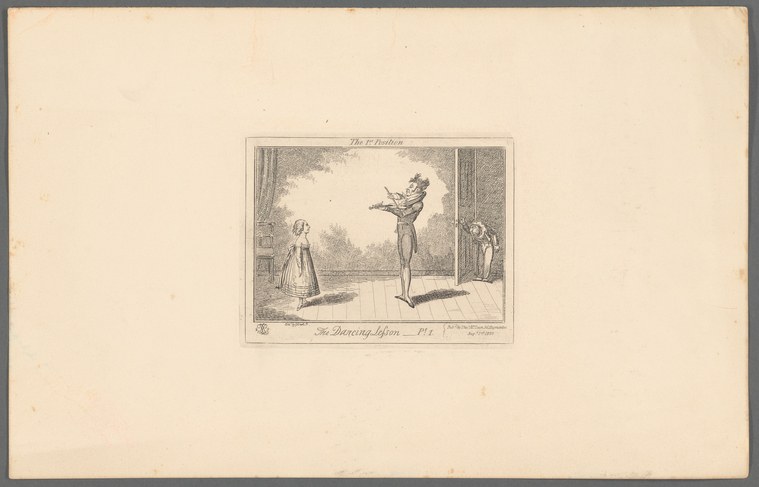
The dancing lesson, pt. 1: The 1st position
Unknown artist
- Collection:
- Prints depicting dance
- Source:
- New York Public Library
- Rights:
- Public domain — free to use, share and adapt.
- Recorded as:
- Public Domain
For historians of dance pedagogy and social history, this print is evidence of how ballroom technique was actually taught and at what rudimentary level instruction began. For performers and dance reconstructionists, it provides a visual record of posture, arm carriage, and the formal relationship between teacher and student in the period. The serial format—'pt. 1' in the title—suggests a systematic method being disseminated in printable form, making it a rare glimpse into the infrastructure of dance training.
What you are looking at
A dancing master instructs a young pupil in the fundamentals of ballroom dance. The scene is set indoors, with tall windows opening onto a garden visible in the background. The master, dressed formally in breeches and coat, gestures expressively with one arm raised, demonstrating proper deportment and position. His pupil, a young woman in a long dress with full skirts, stands before him in an attentive posture, absorbing the instruction. A second figure—possibly a chaperone or additional instructor—observes from the right side of the composition. The engraving captures a moment of pedagogical authority: the master's animated pose contrasts with the student's composed receptiveness, creating a visual hierarchy of knowledge and obedience. The interior is spare and elegant, with classical framing that emphasizes the formal nature of this social accomplishment.
The dancing
The dancing master stands with weight on one leg, the other extended, his upper body angled toward his pupil with one arm raised demonstratively and the other gesturing toward her position. His posture conveys active instruction and spatial clarity. The young woman holds herself upright with arms held in what appears to be a preparatory or resting position—not yet in active dance hold. Both figures are balanced and controlled rather than caught mid-step; this is a moment of pause and instruction rather than performance. The composition emphasizes verticality and the visual transmission of knowledge through the master's authoritative stance.
The dance depicted
The image depicts instruction in what the title identifies as the first position of ballroom dance, a fundamental element of late 18th-century elite dance training. The first position typically refers to the stance or foot placement that opens any formal dance—in Regency-era ballroom practice, often the starting posture for minuets, cotillions, and other courtly dances. The scene represents the pedagogical model of the period: one-to-one or small-group instruction, with the master demonstrating while the student observes and mimics. The engraving's title suggests this is part of a serial instructional work, making it documentary evidence of how ballroom fundamentals were taught to young women of the gentry and aristocracy.
How it was made
This is an engraving, a print medium characteristic of 18th-century instructional and satirical publications. The fine cross-hatching and linear precision visible in the rendering of fabric, shadow, and architectural detail are consistent with intaglio engraving, which allowed for wide distribution and multiple impressions. The technique was ideal for instructional purposes—the clarity of line makes the positions and relationships between figures legible, and the reproducibility meant such works could serve as teaching aids in multiple households. The inclusion of title cartouches and the composition's didactic clarity suggest this was produced as part of a series or instructional manual rather than as fine art.
About this work
This engraving documents the pedagogical foundation of 18th-century ballroom dance: the formal instruction of young women in the elementary positions and deportment required for social dancing. As the first plate in a series, it establishes the master-pupil relationship and the emphasis on posture and position that undergirded all subsequent ballroom training. The image is valuable not for capturing dance in motion but for recording the moment of transmission—how knowledge of movement was literally shown and taught within the domestic sphere. It belongs to a broader tradition of dance instruction prints and manuals that made elite dance practices visible and reproducible.
How to look at it
Observe the master's raised arm and demonstrative posture: the engraver has frozen him mid-gesture, showing the didactic moment rather than the execution of a step. Note the student's stillness and attentiveness; she is receiving rather than dancing, which tells us this is about position and posture, not footwork or momentum. The architectural clarity and the spatial separation between teacher and pupil reinforce the authority structure of the instruction. Look also at the second figure in the background—her presence signals that witnessing and learning by observation was part of the pedagogical model.
The period
This engraving dates to the era of refined ballroom culture, most likely the late 18th or early 19th century based on costume and stylistic conventions. Ballroom dancing was a marker of gentility and social status, and instruction in dance was a standard component of education for young women of the upper and middle classes. The period saw a proliferation of dance manuals and instructional prints—works like those by Kellom Tomlinson, Pierre Rameau, and later G. Desrat sought to codify and disseminate the rules of formal dancing. The emphasis on the 'position'—a foundation of ballet and ballroom alike—reflects the period's belief that correct bodily alignment and controlled movement were both aesthetic and moral accomplishments.
Where it lives
The work is held in the New York Public Library's collection of dance prints. It is part of a broader archival tradition of instructional and satirical prints from the 18th and early 19th centuries, many of which documented dance practice and social customs.
Dance in this work
Questions about this work
What is 'the first position' in 18th-century ballroom dance?
The first position was a foundational stance from which dancers began; it typically involved specific foot placement and upright carriage. Different dances had variations, but the position was essential to deportment and was always the first thing a student learned. It established the line of the body and the dancer's relationship to their partner and the room.
Was ballroom dance instruction always one-to-one?
No, though one-to-one and small-group instruction were common for young women of the gentry, who often learned at home. Group classes were also held, and instruction ranged from formal to informal. This print emphasizes the formal, individualized model, which was the most prestigious and expensive form of instruction.
Why are there so many instructional dance prints from this period?
Ballroom dancing was a social necessity for the educated elite, and dance manuals served as both reference works and status symbols. Instructional prints could be distributed widely and served as visual supplements to written instruction, making them useful for teachers and ambitious students. They also reflected and reinforced social anxieties about correct behavior and decorum.
More dance artwork





