49 works in this view — arrow keys or swipe to move between them.
Dance in Art
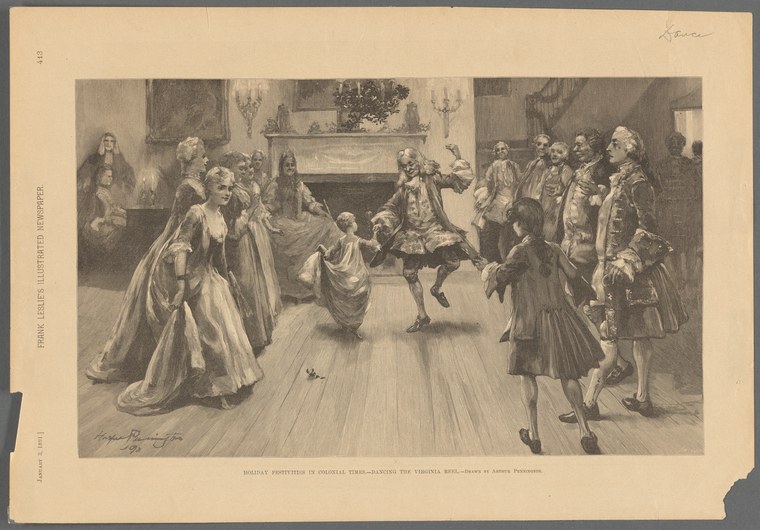
Holiday festivities in colonial times; dancing the Virginia reel
Unknown artist
- Collection:
- Prints depicting dance
- Source:
- New York Public Library
- Rights:
- Public domain — free to use, share and adapt.
- Recorded as:
- Public Domain
The Virginia Reel is a foundational American contra dance, and this image is a rare visual document of its performance in an authentic colonial setting. For historians and dancers, it provides concrete evidence of costume, grouping, spatial arrangement, and the social frame in which the dance took place.
What you are looking at
An interior gathering of colonists in formal dress enacts the Virginia Reel in what appears to be a substantial colonial-era room. The space is paneled and appointed with a fireplace and mantelpiece visible in the background, suggesting a genteel household. Figures line both sides of the room in two long files, with several dancers in motion in the center of the floor. The women wear long gowns with full skirts and draped trains; the men wear breeches, coats, and what appear to be stockings. The lighting is warm and even, rendered through careful tonal work that creates depth and atmosphere. The composition draws the eye down the length of the paired lines toward the dancing figures, emphasizing the linear formality of the dance and the social occasion of the gathering.
The dancing
The dancers in the center perform the characteristic movements of the Virginia Reel: facing partners across a line, with some figures shown mid-stride or mid-turn. The standing figures on either side form the waiting lines, their postures upright and attentive. The active dancers show the turning and traveling motions essential to the reel—one central figure appears to be in a forward stride or skip, consistent with the stepping patterns of the dance. Arms are raised and extended in the manner of social dance partners maintaining frame and balance across the floor.
The dance depicted
This depicts the Virginia Reel, a contra dance that was a cornerstone of colonial American social dancing and remained popular well into the nineteenth century. The reel is a progressive dance for couples arranged in two long facing lines, featuring a sequence of figures (reels, forward-and-back, right-and-left, etc.) that cycle through the length of the set. The image captures the informality and social character of the dance in a domestic setting rather than a public ballroom, suggesting this was a private house gathering—a "holiday festivity" as the title states. The presence of both active dancers and waiting couples reflects the reel's structure, in which couples dance in sequence while others stand ready for their turn.
How it was made
This is a wood engraving or engraved print, rendered in black and white with extensive tonal work to suggest volume, fabric texture, and interior light. The technique allowed precise architectural detail and fine gradation of shade, making it suitable for reproduction and circulation in periodicals or as a standalone print. The careful hatching and line work create a sense of depth and documentary specificity—the artist has attended to the character of the room, the cut of the garments, and the particularity of the moment rather than producing a schematic illustration.
About this work
This print documents the Virginia Reel as it was performed in colonial American domestic interiors, capturing both the prescribed geometry of the dance (the facing lines, the couples in motion) and the social occasion it served. The Virginia Reel was fundamental to American social dancing from the eighteenth century onward, and this image preserves the visual record of how it was executed and valued in its original context. The work belongs in a dance history collection as evidence of dance practice, interior social life, and the visual conventions by which dance was documented and circulated to a broad audience in the nineteenth century.
How to look at it
Observe the two facing lines of standing figures and the central couple in motion: the artist has frozen a moment of traveling or turning that would have been part of a longer sequence of figures. The spatial arrangement—the depth of the room, the positioning of the waiting dancers—shows the reel's linear, progressive structure. Notice also the attention to costume detail: the cut and drape of women's skirts, the formality of men's dress, and the way the engraver has used line and shadow to suggest the weight and texture of fabric in motion.
The artist
The artist is not recorded in the catalogue. The signature or attribution mark visible in the image may identify the maker, but without further research this cannot be confirmed. The competent handling of interior space, costume, and figured arrangement suggests a professional illustrator or engraver working in the nineteenth century, when such historical scenes were popular subjects for periodicals and educational prints.
The period
The Virginia Reel was at the height of its social prestige in the eighteenth and early nineteenth centuries, when it was danced in both colonial and early American contexts alongside other contra and country dances. By the nineteenth century, when this print was likely made, the reel had become a retrospective subject—a way of visualizing and sentimentalizing the colonial past. The rise of commercial ballroom dancing (waltz, quadrille) in the nineteenth century displaced many older contra dances, making historical images of the reel a form of cultural memory.
Where it lives
The work is held in the New York Public Library's collection of prints depicting dance. It is an engraved or wood-engraved print, likely from the nineteenth century, produced for circulation and reproduction rather than as a unique work.
Dance in this work
Questions about this work
What is the Virginia Reel?
The Virginia Reel is a contra dance performed by couples arranged in two facing lines. Dancers progress down the line through a set sequence of figures—reels, forward-and-back movements, right-and-left turns, and promenade—with each couple taking a turn at the head of the set. It became one of the most popular social dances in colonial America and remained widely danced into the twentieth century.
Why are some dancers standing and some dancing?
The Virginia Reel is a progressive dance: only one or two couples dance the full sequence at a time, while the other couples wait in line for their turn. As each couple completes the sequence, they move down the line and the next couple begins, creating a continuous flow of dancing over the course of an entire set.
How do we know this is a Virginia Reel and not another colonial dance?
The title explicitly identifies it as the Virginia Reel. The image also shows the characteristic two-line arrangement and the central positioning of the active dancers, which is distinctive to contra dances like the reel, quadrille, or country dance. The informal domestic setting and the style of dress support an eighteenth- or early nineteenth-century American context.
More dance artwork





