49 works in this view — arrow keys or swipe to move between them.
Dance in Art
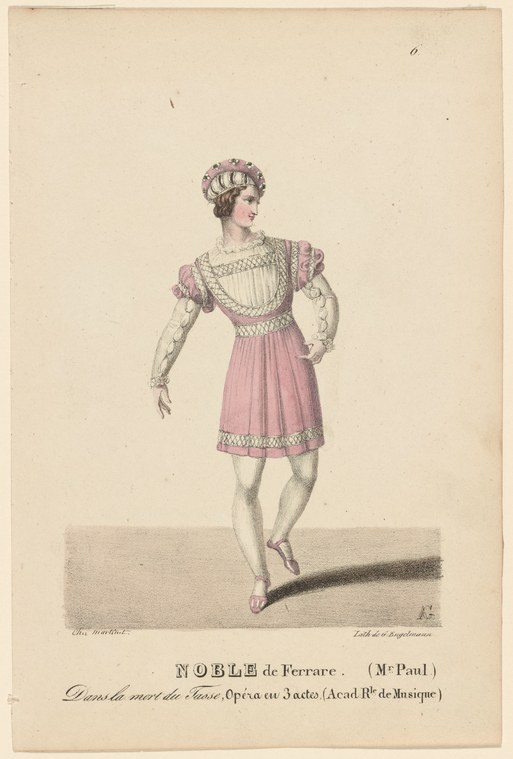
Noble de Ferrare (Mr. Paul) dans La mort du Tasse, opéra en 3 actes, Acad. r'le de musique
Unknown artist
- Collection:
- Prints depicting dance
- Source:
- New York Public Library
- Rights:
- Public domain — free to use, share and adapt.
- Recorded as:
- Public Domain
This image is a rare specific record of gender performance in early 19th-century dance theater, capturing a moment when the crossing of gender lines in costume and casting was embedded in mainstream opera production. For historians of theatrical dance and gender studies, it documents the physical vocabulary and presentation expected of a dancer in such a role—the posture, the frame, the carriage—preserved at the moment of performance.
What you are looking at
A single female dancer stands in profile against a plain cream background, posed in a moment of arrested motion. She wears an early 19th-century dress with a high waistline, short puffed sleeves trimmed in a darker fabric, and a skirt that falls to mid-knee in pale pink with a decorative border. Her hair is dressed up elaborately in the Regency style. The figure is rendered in hand-colored engraving or lithograph, with careful attention to the costume's drape and the dancer's elegant posture. She stands with one leg straight and one slightly flexed, her arms held away from her body in an open, graceful frame—a pose capturing the moment between movements rather than mid-leap.
The dancing
The dancer's weight appears to rest primarily on the back leg, with the front leg lightly extended or flexed, suggesting the kind of gliding, controlled movement characteristic of Regency and early Romantic-era dance. Her arms are held at a moderate height, extended but not pressed back dramatically, palms facing gently forward. The carriage is upright and refined, with the chest lifted and the gaze directed slightly downward in a modest, theatrical manner. There is no partner; she occupies the stage alone.
The dance depicted
This is a portrait of a specific performer, 'Monsieur Paul,' as the female dancer who played the male role of the 'Noble de Ferrare' (a nobleman from Ferrara) in Torquato Tasso, a three-act opera given at the Paris Académie Royale de Musique. The work documents an operatic ballet role, likely a principal solo or a significant ensemble part. The costume and pose reflect the theatrical ballet conventions of the early 1800s, with the emphasis on graceful, controlled articulation and aristocratic bearing. The inscription indicates this is a documentary portrait of a specific performance rather than a generic dance image.
How it was made
This is a hand-colored print, likely a lithograph or engraving, produced as a souvenir or documentary record of a Paris Opéra production. The technique—outline drawing with delicate watercolor or gouache tinting—was standard for theatrical prints of this period and allowed for relatively quick, affordable mass production. Such prints circulated among theater patrons, dancers, and collectors, serving as both mementos and advertising. The care taken with costume detail suggests this was made from direct observation or a sketch by someone with access to the stage.
About this work
This is a theatrical souvenir print documenting a specific performer's role in an operatic ballet at the Paris Académie Royale de Musique in the early 19th century. It records not a dance type or social practice, but a singular stage performance—the moment when a male dancer took a female role in a work based on Torquato Tasso's Renaissance Italian drama. The image places us in the world of early Romantic opera-ballet, when such cross-dressing roles were an established convention of French theater and when printed images of celebrated performers were eagerly collected. It is both a historical document of stagecraft and a portrait of an individual artist.
How to look at it
Attend to the dancer's restraint and refinement: this is not a moment of visible exertion or virtuosity, but of composed, dignified bearing. The pose is stable and self-possessed—not mid-leap or mid-turn, but held. The costume is the co-star; the expensive puffed sleeves, the high waistline, and the careful dressing of the hair are all part of the role's identity as a nobleman. The absence of a partner and the facing-away gaze are conventions of the solo theatrical portrait, meant to present the character rather than a narrative interaction.
The artist
The artist is not recorded in the catalogue. The signature or attribution line at the bottom of the print is not clearly legible in the image provided. The print was produced for the commercial market of Paris theater souvenirs, likely by an established print publisher or theater print specialist of the period.
The period
The early 19th century saw the rise of the operatic ballet and the consolidation of the Paris Opéra as the center of European dance. Cross-dressed roles were a recognized convention in comedy and heroic opera; this Ferrara nobleman was likely a dramatic or comic character. The theatrical print—a hand-colored lithograph or engraving—was the mass medium for documenting famous dancers and roles; prints of celebrated performers by artists such as Jacques-Louis David, Eugène Lami, and others were sold at the theater and in shops. The costume shown here is accurate to the early 1810s–1820s silhouette.
Where it lives
The print comes from the NYPL's collection of prints depicting dance, part of a broader library of theatrical and dance ephemera. It is a commercial souvenir of a Paris Opéra production, likely circulated in the 1810s–1820s.
Dance in this work
Questions about this work
Why is there a male dancer shown in a woman's dress?
Cross-dressed roles were a convention of early 19th-century French opera. Male dancers occasionally performed female aristocratic roles, particularly in comic or heroic works. This was especially true for secondary roles and in operas derived from classical or early modern drama, as this one was (after Torquato Tasso).
Is this a real person or a type?
This is a portrait of a specific performer known professionally as 'Monsieur Paul,' who danced the role of the Noble de Ferrare in a documented production at the Paris Académie Royale de Musique. The print was produced and sold as a theater souvenir, much as cast photographs are today.
What opera was this from?
The work is titled 'La mort du Tasse' (The Death of Tasso), a three-act opera performed at the Paris Académie Royale de Musique (now the Opéra Garnier). It was based on the life and death of the Renaissance Italian poet Torquato Tasso. The role of the Noble de Ferrara was likely a supporting dramatic part.
What is the dancer actually doing?
The dancer is posed in a restful moment—standing with the weight on one leg and the other flexed, arms held in an open frame. It is not a high leap or a turn, but a composed, aristocratic stance. This type of portrait pose was typical of theatrical prints of the period; it shows the character's bearing and costume rather than a virtuosic feat.
More dance artwork





